The Small Box That Broke the Crown
Alshahrani and colleagues tested three CAD-CAM ceramic materials across wide and narrow rest seat designs, finding that rest seat geometry significantly influenced both fracture resistance and internal fit — with wide designs delivering superior strength and better adaptation.
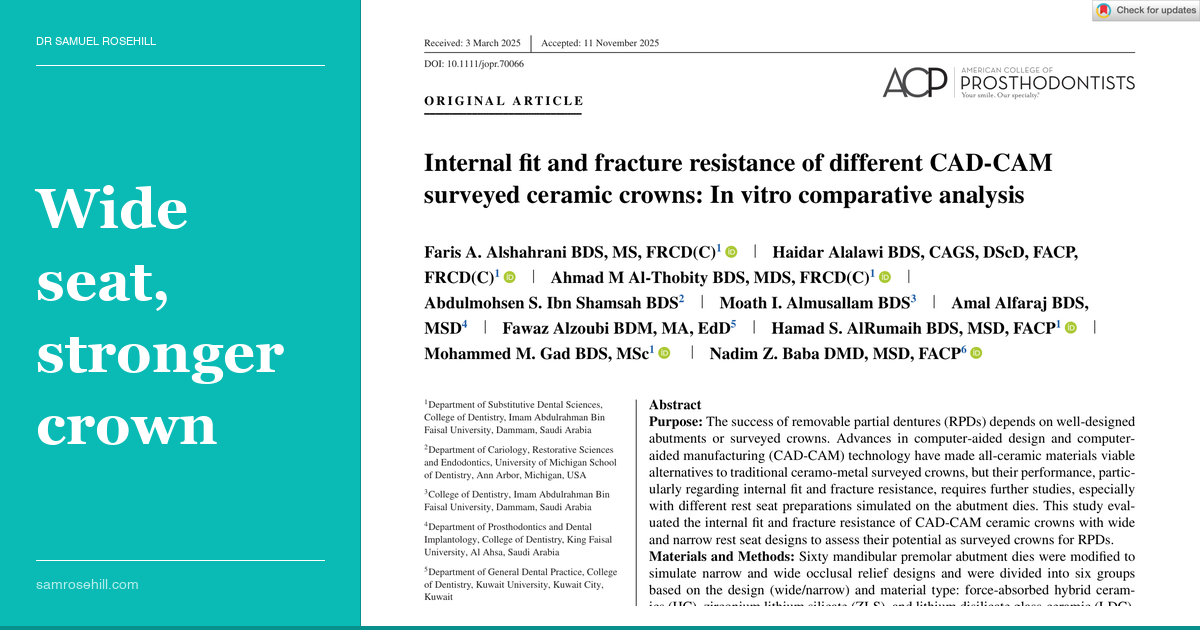
Wide seat, stronger crown
Source Paper
Internal fit and fracture resistance of different CAD-CAM surveyed ceramic crowns: In vitro comparative analysis
The removable partial denture (RPD) design form contains a great many small decisions, and most of them are made quietly, without ceremony. Ridge support, clasp type, major connector, bracing: these get discussed with diagrams. The rest seat, that modest spoon-shaped depression designed to transmit occlusal load down the long axis of the abutment, tends to receive planning time in proportion to its glamour. Not much.
Internal fit and fracture resistance of different CAD-CAM surveyed ceramic crowns: In vitro comparative analysis, by Alshahrani, Alalawi, Al-Thobity and colleagues from Imam Abdulrahman Bin Faisal University, suggests the rest seat deserves considerably more thought, particularly now that the surveyed crown can be milled from ceramic rather than cast from metal.
The Data Anchor
The study fabricated 60 mandibular premolar abutment dies across two rest seat configurations: a narrow relief (2.5 mm buccolingually × 2.0 mm mesiodistally × 1.5 mm depth) and a wide relief (3.5 mm buccolingually, same depth and mesiodistal dimensions). Three computer-aided design and computer-aided manufacturing (CAD-CAM) ceramic materials were milled across both geometries: force-absorbed hybrid ceramics (HC, Ceramsmart, GC America), zirconium lithium silicate (ZLS, Celtra Duo, Dentsply Sirona), and lithium disilicate glass-ceramic (LDC, E.max CAD, Ivoclar Vivadent). Ten crowns per group, 60 total.
Internal fit was quantified with Geomagic Control X software, fracture resistance with a universal testing machine (in newtons), and fracture morphology via scanning electron microscopy (SEM). Two-way analysis of variance (ANOVA) with Tukey post hoc testing was the statistical framework.
E.max CAD crowns with wide rest seats recorded a mean fracture resistance of 941.42 ± 270.54 N — more than double the 444.71 ± 146.33 N of their narrow-rest equivalents. Rest seat geometry was the dominant factor for both fracture resistance [F(1) = 68.581, p < 0.001] and internal fit [F(1) = 11.185, p = 0.002]. Material type alone did not significantly affect internal gap values [F(2) = 0.381, p = 0.686].
Key Findings
- Wide rest seat designs were significantly stronger across all three materials; E.max CAD wide-rest crowns led at 941.42 ± 270.54 N.
- Narrow rest seats produced larger internal gaps. ZLS (Celtra Duo) narrow-rest showed the largest mean discrepancy at 161.20 ± 83.75 µm, versus 67.62 ± 40.02 µm with a wide rest; the authors attribute this to milling bur limitations in reproducing tight internal geometries.
- LDC (E.max) carried the highest fracture resistance among materials [F(2) = 10.523, p < 0.001], though also a marginally larger internal gap, a difference that was not statistically significant.
- SEM confirmed crack initiation at the rest seat base in all groups; longer propagation lines in wide-rest specimens suggest broader stress distribution rather than concentrated fracture.
- The study is in vitro only, tested with static loading on resin dies. Real masticatory forces are cyclical, multidirectional, and modified by temperature and moisture.
💡 The Clinical Bottom Line
The clinical translation is straightforward: when preparing an abutment for a CAD-CAM ceramic surveyed crown, the width of the relief you cut matters. Wide beats narrow for both strength and fit, regardless of whether you choose hybrid ceramic, ZLS, or lithium disilicate. Material selection still matters for fracture resistance (E.max led) but geometry appears to be the more influential variable.
For clinicians familiar with the tradeoffs ceramic introduces to any RPD design (stronger than resin, more brittle than metal), this paper reframes the rest seat not as an afterthought carved into the occlusal surface, but as a structural specification with measurable consequences.
The small box on the design form, it turns out, is load-bearing.
Dr Samuel Rosehill is a general dentist with a prosthodontic focus, practising at Ethical Dental in Coffs Harbour, NSW. He holds a BDSc (Hons) from the University of Queensland, an MBA, an MMktg, and an MClinDent in Fixed & Removable Prosthodontics (Distinction) from King’s College London.
Clinical Relevance
When planning a CAD-CAM ceramic surveyed crown for a removable partial denture framework, rest seat geometry matters more than material choice for internal fit. Wide rest seat designs show significantly higher fracture resistance and better internal adaptation than narrow ones, across all three tested materials. Lithium disilicate (E.max) delivered the highest fracture resistance overall. This in vitro study supports clinical preference for wide rest seat preparations when milling all-ceramic surveyed crowns.
Disclosure: The author has no financial conflicts of interest related to the products or topics discussed in this review. This is an independent summary prepared for educational purposes.
Continue the conversation
This review is also published on Substack, where you can leave comments and join the discussion.
Read on Substack →