Short Implants, Superior Stability: The Case for Going Wide Instead of Long
An in vitro study from Stony Brook University places 80 short (6 × 7 mm) and conventional (3.75 × 10 mm) Ditron implants in hard and soft bone simulants, finding that short wide implants outperform their conventional-length counterparts on insertion torque and Periotest values in both bone types — challenging the assumption that more length automatically means more stability.
Short beats long on torque
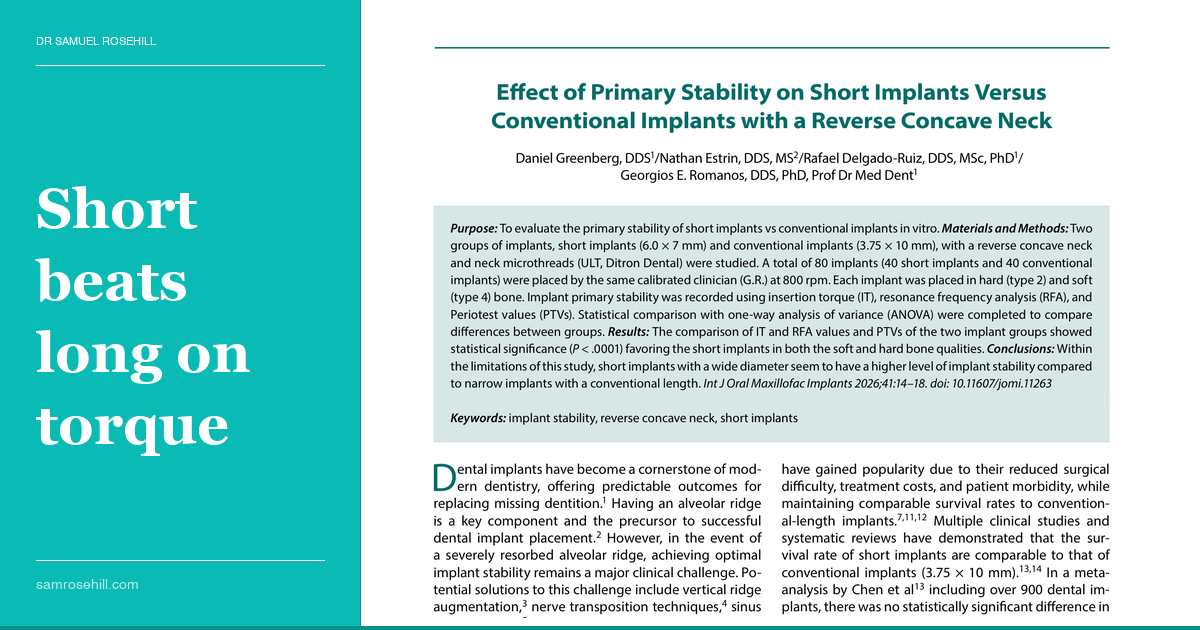
Source Paper
Effect of Primary Stability on Short Implants Versus Conventional Implants with a Reverse Concave Neck
Everything we assume about implant stability points in the same direction: longer is safer, deeper engagement means better anchorage, and the surgeon reaching for a 10 mm fixture is making the conservative choice. Greenberg, Estrin, Delgado-Ruiz, and Romanos at Stony Brook University put that assumption to the test in “Effect of Primary Stability on Short Implants Versus Conventional Implants with a Reverse Concave Neck” — and the data has a certain impertinence about it.
What has been less examined is whether short implants can exceed their conventional-length counterparts at the most critical moment: placement.
The Data Anchor
Eighty implants from a single manufacturer (ULT, Ditron Dental) were divided equally: 40 short implants (6.0 × 7 mm) and 40 conventional implants (3.75 × 10 mm), each sharing the same reverse concave neck and microthread design. They were placed by one calibrated clinician at 800 rpm into polyurethane foam blocks simulating type 2 (hard) and type 4 (soft) bone, with 20 implants per group per bone type. Primary stability was measured three ways: insertion torque (IT) via an Implantmed surgical motor, resonance frequency analysis (RFA) via Osstell Mentor, and Periotest values (PTVs). One-way ANOVA with post hoc Bonferroni testing was used throughout.
In type 2 bone, short implants produced a mean IT of 44.25 ± 1.83 Ncm against 34.00 ± 2.05 Ncm for conventional implants (P < .0001). In the softer type 4 bone, the gap was wider still: 28.5 ± 3.66 Ncm versus 16.25 ± 3.58 Ncm (P < .0001). Periotest values followed suit. The exception was RFA: ISQ values ran higher for conventional implants in both conditions (60.1 vs 57.23 in type 2; 50.74 vs 47.33 in type 4), a reminder that three stability metrics do not always agree on the same verdict.
The ISQ result is not a design flaw; it is a useful complication. Diameter affects thread engagement more than resonance frequency, so IT and RFA are measuring related but genuinely different things.
Key Findings
- Short implants generated significantly higher insertion torque in both bone types: 44.25 Ncm (hard) and 28.5 Ncm (soft) versus 34.00 and 16.25 Ncm for conventional implants (P < .0001). The wider diameter appears to drive anchorage through thread engagement rather than length.
- Periotest values consistently favoured short implants in both bone types (P < .0001), indicating lower mobility at placement.
- ISQ values ran counter to the trend. Conventional implants recorded higher RFA scores in both conditions, demonstrating that no single stability metric captures the complete picture.
- The advantage held in soft (type 4) bone, the clinical scenario most likely to cause anxiety at the surgical motor.
- The study’s core limitation: polyurethane foam does not replicate living alveolar bone. No cortical layer, no biology, no healing response. In vivo confirmation is the essential next step.
💡 The Clinical Bottom Line
For surgeons managing the atrophic posterior ridge, the data suggests a reframe: when horizontal augmentation is feasible, pairing it with a short wide implant may deliver superior primary stability without the surgical complexity of vertical grafting. The reverse concave neck’s deliberate disengagement from crestal bone is designed to reduce compression during remodelling, a mechanism that in vivo studies will need to verify.
The ISQ divergence is the detail that lingers. Two metrics say the short wide implant wins; one says it loses. Clinicians who rely exclusively on RFA would draw the opposite conclusion from the same placement — and that, more than any single torque value, is what makes this paper worth reading.
Dr Samuel Rosehill is a general dentist with a prosthodontic focus, practising at Ethical Dental in Coffs Harbour, NSW. He holds a BDSc (Hons) from the University of Queensland, an MBA, an MMktg, and an MClinDent in Fixed & Removable Prosthodontics (Distinction) from King’s College London.
Clinical Relevance
Short wide implants (6 × 7 mm) with a reverse concave neck and microthreads generated significantly higher insertion torque and better Periotest values than conventional 3.75 × 10 mm implants in both type 2 and type 4 bone simulants (P < .0001), suggesting that in atrophic ridges where horizontal augmentation is feasible, short wide implants may deliver superior initial mechanical stability without the surgical complexity of vertical bone grafting.
Disclosure: The author has no financial conflicts of interest related to the products or topics discussed in this review. This is an independent summary prepared for educational purposes.
Continue the conversation
This review is also published on Substack, where you can leave comments and join the discussion.
Read on Substack →