The Sequential Drill Protocol Is an Act of Faith
Brizuela-Velasco and colleagues used bovine rib and a live rabbit model to measure heat generated by conventional six-drill sequential protocols versus a single-drill approach in guided implant surgery, finding similar peak temperatures but dramatically different thermal exposure times.
Same heat, far less time
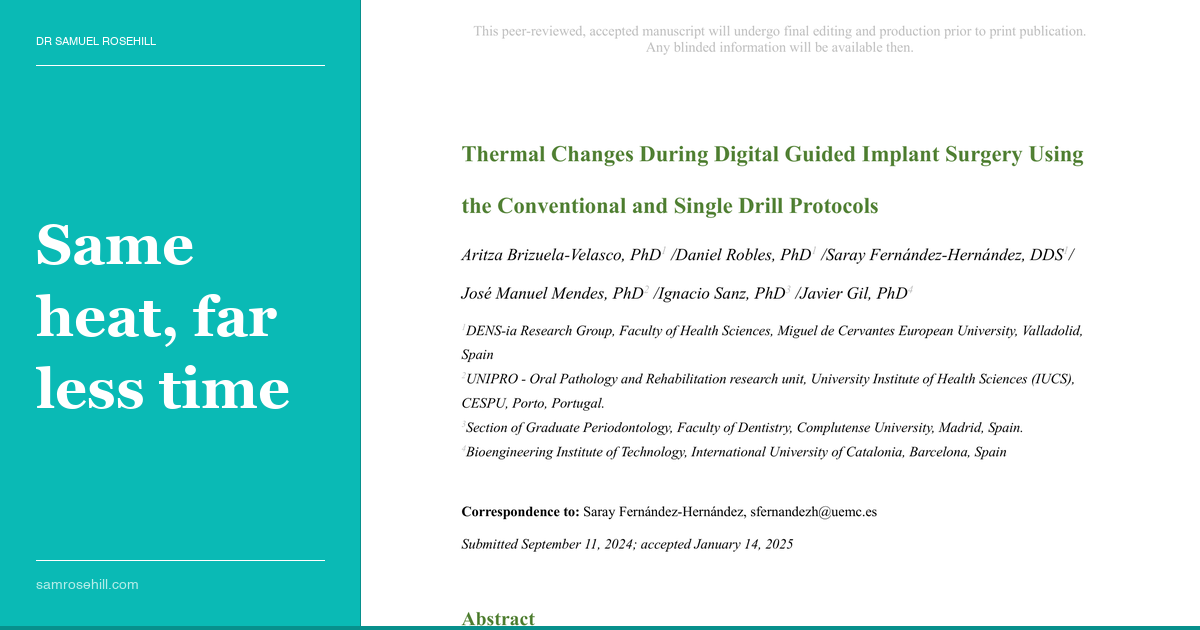
Source Paper
Thermal Changes During Digital Guided Implant Surgery Using the Conventional and Single Drill Protocols
Sequential implant drilling survives on momentum more than evidence. The incremental logic is sensible enough — pilot through cortical, then 2.35, 2.8, 3.3, 3.8, final diameter, each drill widening the path for the next — but nobody asks what that sequence costs the bone in thermal terms across all those passes. “Thermal Changes During Digital Guided Implant Surgery Using the Conventional and Single Drill Protocols” by Aritza Brizuela-Velasco and colleagues finally asks.
The answer is not what the ritual suggests.
The Data Anchor
The DENS-ia Research Group at Miguel de Cervantes European University used bovine rib as their model (a type I dense cortical bone chosen because it represents the worst thermal scenario). A 3D-printed surgical splint anchored everything; a type K thermocouple sat 4 mm deep and 0.2–0.5 mm lateral to each osteotomy.
Both protocols ran at 1,500 rpm under controlled pressure (< 10 N) with saline irrigation. Twenty osteotomies per group, plus a rabbit tibia validation arm confirming the ex vivo model behaved like living bone (p = 0.926).
The conventional group (n = 20) used the full Klockner Sniper six-drill sequence to 4.1 mm. The single-drill group (n = 20) used one 4.1 mm Maillefer drill designed for simplified protocols. Same final diameter; completely different journey.
Peak temperature rise: 1.977°C for the conventional group, 2.634°C for the single-drill group, with no significant difference (p = 0.1688). Both sit well below the Eriksson injury thresholds of 47°C for one minute or 40°C for seven minutes.
The exposure time data is a different story altogether.
Key Findings
- Six sequential drills cannot let bone recover between passes. Temperature plots show a pulse train of successive peaks, each starting from a slightly elevated baseline. The bone never returns to ambient during the drilling sequence.
- Exposure time: 107 seconds versus 17 seconds. The conventional protocol kept bone thermally stressed for a mean of 107.1 seconds (SD 29.2). The single-drill protocol: 16.8 seconds (SD 8.1). A six-fold difference, statistically significant, and clinically obvious.
- Heat dissipates quickly once the drill stops. The bone shed half its temperature rise in a mean of 4.615 seconds, which implies the inter-drill pause in conventional protocols needs to exceed that threshold to avoid compounding effects.
- Limitation. Ex vivo bone with a single cortical density; clinical variability in bone type, surgical guide design, and irrigation access will influence real-world temperatures.
The authors acknowledge that the literature cannot yet resolve whether longer moderate exposure is more damaging than briefer intense exposure. That is an honest concession, and a reason to hold both protocols under continued scrutiny.
💡 The Clinical Bottom Line
In guided surgery, where the splint already constrains irrigation access, the thermal case for a single-drill approach is stronger than its reputation suggests. Peak temperature is no worse than sequential drilling; what changes is how long bone sits at that temperature. A protocol that finishes in 17 seconds and dissipates heat within seconds of completion does something a six-step sequence structurally cannot: it stops.
The recommendation from the paper for conventional protocols is pragmatic: pause longer between drills to allow thermal relaxation. For single-drill work, the familiar rules apply: irrigation, pressure control, guide stability. Neither protocol is a hazard in controlled conditions. But if the choice is already guided surgery, the single drill is not just a shortcut. It is the thermally tidier one.
Dr Samuel Rosehill is a general dentist with a prosthodontic focus, practising at Ethical Dental in Coffs Harbour, NSW. He holds a BDSc (Hons) from the University of Queensland, an MBA, an MMktg, and an MClinDent in Fixed & Removable Prosthodontics (Distinction) from King’s College London.
Clinical Relevance
Peak temperature during osteotomy is similar whether you use a single drill or a full sequential kit. The meaningful difference is how long bone spends at an elevated temperature: six-step protocols keep bone thermally stressed for around 107 seconds versus under 17 seconds for a single-drill approach. If exposure time is the more relevant injury variable, the single-drill protocol has a strong thermal argument in its favour.
Disclosure: The author has no financial conflicts of interest related to the products or topics discussed in this review. This is an independent summary prepared for educational purposes.
Continue the conversation
This review is also published on Substack, where you can leave comments and join the discussion.
Read on Substack →