One Implant, Half the Price — But Is It Half the Prosthesis?
A systematic review and meta-analysis of 17 RCTs finds that single implant-supported mandibular overdentures deliver equivalent implant survival to two-implant designs at up to 5 years, but carry roughly twice the risk of denture fracture and need for full denture replacement — a trade-off with real implications for patients who can only afford one.
Same survival, more fractures
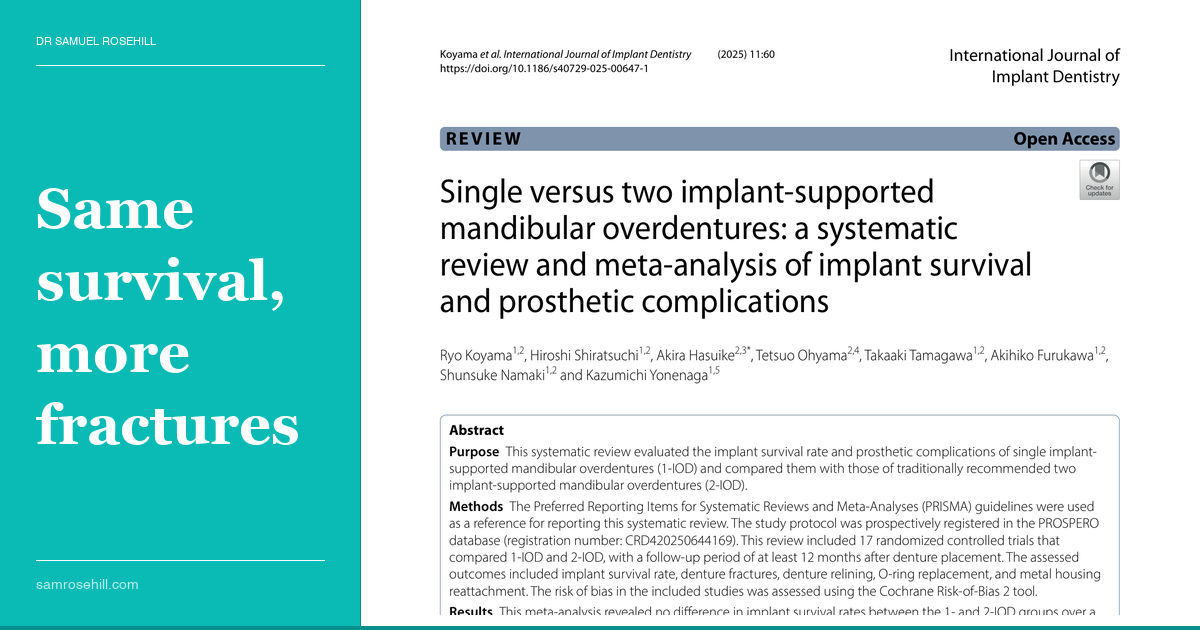
Source Paper
Single versus two implant-supported mandibular overdentures: a systematic review and meta-analysis of implant survival and prosthetic complications
Implant dentistry has spent the better part of two decades building an evidence base, achieving consensus, and arriving at a standard of care for the edentulous mandible. The McGill Consensus Statement in 2002, and the York Consensus in 2009, said it clearly: two implants, minimum. The profession agreed, the literature settled, and prosthodontists around the world began managing patient expectations accordingly. The only group who didn’t quite get the memo were the patients who couldn’t afford two implants, which, depending on the country and clinic, is rather a lot of them. Against that backdrop, Koyama and colleagues at Nihon University School of Dentistry have published “Single versus two implant-supported mandibular overdentures: a systematic review and meta-analysis of implant survival and prosthetic complications” in the International Journal of Implant Dentistry (2025), asking whether one implant can reasonably substitute for two — and producing an answer that is, as these things tend to be, both reassuring and cautionary in equal measure.
The Data Anchor
The review followed PRISMA guidelines and included 17 randomised controlled trials comparing single implant-supported overdentures (1-IOD) and two implant-supported overdentures (2-IOD), all with follow-up periods of at least 12 months. The search, conducted in April 2025 across PubMed, Google Scholar, CENTRAL, and Web of Science, identified 1,083 articles; after excluding duplicates, insufficient follow-up, and duplicated data sets, 17 remained. Outcomes assessed included implant failure, denture fracture, denture relining, O-ring replacement, and metal housing reattachment, all analysed using risk ratios (RR) with 95% confidence intervals via a random-effects model in RevMan 5.4.1. The cost context is worth noting: Hartmann et al. (included in the analysis) reported that 1-IOD costs approximately 75% of 2-IOD, though the authors observe that adding a metal framework to reduce fracture risk would narrow that gap further.
Key Findings
- Implant survival: no significant difference across 1-, 3-, and 5-year follow-up. Subgroup analyses by loading protocol (immediate, early, conventional) also found no significant differences, which is a usefully clean result for clinicians who have been uncertain about the single implant’s long-term osseointegration prospects.
- Denture fracture: significantly higher in 1-IOD at 1 year (RR 2.28; 95% CI: 1.01–5.14; P = 0.05) and 5 years (RR 2.10; 95% CI: 1.21–3.64; P = 0.008). The 3-year figure trended in the same direction (RR 2.08) without reaching significance.
- Denture replacement: significantly higher at 5 years in 1-IOD (RR 2.57; 95% CI: 1.11–5.94; P = 0.03), a finding that carries real financial weight for the patient who chose a single implant on cost grounds.
- Metal housing reattachment: significantly higher in 1-IOD at both 3 years (RR 2.29; P = 0.04) and 5 years (RR 2.31; P = 0.04), though substantial heterogeneity in the 5-year comparison (I² = 84%) warrants some caution.
- Relining and O-ring replacement: no significant differences at any time point, suggesting that ridge resorption dynamics and attachment retention are comparable between designs.
- Limitation: most included RCTs had follow-up periods of 5 years or less, and subgroup analyses by implant length, diameter, or type were not feasible due to insufficient sample sizes. The long-term complication profile beyond 5 years remains genuinely unknown.
💡 The Clinical Bottom Line
The data permits a carefully worded “yes” to the single implant overdenture as a viable option — but the conditions attached to that yes are important. Implant survival is equivalent; that is no small thing. The prosthetic complication picture, however, is materially worse over time, and the patient who selects a 1-IOD to reduce upfront cost may find that the savings are partially recouped in subsequent fracture repairs and denture remakes. The practical implication is specific: if you place a single implant overdenture, build in a metal framework. Finite element analysis from the discussion section shows that a metal framework reduces tensile stress around the implant housing by 61.8% — a number worth remembering when the patient asks whether the reinforcement is really necessary.
A single implant overdenture without a metal framework, for a patient who cannot easily return for repairs, may ultimately cost more — in money and distress — than a second implant would have.
The economic argument for single implant overdentures is genuinely compelling for populations where two implants remain inaccessible. This meta-analysis does not undermine that argument; it just asks that the clinician be transparent about the maintenance commitment. One implant can do the job. It simply needs more looking after.
Dr Samuel Rosehill is a general dentist with a prosthodontic focus, practising at Ethical Dental in Coffs Harbour, NSW. He holds a BDSc (Hons) from the University of Queensland, an MBA, an MMktg, and an MClinDent in Fixed & Removable Prosthodontics (Distinction) from King’s College London.
Clinical Relevance
This meta-analysis of 17 RCTs shows no statistically significant difference in implant survival between single and two-implant mandibular overdentures over 5 years. However, single-implant designs carry approximately twice the risk of denture fracture (RR 2.28 at 1 year, 2.10 at 5 years) and a significantly higher need for full denture replacement at 5 years (RR 2.57). A metal framework is strongly recommended for single-implant overdentures to reduce fracture risk around the implant housing.
Disclosure: The author has no financial conflicts of interest related to the products or topics discussed in this review. This is an independent summary prepared for educational purposes.
Continue the conversation
This review is also published on Substack, where you can leave comments and join the discussion.
Read on Substack →