Small Implants, Big Claims: Can Narrow-Diameter Fixtures Survive in the Posterior?
Pachiou et al.'s 2025 systematic review and meta-analysis of 2,741 narrow-diameter implants finds 97.7% pooled survival in posterior sites — comparable to standard-diameter fixtures.
97.7% survival in posterior
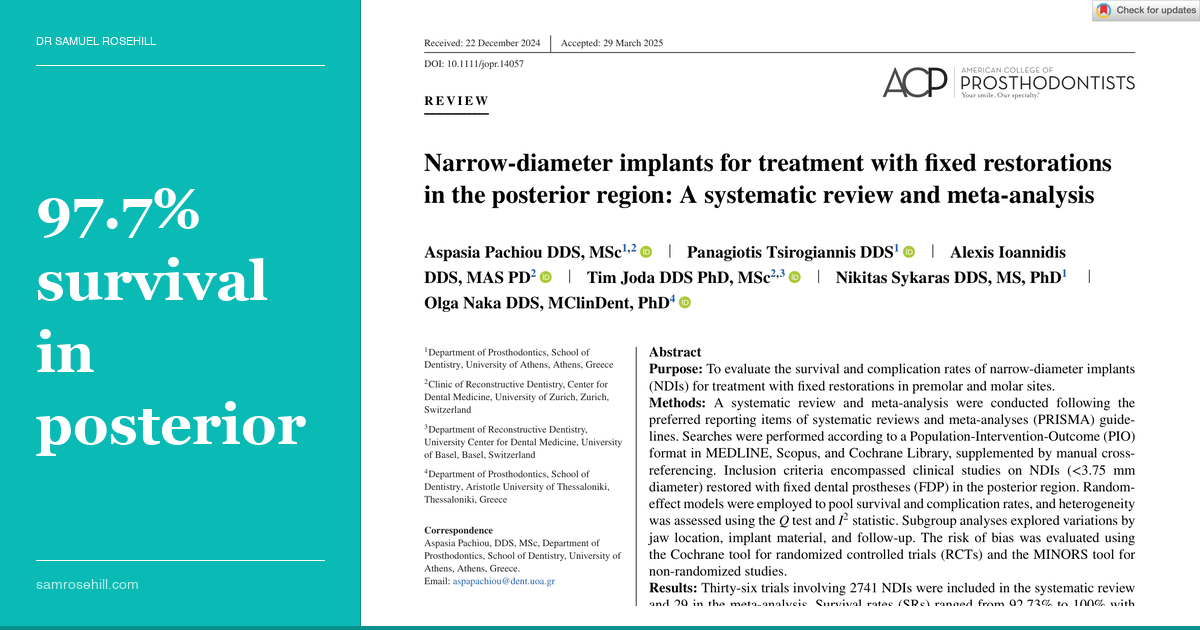
Source Paper
Narrow-diameter implants for treatment with fixed restorations in the posterior region: A systematic review and meta-analysis
There is a particular kind of clinical conservatism that treats narrow-diameter implants the way a cautious parent treats a child on a trampoline: technically it’s fine, probably nothing will go wrong, but you’d really rather they didn’t. The reasoning is intuitive enough — less titanium means less fracture resistance, and the posterior jaw is where the occlusal forces live. For years, narrow-diameter implants (NDIs) have been politely confined to lower incisors and lateral replacements, the quiet achievers of the fixture catalogue permitted to work only where the loads are gentle. Pachiou and colleagues, in “Narrow-diameter implants for treatment with fixed restorations in the posterior region” (Journal of Prosthodontics, 2025), have assembled the most comprehensive meta-analysis to date asking whether that caution is still warranted.
The Data Anchor
This PRISMA-compliant systematic review and meta-analysis (PROSPERO-registered) screened 357 records and included 36 trials with 2,741 narrow-diameter implants (defined as < 3.75 mm) restored with fixed dental prostheses in premolar and molar sites. Twenty-nine studies entered the meta-analysis. Study designs were predominantly retrospective (50%), with follow-up periods ranging from 10.8 months to 12 years and a median of 4 years. The pooled survival rate across all included studies was 97.7% (SE = 0.004, P < .001). Heterogeneity after sensitivity analysis was negligible (I² = 0.403%), which is remarkably low for a meta-analysis of this scope. Risk of bias was assessed using the Cochrane tool for the three included RCTs and the MINORS tool for non-randomised studies, with most scoring 17–18 out of 24.
Key Findings
- Pooled survival: 97.7% across 29 studies and 2,741 NDIs in posterior sites — well within the range reported for standard-diameter implants
- No difference between jaws: maxillary NDIs survived at 97.0% (95% CI: 96.2–97.8%) versus mandibular at 96.5% (95% CI: 95.7–97.3%); the difference was not significant (P = .688)
- Premolar vs molar sites: 97.5% and 98.6% survival respectively — no significant difference (P = .301), challenging the assumption that molar loading is a contraindication
- Titanium and TiZr alloys performed identically at 98.4% survival each, suggesting the newer TiZr material is a viable option for narrow fixtures
- Technical complications ranged from 0% to 23.5%, primarily screw loosening, fractures, and restoration detachment; platform-switching connections reduced these failures
- Limitation: only 25.6% of studies reported biological complications, and heterogeneity in definitions made cross-study comparison impossible
The data suggest that the long-standing reluctance to place narrow implants posteriorly may owe more to mechanical intuition than to clinical evidence.
💡 The Clinical Bottom Line
For clinicians facing a narrow posterior ridge and a patient who would rather not undergo bone augmentation, the numbers here are genuinely reassuring: a 97.7% pooled survival rate with fixed restorations across both jaws, both premolar and molar sites, and both titanium and TiZr alloys. Platform-switching connections appear to reduce technical complications. The practical implication is that NDIs deserve a place in posterior treatment planning, not as a compromise, but as a legitimate minimally invasive option backed by a substantial and consistent evidence base.
Dr Samuel Rosehill is a general dentist with a prosthodontic focus, practising at Ethical Dental in Coffs Harbour, NSW. He holds a BDSc (Hons) from the University of Queensland, an MBA, an MMktg, and an MClinDent in Fixed & Removable Prosthodontics (Distinction) from King’s College London.
Reference: Pachiou A, Tsirogiannis P, Ioannidis A, Joda T, Sykaras N, Naka O. Narrow-diameter implants for treatment with fixed restorations in the posterior region: A systematic review and meta-analysis. J Prosthodont. 2025;34:670–685. doi:10.1111/jopr.14057
Clinical Relevance
NDIs (<3.75 mm) achieve 97.7% pooled survival in posterior sites with fixed restorations, supporting their use where bone width is limited.
Disclosure: The author has no financial conflicts of interest related to the products or topics discussed in this review. This is an independent summary prepared for educational purposes.
Continue the conversation
This review is also published on Substack, where you can leave comments and join the discussion.
Read on Substack →