Sintering Temperature and Zirconia's Secret Handshake with Strength
Lower sintering temperatures produce mechanically superior conventional zirconia, whilst translucent formulations stubbornly resist this advantage regardless of heat protocol — Brunetto et al. clarify what the firing chart has been trying to tell us.
1350°C — stronger crowns
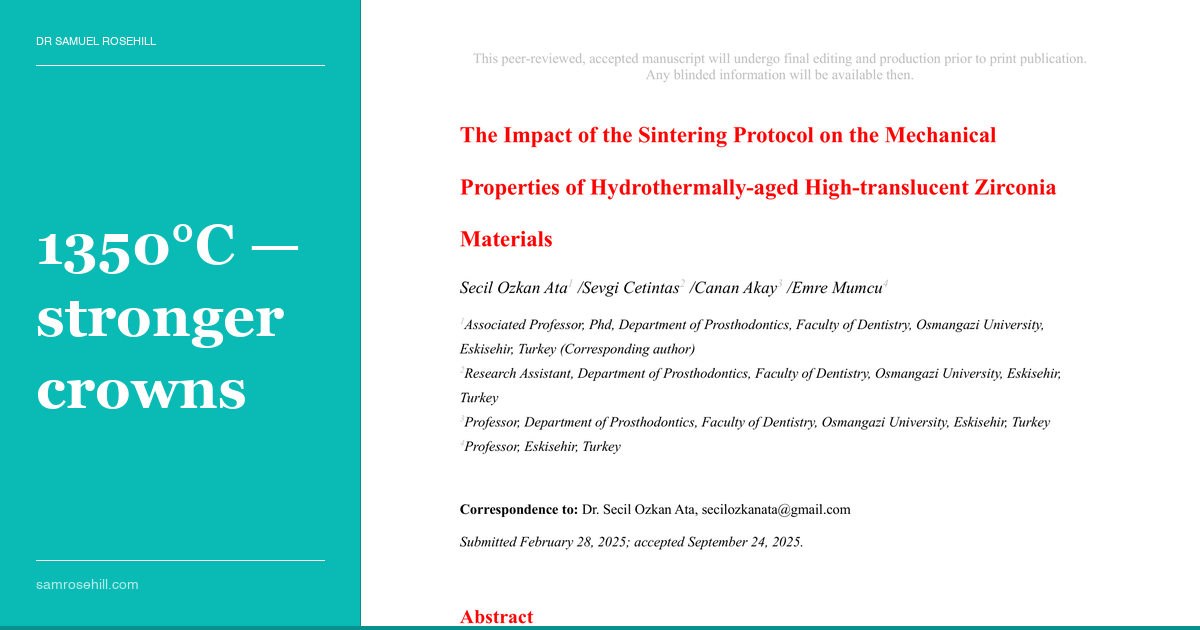
Source Paper
Effect of Sintering Temperature on the Microstructure and Mechanical Properties of Conventional and Translucent Zirconia
You’re three crowns deep into a Thursday morning when you notice the usual tension in your lab liaison’s emails about delivery schedules. The translucent zirconia you ordered — the stuff that’s supposed to look like actual teeth — keeps fracturing at temperatures that nobody really warned you about. Is it the material, the firing protocol, or some invisible choreography between the two that nobody’s bothering to rehearse?
Brunetto et al. decided to find out. Their paper — Effect of Sintering Temperature on the Microstructure and Mechanical Properties of Conventional and Translucent Zirconia — in The International Journal of Prosthodontics (2026) offers a genuinely clarifying answer: lower sintering temperatures produce mechanically superior conventional zirconia, whilst translucent formulations stubbornly resist this advantage regardless of heat protocol.
The Data Anchor
The choreography, it turns out, matters enormously — but only for one of the dancers. The team at São Paulo State University examined 320 specimens of IPS e.max ZirCAD in two compositional variants: conventional (MO) and translucent (MT), subjecting them to a slow, conservative routine at 1350°C for 8 hours and a faster, hotter one at 1530°C for 2.5 hours.
Conventional zirconia responded beautifully to the slower tempo — significantly higher flexural strength and fracture toughness compared to the aggressive protocol, with smaller grain size in both compositions and a notably denser microstructure. Translucent zirconia, however, danced identically regardless of the music; no statistically significant mechanical differences between the two temperatures.
The quiet implication: translucent formulations have already traded their mechanical ceiling for optical properties. No amount of sintering optimisation buys it back.
X-ray diffraction confirmed that all specimens retained tetragonal crystal structure regardless of firing temperature — the crystal doesn’t care, even if the clinician should.
Key Findings
- Conventional zirconia favours conservative sintering: Lower temperature (1350°C/8h) produces smaller grain size, superior strength, and better fracture resistance than higher-temperature protocols
- Translucent zirconia is mechanically indifferent to temperature variation: No significant strength differences across sintering protocols, implying optical requirements have already determined mechanical outcomes
- Density is the microstructural hero: Cooler, longer sintering reduces porosity and strengthens the material at a grain-boundary level
- Caveat: In-vitro findings don’t account for the thermocyclic stress patterns of oral function; translucent zirconia’s lower absolute mechanical properties remain a design constraint regardless of sintering optimisation
💡 The Clinical Bottom Line
If you’re placing conventional zirconia, insist on the 1350°C/8h sintering protocol—you’re getting measurably stronger crowns that will laugh at occlusal forces. For translucent zirconia, accept that you’re trading mechanical supremacy for aesthetics; sintering temperature optimisation won’t solve the inherent strength gap, so design margins and guide surfaces accordingly. The material doesn’t lie—it just reminds us that every clinical gain usually demands a structural sacrifice.
Dr Samuel Rosehill is a general dentist with a prosthodontic focus, practising at Ethical Dental in Coffs Harbour, NSW. He holds a BDSc (Hons) from the University of Queensland, an MBA, an MMktg, and an MClinDent in Fixed & Removable Prosthodontics (Distinction) from King’s College London.
Reference: Brunetto et al. Effect of Sintering Temperature on the Microstructure and Mechanical Properties of Conventional and Translucent Zirconia. Int J Prosthodont. 2026;39. https://doi.org/10.11607/ijp.9487
Clinical Relevance
For conventional zirconia, insist on the lower sintering protocol (1350°C/8h) — you get measurably stronger crowns with smaller grain size and denser microstructure. For translucent zirconia, sintering optimisation won't close the inherent strength gap; design margins and guide surfaces accordingly and accept the mechanical trade-off as the cost of aesthetics.
Disclosure: The author has no financial conflicts of interest related to the products or topics discussed in this review. This is an independent summary prepared for educational purposes.
Continue the conversation
This review is also published on Substack, where you can leave comments and join the discussion.
Read on Substack →