When the Sinus Floor Is Your Floor: What Happens to Implants When You Have to Build Bone from Scratch
A systematic review of 20 studies and 1,245 patients finds that sinus augmentation and combined sinus-onlay grafting produce similarly high implant survival rates in the resorbed posterior maxilla — but the evidence base is thin, and crown-to-implant ratio remains a largely unexamined complication driver.
Both work, evidence thin
Source Paper
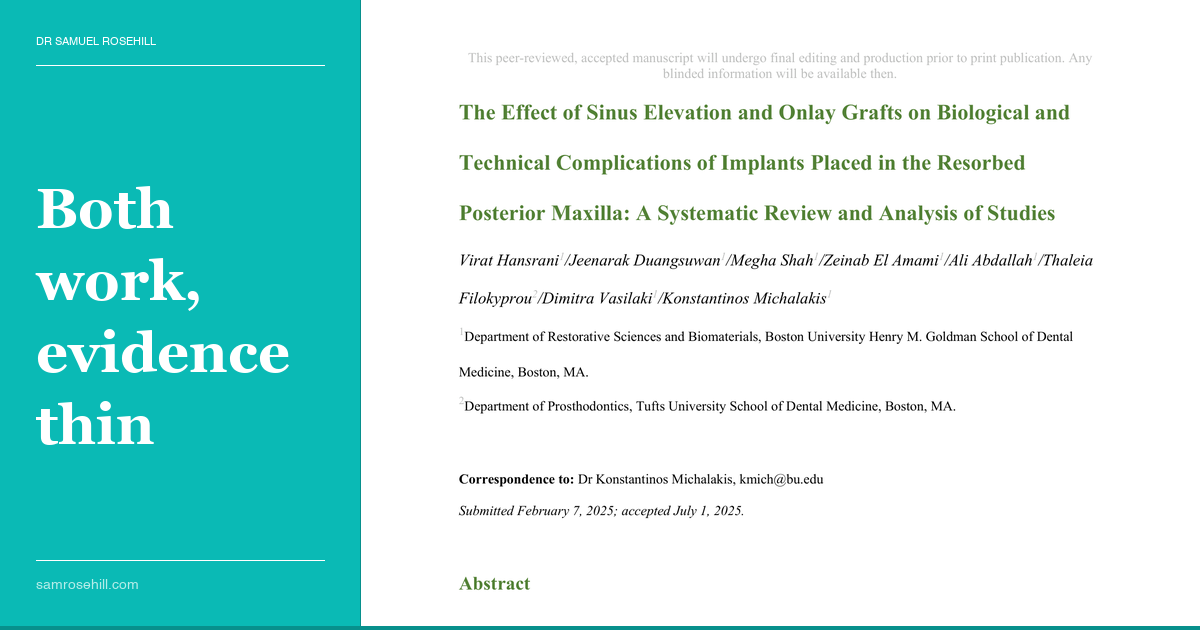
The Effect of Sinus Elevation and Onlay Grafts on Biological and Technical Complications of Implants Placed in the Resorbed Posterior Maxilla: A Systematic Review and Analysis of Studies
It does not particularly matter whether you choose a sinus lift or an onlay graft when placing implants in the severely resorbed posterior maxilla. The two techniques produce broadly similar survival rates and complication profiles. That conclusion will surprise anyone who has spent time with a piezosurgery unit trying not to perforate a sinus membrane, and yet it is essentially what the literature says, according to Hansrani et al. in “The Effect of Sinus Elevation and Onlay Grafts on Biological and Technical Complications of Implants Placed in the Resorbed Posterior Maxilla” (International Journal of Oral and Maxillofacial Implants, 2025). The catch: the evidence base is thin, and the clinical complexity of the posterior maxilla has outrun it.
The Data Anchor
This PRISMA-compliant systematic review searched four databases covering January 2000 to December 2023, screening 1,199 studies to include 20 articles with at least five years of follow-up. The 1,245 patients comprised 81.8% (n = 1,019) who underwent sinus augmentation alone (SA) and 18.1% (n = 226) who received sinus augmentation with onlay grafting (SAOG). No studies evaluated onlay grafting in isolation, forcing a pivot in the review’s original intent. Mean follow-up was 60 months. Quality assessment used a modified Cochrane Collaboration tool and the ROBINS-I framework.
Key Findings
- Implant survival was high in both groups: SA reported survival from 80.25% to 100% (mean ~96.6%); overall success ranged from 91.5% to 100%.
- No significant difference in complication profile between SA and SAOG, with similar rates of membrane perforation (3.8% overall), graft loss, and marginal bone loss.
- Onlay grafts offered one advantage sinus lifts cannot: reduced crown height, which matters because a crown-to-implant ratio (CIR) exceeding 1.5:1 is associated with unfavourable loading. No included study systematically reported CIR data, leaving this question unresolved.
- Wiltfang et al. found 5-year survival favouring SA (94.6%) over onlay grafts (91.5%), with differences emerging from 7 months onward.
- Limitation: the evidence base comprises 11 retrospective studies, 7 prospective, 1 RCT, and 1 case series. Not a single RCT directly compared sinus elevation with standalone onlay grafting.
💡 The Clinical Bottom Line
Both approaches are viable, and neither has demonstrated a decisive advantage. What this review makes clear is that the profession has been nearly silent on the one complication driver most specific to this anatomy: the CIR that results when bone height is gained vertically without addressing crown length above it. The answer to “sinus lift or onlay graft?” may well be “start with the crown.”
Dr Samuel Rosehill is a general dentist with a prosthodontic focus, practising at Ethical Dental in Coffs Harbour, NSW. He holds a BDSc (Hons) from the University of Queensland, an MBA, an MMktg, and an MClinDent in Fixed & Removable Prosthodontics (Distinction) from King’s College London.
Clinical Relevance
When planning implants in the resorbed posterior maxilla, both sinus augmentation and combined sinus-onlay grafting can achieve high survival rates — but clinicians should proactively assess crown-to-implant ratio at the treatment planning stage and consider splinting prostheses where ratios are unfavourable.
Disclosure: The author has no financial conflicts of interest related to the products or topics discussed in this review. This is an independent summary prepared for educational purposes.
Continue the conversation
This review is also published on Substack, where you can leave comments and join the discussion.
Read on Substack →