What 37,000 Older Implant Patients Tell Us About Medical Risk
A nationwide Korean study reveals that nearly 9 in 10 patients over 65 receiving implants have at least one systemic disease — and the medications that worry clinicians most may not be the ones causing failures.
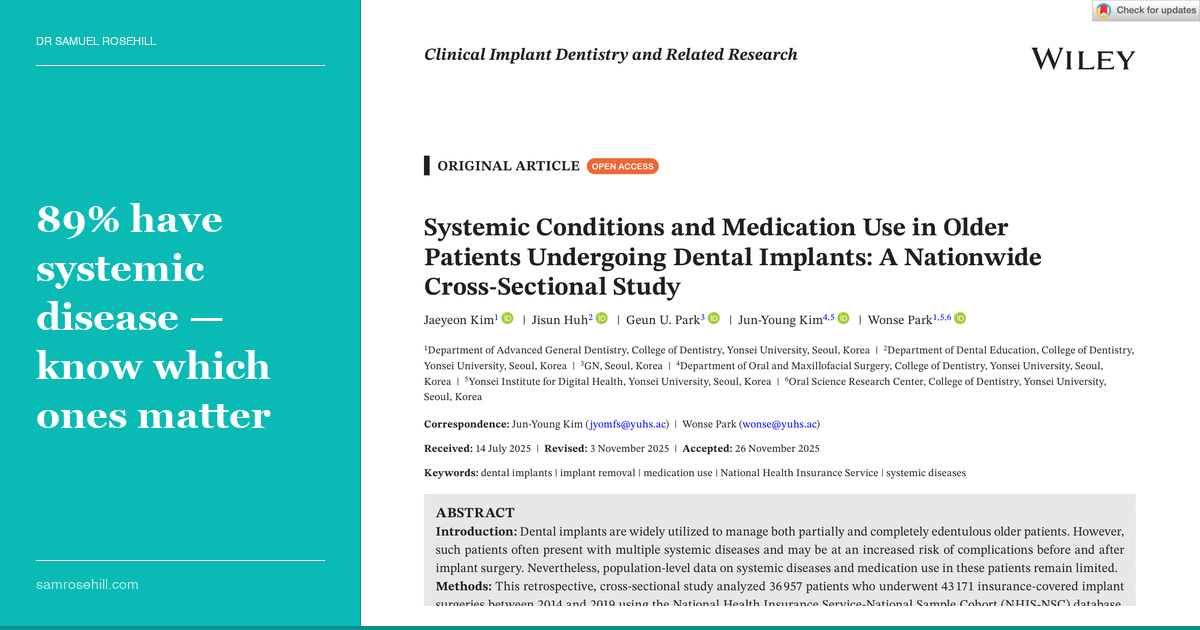
89% have systemic disease — know which ones matter
Source Paper
Systemic Conditions and Medication Use in Older Patients Undergoing Dental Implants: A Nationwide Cross-Sectional Study
In architecture, there is a useful concept called “load-bearing walls”: the ones that, if you remove or weaken them, bring the whole structure down. The tricky part is that they often look exactly like the decorative ones. Implant dentistry in older patients operates on a similar principle. We know our over-65 patients arrive with medical histories that read like a pharmacology textbook, but we have been surprisingly poor at identifying which conditions actually bear the load when it comes to implant failure. Kim and colleagues from Yonsei University, in “Systemic Conditions and Medication Use in Older Patients Undergoing Dental Implants: A Nationwide Cross-Sectional Study” (Clinical Implant Dentistry and Related Research, 2025), have done what single-institution studies could not: interrogated a national health insurance database covering nearly 37,000 older patients to determine which systemic conditions and medications genuinely predict implant removal.
The Data Anchor
This retrospective cross-sectional study analysed 36,957 patients aged 65 years and older who underwent 43,171 insurance-covered implant surgeries between 2014 and 2019, drawn from the Korean National Health Insurance Service–National Sample Cohort (NHIS-NSC) database. The NHIS-NSC represents approximately 2% of the eligible Korean population, stratified by age, sex, insurance type, and income. Systemic disease diagnoses were captured within one year before surgery using ICD-10 codes. Medication histories, including antithrombotics, antiresorptive agents, and immunosuppressants, were extracted from pharmacy prescription records. The primary outcome was implant removal, which occurred in 803 patients. Logistic regression was used to identify factors independently associated with removal.
Key Findings
- The comorbidity burden is enormous. Among all patients, 89.3% had at least one systemic disease within the year before surgery: hypertension (57.9%), arthritis (43.4%), and diabetes (34.6%).
- The real risk factors are not the usual suspects. Logistic regression showed cerebrovascular disease and kidney disease significantly increased the odds of implant removal. Diabetes and hypertension, despite their prevalence, did not independently predict failure.
- Antiresorptive therapy was protective, not harmful. Osteoporosis and antiresorptive agent use were associated with decreased risk of implant removal — the opposite of what many clinicians fear.
- Medication trends are shifting fast. Use of IV bisphosphonates, denosumab, and DOACs increased markedly over the study period, while oral bisphosphonates and warfarin declined. Roughly 6.8% of patients were prescribed antithrombotics and 5.1% antiresorptive agents.
- Caveat: This is a Korean population study; disease prevalence and prescribing patterns may differ elsewhere. The database captures implant removal rather than biological failure, and cannot distinguish between early and late failure mechanisms.
The finding that antiresorptive agents decreased implant removal risk challenges the reflexive caution many clinicians apply to bisphosphonate patients — and suggests our risk calculus may need recalibration.
💡 The Clinical Bottom Line
When an older patient presents for implant treatment, the medical history questions that matter most may not be the ones we are asking most carefully. This study suggests that cerebrovascular and renal disease deserve prominence in the risk assessment conversation, while the anxiety many clinicians attach to osteoporosis medications may be somewhat misplaced. With nearly nine in ten geriatric implant patients carrying at least one systemic condition, the question is not whether your next patient has comorbidities; it is whether you are paying attention to the ones that actually predict trouble.
Dr Samuel Rosehill is a general dentist with a prosthodontic focus, practising at Ethical Dental in Coffs Harbour, NSW. He holds a BDSc (Hons) from the University of Queensland, an MBA, an MMktg, and an MClinDent in Fixed & Removable Prosthodontics (Distinction) from King’s College London.
Reference: Kim J, Huh J, Park GU, Kim JY, Park W. Systemic conditions and medication use in older patients undergoing dental implants: A nationwide cross-sectional study. Clin Implant Dent Relat Res. 2025;27:e70104. doi: 10.1111/cid.70104
Clinical Relevance
Provides population-level evidence that cerebrovascular and kidney disease — not osteoporosis or antiresorptive therapy — are the strongest predictors of implant removal in older patients
Disclosure: The author has no financial conflicts of interest related to the products or topics discussed in this review. This is an independent summary prepared for educational purposes.
Continue the conversation
This review is also published on Substack, where you can leave comments and join the discussion.
Read on Substack →