Denosumab, Osteoporosis and the Implant Conversation
Hwang and colleagues studied 1,694 implants in post-menopausal women and found similar implant survival among bisphosphonate, denosumab, and control groups, while reinforcing the need for individualised medical risk planning.
Low-dose ARDs reassure
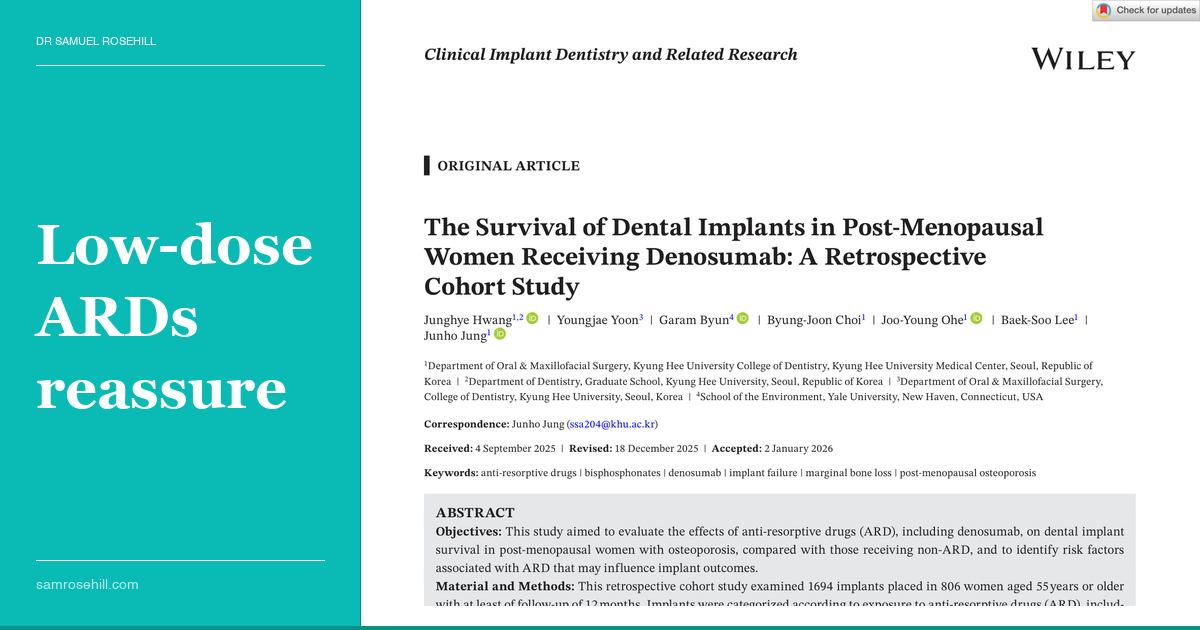
Source Paper
The Survival of Dental Implants in Post-Menopausal Women Receiving Denosumab: A Retrospective Cohort Study
The implant consult changes temperature when a patient mentions denosumab. A minute earlier you were discussing ridge width and healing abutments; suddenly the room contains osteoporosis, medication-related osteonecrosis of the jaw, rebound vertebral fractures, and the faint sense that everyone would like a simple rule. The Survival of Dental Implants in Post-Menopausal Women Receiving Denosumab: A Retrospective Cohort Study offers something better than a rule: reassuring survival data, with enough caveats to keep medication decisions where they belong, with the prescribing physician.
The Data Anchor
Hwang, Yoon and colleagues retrospectively examined 1,694 implants in 806 women aged 55 years or older, all followed for at least 12 months. Implants were grouped by most recent anti-resorptive drug exposure: control with no bone-modifying agent, bisphosphonates (BPs), or denosumab (DMAB). The cohort included 1,360 control implants, 230 BP-exposed implants, and 104 DMAB-exposed implants.
Implant survival was almost stubbornly similar: 98.24% in controls, 99.13% with BPs, and 98.08% with DMAB. Firth logistic regression with patient-level clustering and propensity score matching found no significant difference in implant failure between groups. No MRONJ-related complications were observed in any patient.
Key Findings
- Low-dose osteoporosis therapy did not reduce implant survival in this cohort. The study excluded cancer-dose anti-resorptive therapy, which is an entirely different risk conversation.
- Denosumab was not worse than bisphosphonates. DMAB versus control remained non-significant after propensity matching (OR 1.677, P = .565), and DMAB versus BP was also non-significant (OR 2.327, P = .298).
- The bigger risk signals were not the drug labels. Diabetes mellitus (OR 3.233, P = .033), alcohol use (OR 2.967, P = .035), and implant-supported overdenture prostheses (OR 4.614, P = .012) were associated with higher failure risk.
- Timing still matters clinically. The authors note DMAB bone turnover may resume 5-7 months after the final dose, but they do not endorse casual discontinuation; stopping denosumab can increase rebound fracture risk.
- The limitations are real. This was retrospective, control-group osteoporosis status was not objectively confirmed, medication route and re-administration timing were incomplete, and supportive maintenance was not verified.
💡 The Clinical Bottom Line
For post-menopausal women taking low-dose denosumab or bisphosphonates for osteoporosis, this paper supports a calmer implant conversation. Comparable survival does not mean risk-free surgery, but it does argue against treating osteoporosis-dose anti-resorptive therapy as an automatic implant contraindication.
The Monday-morning move is practical: confirm the indication and dose, speak with the prescribing physician where needed, time surgery intelligently, reduce avoidable trauma, and maintain the prosthesis as though peri-implant inflammation still matters. Because it does. The drug is only one guest at the party.
Dr Samuel Rosehill is a general dentist with a prosthodontic focus, practising at Ethical Dental in Coffs Harbour, NSW. He holds a BDSc (Hons) from the University of Queensland, an MBA, an MMktg, and an MClinDent in Fixed & Removable Prosthodontics (Distinction) from King’s College London.
Clinical Relevance
For post-menopausal women receiving low-dose anti-resorptive therapy for osteoporosis, implant survival in this cohort was comparable with non-exposed controls. The reassuring survival data should still be paired with medical consultation, careful timing, and long-term peri-implant maintenance rather than casual drug-holiday assumptions.
Disclosure: The author has no financial conflicts of interest related to the products or topics discussed in this review. This is an independent summary prepared for educational purposes.
Continue the conversation
This review is also published on Substack, where you can leave comments and join the discussion.
Read on Substack →