Hundreds of Bleaching Trials. Still No Clean Answer for the Patient in the Chair.
A 2025 bibliometric analysis of 275 tooth bleaching studies published between 2001 and 2024 maps where dental research effort has pooled — in-office hydrogen peroxide, Brazilian institutions, and sensitivity management — and what remains conspicuously unaddressed: long-term enamel effects, standardised light-activation protocols, and robust evidence for over-the-counter products.
Lots of trials, inconclusive on light
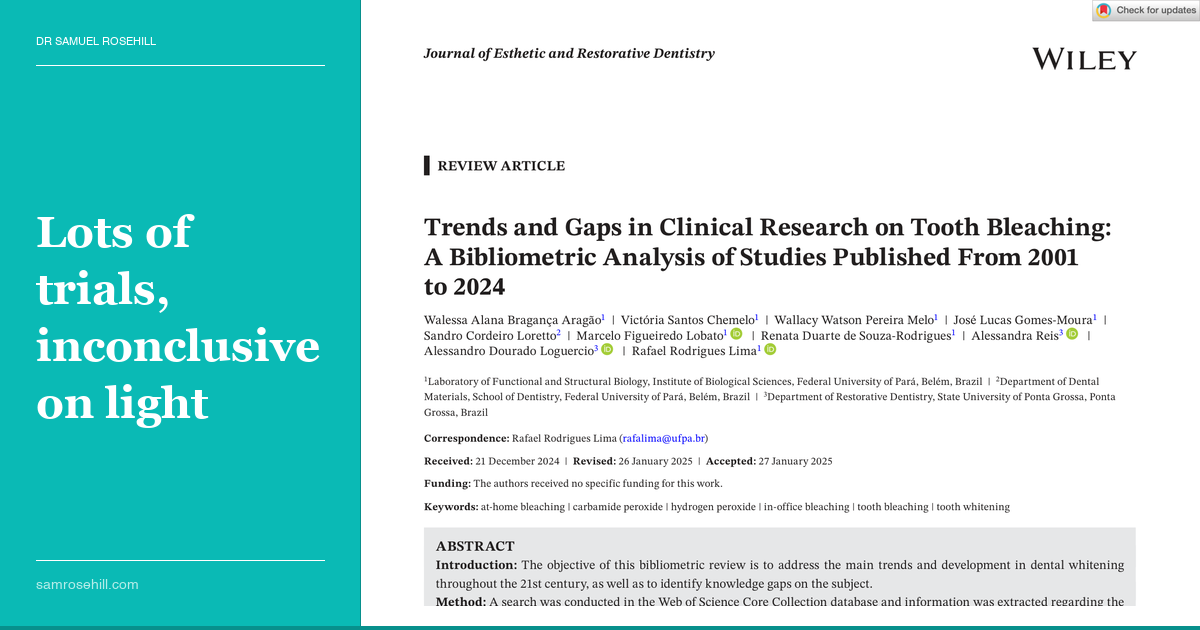
Source Paper
Trends and Gaps in Clinical Research on Tooth Bleaching: A Bibliometric Analysis of Studies Published From 2001 to 2024
Tooth bleaching is among the most studied procedures in esthetic dentistry, and one of those for which the literature still cannot give the patient in the chair a clean answer. Whether light activation works, what the right peroxide concentration is, whether chemist-shelf strips do anything meaningful: none of these questions have crisp answers. Hundreds of randomised trials, six thousand citations.
“Trends and Gaps in Clinical Research on Tooth Bleaching: A Bibliometric Analysis of Studies Published From 2001 to 2024,” by Aragão and colleagues from the Federal University of Pará and the State University of Ponta Grossa, maps that paradox rather than resolving it. From 10,703 studies in Web of Science, 275 met eligibility criteria, accumulating 6,181 citations: a picture of where 24 years of research effort has gone, and where it has not.
The Data Anchor
The 275 studies were predominantly randomised clinical trials (n = 133, 48.3%), with non-randomised trials (n = 111, 40.3%) and systematic reviews (n = 31, 11.1%). Brazil produced 179 of them (65%); the State University of Ponta Grossa contributed 73 publications, with Loguercio AD (n = 82) and Reis A (n = 76) as the corpus’s dominant authors.
In-office bleaching with 35% hydrogen peroxide leads the literature (n = 149, 53.7%), followed by at-home carbamide peroxide in customised trays (95 articles). OTC products are sparse: whitening strips (n = 17), dentifrice (n = 16), paint-on gels (n = 3). Colour change by spectrophotometer (ΔEab, ΔE₀₀, ΔWID) was the primary outcome in 220 studies; tooth sensitivity appeared in 136.
Thematic drift is readable from keyword frequency. Early publications centred on carbamide peroxide; by 2011–2017, tooth sensitivity co-anchored the literature. The 2018–2024 period shifted toward at-home protocols and violet LED (n = 9), supplanting the infrared lasers that dominated 2013–2017 (n = 22).
Key Findings
- Light activation remains poorly evidenced. The most-cited paper in the corpus — a systematic review with 239 citations — found no evidence that heat, light, or laser activation improves bleaching efficacy. Violet LED shows promise in some trials but protocols vary too widely for reliable comparison.
- Lower peroxide concentrations may match higher ones with less sensitivity. The bibliometric authors’ synthesis of the at-home literature, not original trial data. Consult the primary systematic reviews before adjusting protocols.
- OTC products are understudied. Thirty-three studies cover strips and dentifrice combined. Some evidence suggests 10% hydrogen peroxide strips achieve comparable whitening to tray-based bleaching, but the base is thin.
- Research geography concentrates risk. Two-thirds of the literature originates from one country; two authors dominate the citation network. Generalisability is not guaranteed.
- Long-term enamel effects are an acknowledged gap. Well-designed trials on wear and demineralisation remain scarce.
- Desensitising adjuvants are underpowered despite sensitivity being the second-most-frequent keyword in the entire corpus.
A bibliometric analysis counts the literature; it does not adjudicate it. Hundreds of trials means the question attracted attention — not that it has been answered.
💡 The Clinical Bottom Line
If you add a lamp to your in-office bleaching protocol believing it delivers extra efficacy, the evidence mapped here does not support that. The corpus’s most-cited synthesis (239 citations) found no benefit from heat, light, or laser activation.
The at-home literature’s trend toward lower peroxide concentrations achieving comparable whitening with reduced sensitivity is worth noting before defaulting to the strongest product.
This review cannot offer protocol certainty. It maps where 275 studies have looked, and what they left blank: long-term enamel effects, desensitising adjuvants, violet LED’s real clinical value. The field has been industrious. The blanks remain.
Dr Samuel Rosehill is a general dentist with a prosthodontic focus, practising at Ethical Dental in Coffs Harbour, NSW. He holds a BDSc (Hons) from the University of Queensland, an MBA, an MMktg, and an MClinDent in Fixed & Removable Prosthodontics (Distinction) from King’s College London.
Clinical Relevance
A bibliometric review of 275 clinical studies and systematic reviews on tooth bleaching (2001–2024) found that most research addresses in-office bleaching with 35% hydrogen peroxide or at-home bleaching with 10% carbamide peroxide. Recent evidence suggests lower peroxide concentrations can achieve comparable colour change with reduced tooth sensitivity. Light activation during in-office bleaching lacks consistent supporting evidence for efficacy improvement; benefits of violet LED remain inconclusive and unstandardised across trials. Long-term enamel effects, optimised desensitising protocols, and robust OTC evidence remain the field's clearest research gaps.
Disclosure: The author has no financial conflicts of interest related to the products or topics discussed in this review. This is an independent summary prepared for educational purposes.
Continue the conversation
This review is also published on Substack, where you can leave comments and join the discussion.
Read on Substack →