Translucent Zirconia Matches Metal-Ceramic at 5 Years in a Digital Workflow RCT
Gseibat et al.'s 5-year prospective RCT finds translucent monolithic zirconia posterior crowns achieve 100% survival and comparable clinical performance to metal-ceramic restorations fabricated via digital workflow.
100% survival, zirconia wins on margins
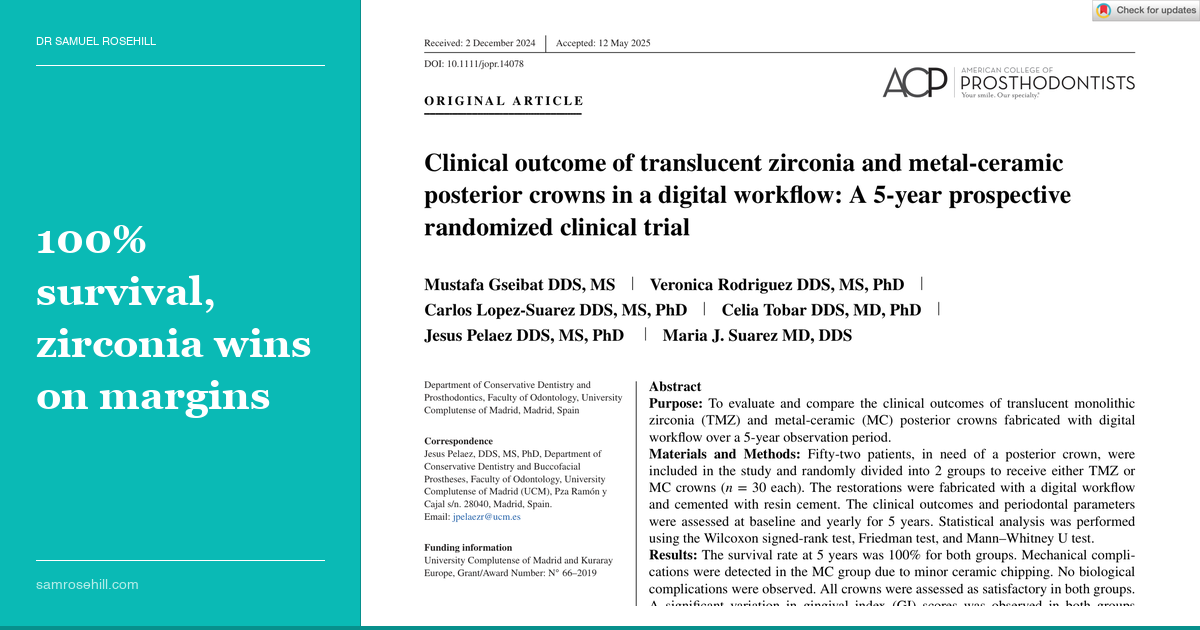
Source Paper
Clinical outcome of translucent zirconia and metal-ceramic posterior crowns in a digital workflow: A 5-year prospective randomized clinical trial
“The question isn’t whether zirconia works,” said a colleague at a prosthodontics conference. “The question is which one, and for how long.” It was the kind of remark that sounds offhand but actually contains the entire argument. Into that gap steps Gseibat et al.’s five-year prospective RCT comparing translucent monolithic zirconia (TMZ) against metal-ceramic (MC) posterior crowns fabricated in a digital workflow, published in the Journal of Prosthodontics in 2025. To the authors’ knowledge it is the first such RCT, and it arrives with a verdict that should settle at least part of the argument.
Third-generation TMZ was developed by increasing yttria content from 4% to 6%, improving translucency at the cost of reduced fracture strength (600 to 1000 MPa versus 1000 to 1500 MPa for conventional zirconia). The clinical question: does that trade-off hold in the posterior region, where occlusal forces are unforgiving.
The Data Anchor
Conducted at the University Complutense of Madrid, the trial enrolled 52 patients (19 male, 33 female; mean age 53.5 years; range 28 to 76) receiving 60 posterior crowns randomised to TMZ (n = 30, KATANA Zirconia STML) or MC (n = 30). Sample size was calculated via G*Power (significance 0.05, effect size 0.8, power 0.8), requiring a minimum of 54 crowns. Both groups used intraoral scanning (Trios 3; 3Shape) and CAD design (Dental System; 3Shape). TMZ crowns were milled from super-translucent multilayered blanks and sintered at 1550°C; MC frameworks were milled from cobalt-chromium discs then manually veneered (a mixed analog-digital workflow). All crowns were cemented with self-adhesive resin cement (Panavia SA Cement Universal). CDA quality criteria and periodontal parameters were recorded at baseline and yearly to five years. Not one participant was lost to follow-up.
Key Findings
- Both groups achieved 100% survival at 5 years: no loss of retention, no biological complications, no secondary caries
- TMZ achieved 100% success; MC reached 97%, with a single veneering ceramic chip in a lower right first molar at year 3 that did not require remake
- TMZ maintained perfect marginal integrity (100% excellent), while MC crowns developed significant marginal discoloration by year 5 (p = 0.001), with confirmed between-group difference (p = 0.005)
- GI worsened over time in both groups (TMZ: p = 0.021; MC: p < 0.001), but MC abutment teeth deteriorated significantly more than TMZ (p = 0.022); MC abutment teeth differed from contralateral controls at year 5 (p = 0.011) while TMZ teeth did not
- Comparable anatomical form changes in both groups from occlusal wear and proximal contact loss (TMZ: p = 0.016; MC: p = 0.001), with no between-group difference
- Surface roughness in 4 TMZ crowns by year 5 (p = 0.04); careful polishing after occlusal adjustment is critical
💡 The Clinical Bottom Line
This paper does two things on Monday morning. It gives you licence to choose third-generation TMZ for posterior single crowns with the confidence once reserved for metal-ceramic (in non-bruxing patients). And it confirms the digital workflow is doing real work: zero biological complications across 60 crowns over five years reflects the precision of IOS-derived margins.
The more nuanced finding is on the gingival index: MC abutment teeth trended worse against their own controls over time, while TMZ abutments did not. That is a periodontal biocompatibility signal subtle enough to miss in a shorter trial, and exactly the kind of thing only a five-year follow-up can deliver.
Whether TMZ holds into a decade of function, and whether it survives the bruxism cohort deliberately excluded here, remain open questions. The trial has earned its conclusions; the sequel is still being written.
Dr Samuel Rosehill is a general dentist with a prosthodontic focus, practising at Ethical Dental in Coffs Harbour, NSW. He holds a BDSc (Hons) from the University of Queensland, an MBA, an MMktg, and an MClinDent in Fixed & Removable Prosthodontics (Distinction) from King’s College London.
Reference: Gseibat M et al. “Clinical outcome of translucent zirconia and metal-ceramic posterior crowns in a digital workflow: A 5-year prospective randomized clinical trial.” Journal of Prosthodontics, 2025. DOI: 10.1111/jopr.14078
Clinical Relevance
This RCT provides the strongest evidence to date that third-generation translucent monolithic zirconia crowns fabricated via digital workflow are a reliable alternative to metal-ceramic for posterior single-unit restorations over five years
Disclosure: The author has no financial conflicts of interest related to the products or topics discussed in this review. This is an independent summary prepared for educational purposes.
Continue the conversation
This review is also published on Substack, where you can leave comments and join the discussion.
Read on Substack →