The Abutment Swap Wasn't Free.
A 36-month split-mouth randomized preliminary clinical study found that using a definitive two-piece abutment after submerged healing reduced marginal bone level changes at key checkpoints compared with a standard healing-abutment workflow.
Less fiddling, less bone loss
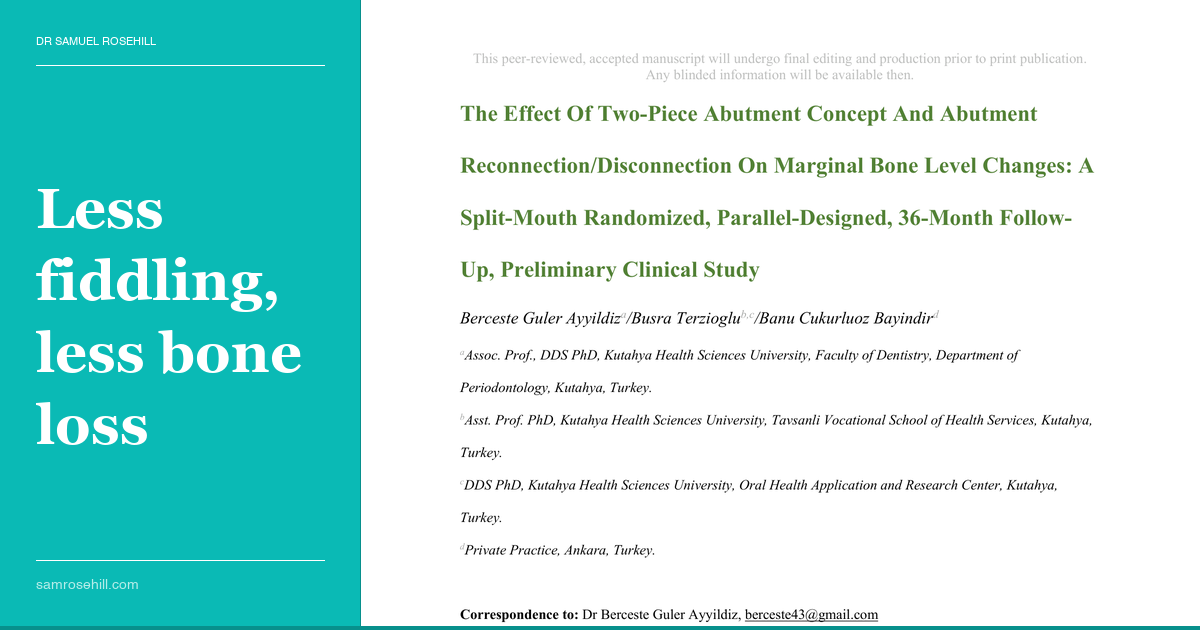
Source Paper
The Effect Of Two-Piece Abutment Concept And Abutment Reconnection/Disconnection On Marginal Bone Level Changes: A Split-Mouth Randomized, Parallel-Designed, 36-Month Follow-Up, Preliminary Clinical Study
There are few acts in implant dentistry more deceptively innocent than unscrewing an abutment, having a look, and putting it back again. It feels administrative, almost clerical. In The Effect Of Two-Piece Abutment Concept And Abutment Reconnection/Disconnection On Marginal Bone Level Changes: A Split-Mouth Randomized, Parallel-Designed, 36-Month Follow-Up, Preliminary Clinical Study, Berceste Guler Ayyildiz and colleagues make the mildly irritating point that the tissues may not share our view of this as routine paperwork. Their two-piece abutment protocol reduced marginal bone level changes at several important checkpoints.
That does not make every healing-abutment reconnection a tiny act of vandalism. It does suggest, however, that peri-implant tissues notice being disturbed, even when the operator regards it as a small and civilised part of prosthetic workflow.
The Data Anchor
This was a prospective, split-mouth, randomised, parallel-designed, blinded preliminary clinical trial involving 10 patients and 20 implants over a 36-month follow-up. The test group received a definitive two-piece abutment after submerged healing, while the control group followed a standard healing-abutment approach. Clinical and radiographic measurements were taken at baseline, 6 months, 12 months, and 36 months.
The radiographic focus was ΔMBL, measured on standardised periapical radiographs. The authors also tracked emergence angles and emergence profiles mesially and distally. That matters because this was not merely an aesthetic or prosthetic flirtation with a new component; it was an attempt to see whether reducing abutment disconnection and reconnection changed the biology around the implant collar in a measurable way.
Key Findings
- The two-piece protocol performed better early, and some of that advantage persisted. Significant differences were found in mesial, distal, and mean ΔMBL from T0 to T1, and in distal and mean ΔMBL from T0 to T3 (P < .05), favouring the two-piece abutment approach.
- The emergence profile story was reassuringly uneventful. Emergence angles stayed below 30 degrees mesially and distally in both groups, with no significant difference between them, which suggests the marginal bone signal was not simply an optical side-effect of a wildly different restorative contour.
- The disconnection ritual appears to matter. A statistically significant correlation was found between healing or definitive abutment disconnection and reconnection and distal ΔMBL at T0 to T3 (P < .05).
- This is a biologically plausible result, which is often the most dangerous kind because it sounds ready for policy. Disturb the peri-implant seal less often, and the tissues may behave a little better. Sensible enough. Also still preliminary.
- The limitation is impossible to ignore. This was a study of 10 patients and 20 implants, which is useful for sharpening suspicion but not yet for delivering commandments from a mountaintop.
💡 The Clinical Bottom Line
If your routine implant workflow involves repeated abutment swapping because it seems harmless, this paper suggests the bone may be keeping score more carefully than you are. A definitive two-piece abutment, placed early and then left alone, may be one way of reducing that disturbance.
But the sensible Monday-morning response is not evangelism. It is selectivity: take the signal seriously, remember the sample size, and resist turning a preliminary clinical study into a universal doctrine before the evidence earns it.
Dr Samuel Rosehill is a general dentist with a prosthodontic focus, practising at Ethical Dental in Coffs Harbour, NSW. He holds a BDSc (Hons) from the University of Queensland, an MBA, an MMktg, and an MClinDent in Fixed & Removable Prosthodontics (Distinction) from King’s College London.
Clinical Relevance
This paper supports the suspicion that repeated abutment disconnection and reconnection are not biologically neutral. In a carefully selected posterior single-implant case, a definitive two-piece abutment may help preserve marginal bone by reducing how often the peri-implant seal is disturbed.
Disclosure: The author has no financial conflicts of interest related to the products or topics discussed in this review. This is an independent summary prepared for educational purposes.
Continue the conversation
This review is also published on Substack, where you can leave comments and join the discussion.
Read on Substack →