Your Hygienist Might Be Scratching Your Crowns — and the Evidence Says It Matters
A systematic review of 42 laboratory studies reveals that ultrasonic scaling and air polishing damage dental restorations, with material-specific effects on surface roughness and marginal quality. Glycine and erythritol powders emerge as the least destructive options.
Choose your powder wisely
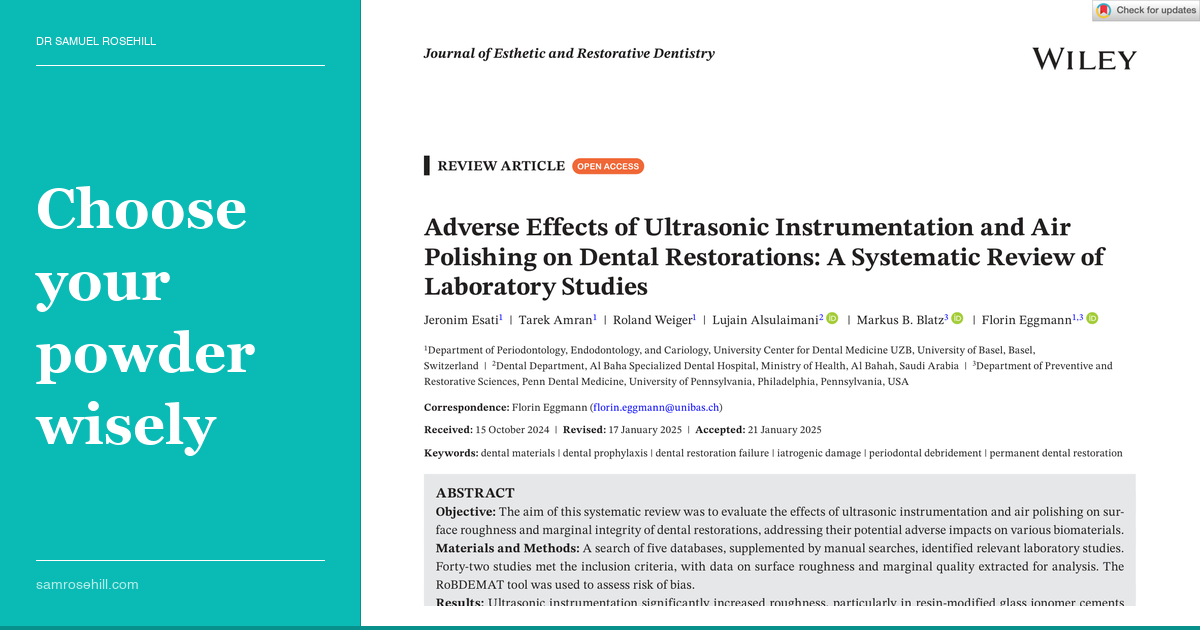
Source Paper
Adverse Effects of Ultrasonic Instrumentation and Air Polishing on Dental Restorations: A Systematic Review of Laboratory Studies
Everything we do to protect a restoration eventually involves doing something to it that might damage it. This is one of dentistry’s quieter ironies — the six-monthly scale and polish that keeps periodontal disease at bay is, according to a growing body of laboratory evidence, simultaneously roughening the surfaces and degrading the margins of the very restorations we placed to fix the problem in the first place.
Esati, Amran, Weiger, Alsulaimani, Blatz and Eggmann’s systematic review — Adverse Effects of Ultrasonic Instrumentation and Air Polishing on Dental Restorations (Journal of Esthetic and Restorative Dentistry, 2025) — compiles 42 in vitro studies spanning 1978 to 2022 and delivers a verdict that should give every clinician pause: routine prophylaxis causes measurable, material-specific harm to restorations, and the degree of that harm depends substantially on what you’re cleaning with.
The Data Anchor
The review searched five databases and assessed bias using the RoBDEMAT tool — a framework purpose-built for dental materials research. Of the 42 included studies, 37 examined surface roughness and nine evaluated marginal quality. The biomaterials investigated included porcelain-fused-to-metal, zirconia (ZrO₂), lithium disilicate (LDS), polymer-infiltrated ceramic (PICN), resin-modified glass ionomer cements (RMGICs), resin-based composites (RBCs), amalgam and gold alloy. Surface roughness was measured using the Ra parameter (average roughness in μm).
The headline finding: 31 of 37 studies found that ultrasonic instrumentation increased surface roughness across multiple restorative materials. RMGICs were the worst affected, with Ra values climbing to 2.52 μm — well above the clinically significant threshold of 0.2 μm at which biofilm accumulation accelerates. RBCs showed variable responses depending on filler type; nanohybrid composites held up reasonably well (Ra changes of 0.03–0.08 μm), while hybrid RBCs showed more pronounced roughening. High-strength ceramics — ZrO₂ and LDS — demonstrated the most resistance, maintaining Ra increases below 0.064 μm across all debridement methods.
Key Findings
- Ultrasonic scaling causes more surface damage than air polishing across virtually all tested biomaterials, with the effect particularly pronounced on RMGICs and amalgam (Ra increases up to 2.73 and 1.79 μm respectively)
- Sodium bicarbonate and calcium carbonate powders are the most abrasive air polishing agents, producing surface roughness comparable to — and sometimes exceeding — that caused by ultrasonic instrumentation
- Glycine and erythritol powders caused the least surface damage, making them the preferred choice for prophylaxis around restored teeth
- Both ultrasonic scaling and air polishing negatively impact marginal quality, with 7 of 9 studies reporting marginal defects — RMGIC and PFM restorations with narrow shoulder widths (0.7 mm) were most susceptible
- Rubber cup and paste polishing post-debridement partially mitigated roughening in four studies, though the evidence base remains thin
- Limitations: All 42 studies were in vitro, with considerable heterogeneity in study designs, debridement protocols and assessment methods — the leap to clinical practice requires caution
💡 The Clinical Bottom Line
The practical implication is straightforward: tailor your debridement method to the restoration. If you’re maintaining a patient with extensive RMGIC or composite work, reach for the glycine or erythritol powder rather than the sodium bicarbonate — the difference in surface damage is not trivial. And if your hygienist is routinely running an ultrasonic scaler across ceramic restorations without a second thought, this review suggests that second thought is worth having.
The broader point is subtler, and perhaps more important: we have spent decades optimising the placement of restorations and rather less time thinking about what happens to them during the fifteen or twenty years of maintenance that follow. The scale and polish is not damage-free. It never was.
If you’re placing RMGICs in patients who attend regularly for maintenance — and you should be asking yourself whether the maintenance protocol is slowly undoing the restoration — this review is worth printing out and leaving in the hygiene room.
Dr Samuel Rosehill is a general dentist with a prosthodontic focus, practising at Ethical Dental in Coffs Harbour, NSW. He holds a BDSc (Hons) from the University of Queensland, an MBA, an MMktg, and an MClinDent in Fixed & Removable Prosthodontics (Distinction) from King’s College London.
Reference: Esati J, Amran T, Weiger R, Alsulaimani L, Blatz MB, Eggmann F. Adverse Effects of Ultrasonic Instrumentation and Air Polishing on Dental Restorations: A Systematic Review of Laboratory Studies. Journal of Esthetic and Restorative Dentistry. 2025;37:1372–1383. https://doi.org/10.1111/jerd.13428
Clinical Relevance
Clinicians should consider biomaterial-specific debridement protocols — using glycine or erythritol powders rather than sodium bicarbonate, and being particularly cautious with ultrasonic scalers around RMGIC and composite restorations — to minimise iatrogenic damage during routine prophylaxis.
Disclosure: The author has no financial conflicts of interest related to the products or topics discussed in this review. This is an independent summary prepared for educational purposes.
Continue the conversation
This review is also published on Substack, where you can leave comments and join the discussion.
Read on Substack →