Stop Agonising Over the Etch: Surface Treatment for Glass Ionomer Sandwich Bases
A 2025 systematic review and meta-analysis by Ismail, Ali, and Garcia-Godoy finds that for fresh resin-modified glass ionomer treated before composite overlay, phosphoric acid and Er,Cr:YSGG laser produce statistically equivalent bond strengths — making one of restorative dentistry's more agonised technique decisions a non-variable.
Acid and laser: equivalent
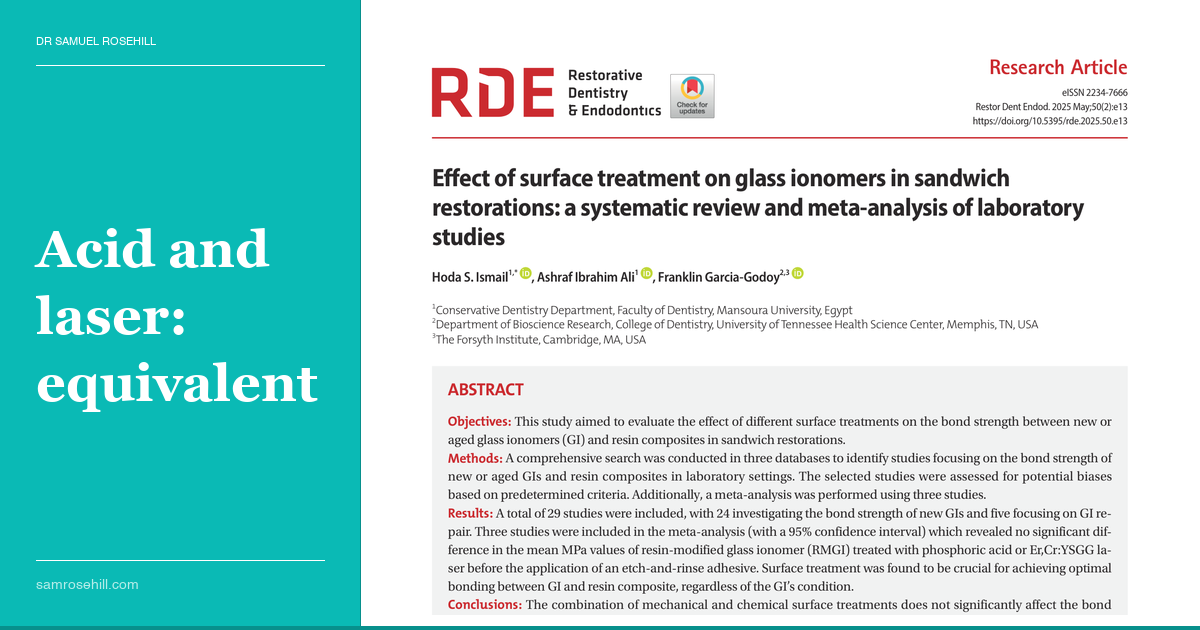
Source Paper
Effect of surface treatment on glass ionomers in sandwich restorations: a systematic review and meta-analysis of laboratory studies
Some clinical decisions consume disproportionate energy relative to their importance. Clinicians debate them at conferences, quietly second-guess their own protocol, spend more on a laser system than the evidence justifies. The surface treatment step before bonding composite over a glass ionomer base in a sandwich restoration is exactly this: phosphoric acid or an erbium, chromium:yttrium, scandium, gallium, garnet (Er,Cr:YSGG) laser?
A 2025 systematic review and meta-analysis in Restorative Dentistry and Endodontics supplies the answer: it does not matter. The paper, “Effect of surface treatment on glass ionomers in sandwich restorations: a systematic review and meta-analysis of laboratory studies” by Ismail, Ali, and Garcia-Godoy (Mansoura University and the University of Tennessee Health Science Center), reviewed 29 laboratory studies and found that for fresh resin-modified glass ionomer (RMGI) prepared with either method before an etch-and-rinse adhesive, bond strength to resin composite is statistically identical.
The Data Anchor
The review screened 11,007 articles across MEDLINE/PubMed, Scopus, and ScienceDirect, yielding 29 laboratory studies. The meta-analysis was narrow: only three studies met criteria for pooled analysis, all comparing shear bond strength (SBS) for Fuji II LC (GC Corporation) treated with either phosphoric acid or Er,Cr:YSGG laser before an etch-and-rinse adhesive, with n = 40 per arm.
Using a random-effects model (I² = 90.83%, p < 0.001), the overall mean difference was 1.555 MPa (95% CI –2.857 to 5.968, P = 0.490). The individual studies disagreed: Ghubaryi et al. favoured acid by 2.19 MPa; Navimipour et al. favoured laser by 5.37 MPa; Zakavi et al. favoured laser by 2.02 MPa. The pooled result lands in no-man’s-land.
The mechanistic explanation is neat. Er,Cr:YSGG laser (2780 nm, high hydroxyl group affinity) produces micro-irregularities and porosity in the RMGI surface. Phosphoric acid achieves a similar outcome by different chemistry. If the surface modification is functionally equivalent, the bond strength follows.
Key Findings
- No statistically significant difference between phosphoric acid and Er,Cr:YSGG laser for fresh RMGI before etch-and-rinse adhesive (mean difference 1.555 MPa, 95% CI –2.857 to 5.968, P = 0.490). Permission to stop optimising on this dimension is hereby granted.
- Surface treatment remains non-negotiable. Seven studies found significant differences between no treatment and chemically treated surfaces; the untreated option is not clinically neutral.
- RMGI outperforms conventional glass ionomer cement (GIC) regardless of surface treatment (seven studies confirm this); the advantage is intrinsic to RMGI’s polymerisable functional groups.
- For aged glass ionomer repair, the calculus changes. Mechanical roughening before adhesive application is supported; bur or silicon carbide sanding exposes unreacted glass particles and methacrylate monomers that a fresh surface provides naturally.
- Adhesive acidity matters more than adhesive category. Mild self-etch adhesives (pH ≥ 2) outperformed strong systems (pH < 1); stronger acids neutralise calcium cations and form weaker bonding structures.
- Limitation: Three studies, all using Fuji II LC, I² = 90.83%, and possible publication bias (Egger’s test P = 0.043). Generalisability beyond this specific protocol is unestablished.
Three studies that individually disagreed producing a pooled null result is not the same as three studies agreeing there is no difference.
💡 The Clinical Bottom Line
For the fresh RMGI base in your next sandwich restoration, the surface treatment decision between phosphoric acid and Er,Cr:YSGG laser has no evidence-based winner. Use what your practice has.
The choice that matters is to use surface treatment at all. For aged glass ionomer repairs, add mechanical roughening to the protocol; that is where the evidence for combined treatment genuinely sits.
Restorative dentistry’s investment in optimising the etch step may occasionally be energy spent on a variable that was never the one that mattered.
Dr Samuel Rosehill is a general dentist with a prosthodontic focus, practising at Ethical Dental in Coffs Harbour, NSW. He holds a BDSc (Hons) from the University of Queensland, an MBA, an MMktg, and an MClinDent in Fixed & Removable Prosthodontics (Distinction) from King’s College London.
Clinical Relevance
For clinicians using a fresh resin-modified glass ionomer (RMGI) base in a sandwich restoration and applying an etch-and-rinse adhesive, this meta-analysis of three studies finds no significant bond strength difference between phosphoric acid etching and Er,Cr:YSGG laser treatment (overall mean difference 1.555 MPa, 95% CI –2.857 to 5.968, P = 0.490). Surface treatment of any kind remains necessary; the specific choice between these two methods, at least for this scenario, does not appear to matter.
Disclosure: The author has no financial conflicts of interest related to the products or topics discussed in this review. This is an independent summary prepared for educational purposes.
Continue the conversation
This review is also published on Substack, where you can leave comments and join the discussion.
Read on Substack →