Wide Implants, Minimal Fuss.
Antoun and colleagues followed 53 six-millimetre wide-diameter implants placed in healed molar sites and immediately provisionally restored out of occlusion, finding only two failures over a mean 6.3 years and average marginal bone loss of 0.89 mm.
Wide implants hold steady
Source Paper
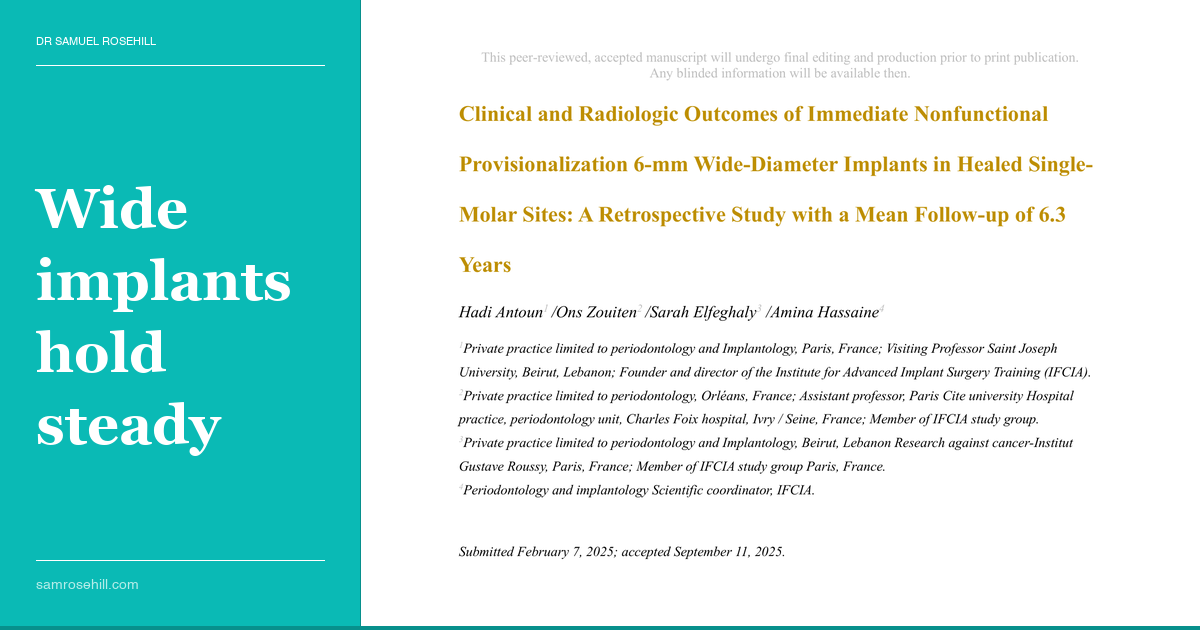
Clinical and Radiologic Outcomes of Immediate Nonfunctional Provisionalization 6-mm Wide-Diameter Implants in Healed Single-Molar Sites: A Retrospective Study with a Mean Follow-up of 6.3 Years
Sometimes the allegedly bold move is the one with less theatrical risk. In Clinical and Radiologic Outcomes of Immediate Nonfunctional Provisionalization 6-mm Wide-Diameter Implants in Healed Single-Molar Sites: A Retrospective Study with a Mean Follow-up of 6.3 Years, Hadi Antoun and colleagues report something rather calming: immediate nonfunctional provisionalisation of 6 mm wide-diameter implants in healed molar sites produced only two failures among 53 implants, with mean marginal bone loss of 0.89 mm over about six years.
Posterior implant papers are often crowded with caveats, which is fair enough because molar occlusion has never been known for gentleness. But this one is interesting because it is not about immediate placement in a dramatic socket or some heroic rescue case. These were healed sites, carefully selected, provisionally restored within 48 hours, and kept out of functional occlusion. In other words, the protocol is quick, but not reckless. That distinction matters.
The Data Anchor
This was a retrospective case series of 48 patients who received 53 NobelSpeedy Groovy WP implants, each 6 mm in diameter and 7 to 13 mm long. The provisional restorations were cement-retained acrylic crowns placed within 48 hours, with all static and dynamic occlusal contacts removed; definitive porcelain-fused-to-metal crowns followed at 3 to 6 months. Mean follow-up was 76.67 ± 34.86 months, or roughly 6.3 years, with the range extending to 10.5 years.
Most implants were placed in the mandible (67.3%), and flap surgery was slightly more common than flapless placement (56.5%). Two implants failed (3.77%): one at 45 days from osseointegration failure, the other at 7.1 years in a heavy smoker with poor oral hygiene who developed peri-implantitis. Mean marginal bone level shifted from -0.02 mm at baseline to -1.10 mm at final review, producing an average bone loss of 0.89 mm. For a posterior implant cohort carrying provisional crowns almost immediately, that is not a shabby performance.
Key Findings
- The main reassurance is simple: the protocol held up. Fifty-one of 53 implants remained in service over a mean 6.3 years, which is strong mid-term performance for healed posterior sites.
- Bone behaved reasonably well. Average marginal bone loss was 0.89 mm, a figure that sits comfortably inside the range most clinicians would regard as clinically acceptable for this kind of case.
- The shortcut worked because it was a disciplined shortcut. These were healed sites with at least 7 mm crest width, immediate provisional acrylic crowns delivered within 48 hours, and no functional occlusal contact during the provisional phase.
- This is encouraging, not permission to become casual. The study was retrospective, there was no delayed-loading comparator, and one late failure came in the exact sort of patient who makes every implant maintenance lecture suddenly feel personal: a heavy smoker with poor hygiene.
💡 The Clinical Bottom Line
If you have a healed molar site with decent width, strong primary stability, and the patience to keep the provisional genuinely nonfunctional, this paper supports immediate provisionalisation with a 6 mm wide-diameter implant as a credible option. What it does not support is swagger. Wide implants appear capable of carrying speed quite nicely, provided the operator remembers that haste in implant dentistry is only impressive when it is wearing a seatbelt.
Dr Samuel Rosehill is a general dentist with a prosthodontic focus, practising at Ethical Dental in Coffs Harbour, NSW. He holds a BDSc (Hons) from the University of Queensland, an MBA, an MMktg, and an MClinDent in Fixed & Removable Prosthodontics (Distinction) from King’s College London.
Clinical Relevance
In healed posterior sites with adequate width and strong primary stability, immediate nonfunctional provisionalisation of a 6 mm wide implant appears defensible rather than reckless. The paper supports careful case selection and occlusal discipline, not a blanket licence to accelerate every molar implant case.
Disclosure: The author has no financial conflicts of interest related to the products or topics discussed in this review. This is an independent summary prepared for educational purposes.
Continue the conversation
This review is also published on Substack, where you can leave comments and join the discussion.
Read on Substack →