Same Retention, Safer Substrate: The Case for NAC on Zirconia RBFDPs
An 8-year randomised controlled trial from the University of Ljubljana finds that nanostructured alumina coating (NAC) and airborne-particle abrasion (APA) produce statistically identical retention rates for cantilevered zirconia resin-bonded fixed dental prostheses — 88.4% vs 89.1% — with NAC offering a non-damaging alternative for increasingly translucent zirconia materials.
Same retention, safer surface
Source Paper
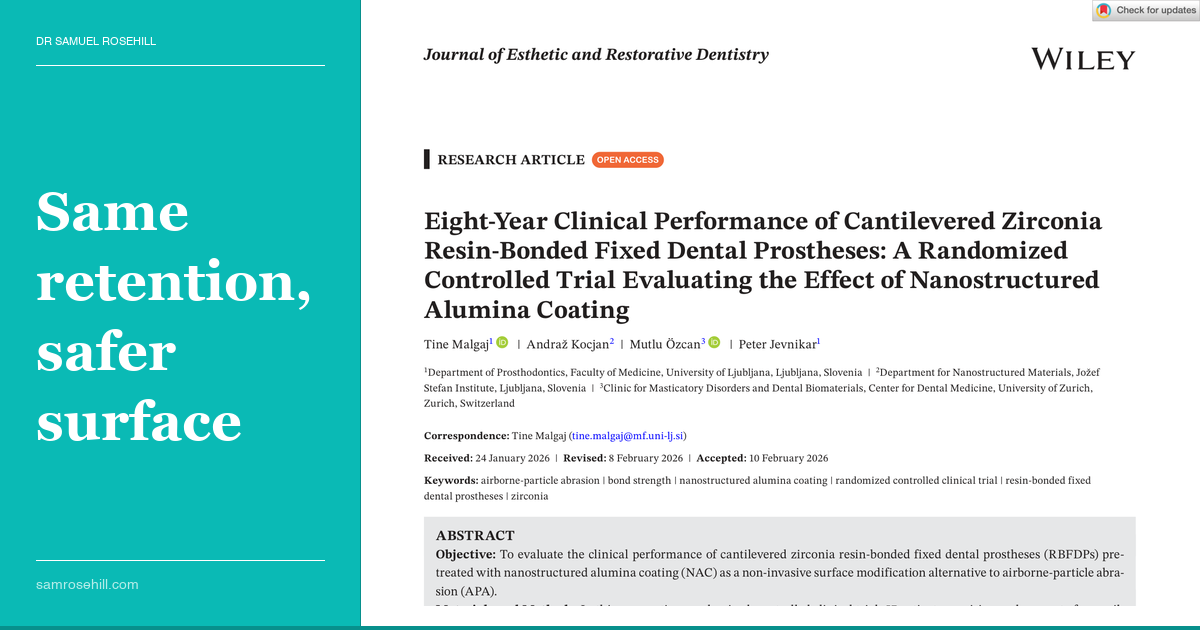
Eight-Year Clinical Performance of Cantilevered Zirconia Resin-Bonded Fixed Dental Prostheses: A Randomized Controlled Trial Evaluating the Effect of Nanostructured Alumina Coating
“Just sandblast it and bond,” said the technician, with the confidence of someone who has never seen a scanning electron microscopy (SEM) image of what 50-µm alumina at 0.1 MPa does to the surface underneath. Eight-Year Clinical Performance of Cantilevered Zirconia Resin-Bonded Fixed Dental Prostheses: A Randomized Controlled Trial Evaluating the Effect of Nanostructured Alumina Coating begins, essentially, from that gap. Airborne-particle abrasion (APA) works. It has always worked. The problem is that it works partly by damaging the surface it is trying to help, and the zirconia now milled for anterior aesthetic work is increasingly the kind that minds being damaged.
Malgaj, Kocjan, Özcan and Jevnikar, working across Ljubljana and Zurich, asked whether nanostructured alumina coating (NAC) could match APA’s retention without the substrate cost. NAC is additive: it deposits a nanolamellar layer that increases the bonding area up to sevenfold while leaving zirconia structure intact. After eight years and 64 resin-bonded fixed dental prostheses (RBFDPs), the answer is yes.
The Data Anchor
This was a prospective, randomised, double-blind, controlled trial (CONSORT-compliant) at the Department of Prosthodontics, University of Ljubljana. Fifty-seven patients (mean age 27.2 ± 16 years) received 64 cantilevered zirconia RBFDPs for missing maxillary or mandibular incisors, allocated to APA (n = 32) or NAC (n = 32), with six enrolled under a split-mouth design.
Frameworks were milled from 3 mol% yttria-stabilised tetragonal zirconia polycrystal (3Y-TZP; Ceramill Zolid, Amann Girrbach) and veneered with feldspathic porcelain (VITAVM9). APA surfaces received 50-µm alumina at 0.1 MPa; NAC surfaces were calcination-fired with VALLBOND precursor (Vall-cer, Ljubljana) at 900°C for 30 minutes before veneering. Bonding used Panavia 21 TC (with the adhesive monomer methacryloyloxydecyl dihydrogen phosphate, or MDP, Kuraray) under rubber dam. The primary outcome was retention, over a mean of 61.4 ± 22.1 months (range 8.3–97.4 months) with zero drop-out.
Key Findings
- Retention rates were statistically identical: NAC 88.4%, APA 89.1% at up to 8 years (log-rank p = 0.99). The null hypothesis of no significant difference was accepted.
- Survival was 100% for both groups. All six debondings were rebonded successfully; no restorations were lost.
- Six debondings total (three per group), mostly within the first three years; three involved traumatic impacts and the rest point to procedural handling, not material failure.
- Pontic position mattered, though not significantly (p = 0.18): mandibular incisors 100% retention; maxillary lateral incisors 88.8%; maxillary central incisors 79%, consistent with higher occlusal and traumatic loading.
- SEM revealed different failure modes: APA failures showed cement delamination from zirconia; NAC failures were adhesive at the NAC–zirconia interface, identifying that bond as the system’s weak link.
- No framework fractures occurred in either group (both used 3Y-TZP). Higher-yttria translucent zirconia types (4Y, 5Y), where APA-induced flaws matter most, remain largely untested in clinical RBFDP studies.
- Limitation: Single-centre, single-operator; maximum follow-up 8 years. Cohorts using translucent zirconia specifically are needed before NAC’s structural advantage can be fully characterised.
The coating delamination in NAC failures is reassuring rather than alarming: the damage is at the adhesive interface, not within the substrate. That is precisely the reversal of what clinicians should fear when APA is applied to damage-prone translucent materials.
💡 The Clinical Bottom Line
For cantilevered zirconia RBFDPs, NAC is now a clinically validated alternative to APA: not because it bonds better, but because it bonds just as well without asking the zirconia to pay a structural price.
The real calculus is about materials, not technique. With conventional 3Y-TZP, either method is defensible. With the higher-yttria materials increasingly specified for anterior aesthetics, APA’s capacity to introduce surface flaws becomes a genuine concern; NAC sidesteps it entirely. The technician’s instinct to sandblast everything is understandable. The zirconia has changed, though, and the habit has not yet caught up.
Dr Samuel Rosehill is a general dentist with a prosthodontic focus, practising at Ethical Dental in Coffs Harbour, NSW. He holds a BDSc (Hons) from the University of Queensland, an MBA, an MMktg, and an MClinDent in Fixed & Removable Prosthodontics (Distinction) from King’s College London.
Clinical Relevance
NAC-pretreated zirconia RBFDPs achieve mid- to long-term retention comparable to conventional airborne-particle abrasion (88.4% vs 89.1% at up to 8 years, p = 0.99) while avoiding the surface flaws and strength degradation that APA introduces — a particular concern with newer translucent, higher-yttria zirconia formulations. For anterior single-tooth replacements where aesthetics and substrate integrity matter, NAC is now a clinically validated alternative. Mandibular incisors showed 100% retention; maxillary central incisors showed the lowest retention at 79%, consistent with their greater exposure to traumatic and occlusal forces.
Disclosure: The author has no financial conflicts of interest related to the products or topics discussed in this review. This is an independent summary prepared for educational purposes.
Continue the conversation
This review is also published on Substack, where you can leave comments and join the discussion.
Read on Substack →