The Goldilocks Zone for Surgical Guide Sleeves
A new in vitro study from Sichuan University finds that 3D print offset settings for surgical guide sleeves have a dramatic effect on implant placement accuracy — and the margin between too tight and too loose is just 0.04 mm.
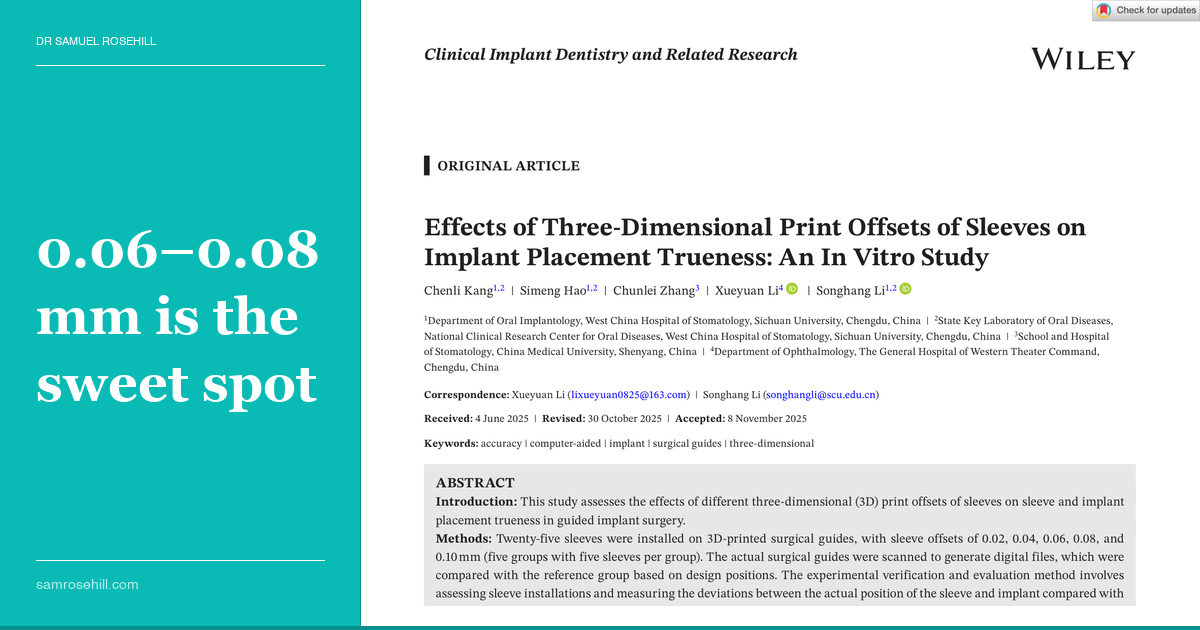
0.06–0.08 mm is the sweet spot
Source Paper
Effects of Three-Dimensional Print Offsets of Sleeves on Implant Placement Trueness: An In Vitro Study
The difference between a perfectly placed implant and one that makes you wince on the post-op X-ray can come down to a parameter you may never have personally set: the print offset of the sleeve hole in your surgical guide. It is a number measured in hundredths of a millimetre, buried in the 3D printer’s software settings, and it turns out to be doing considerably more heavy lifting than most clinicians realise. Kang and colleagues from West China Hospital of Stomatology, in “Effects of Three-Dimensional Print Offsets of Sleeves on Implant Placement Trueness: An In Vitro Study” (Clinical Implant Dentistry and Related Research, 2025), have systematically tested five offset values and found that the window between cracking the sleeve and losing positional accuracy is startlingly narrow.
The Data Anchor
Twenty-five ITI metal-flanged T-sleeves (Institut Straumann AG, Basel, Switzerland) were installed on 3D-printed surgical guides fabricated on an UltraCraft ChairSide Pro printer (HeyGears, Guangzhou, China) using the manufacturer’s Surgical Guide UV photopolymerising resin, with print offsets of 0.02, 0.04, 0.06, 0.08, and 0.10 mm (five per group). The guides were designed in 3Shape Implant Studio based on a patient’s CBCT and intraoral scan data, with Straumann BL implants (Ø3.3 × 10 mm, CrossFit connection) virtually placed 2 mm below each sleeve using Materialise Magics 24.0. After sleeve installation, guides were scanned and the resulting digital files superimposed on the original design using best-fit alignment in Exocad. Deviations were measured at both the sleeve level and the implant level across labial–palatal and mesial–distal directions.
Key Findings
- Too tight is genuinely destructive. The 0.02 mm offset group produced visible cracks in the sleeves during installation; the 0.04 mm group also caused installation difficulties with forced seating and misalignment.
- Too loose amplifies error at the implant tip. The 0.10 mm offset group showed significantly larger implant deviations: 0.453 ± 0.165 mm labially and 0.399 ± 0.160 mm palatally (P < 0.05 vs other groups). That is nearly half a millimetre of drift from a single parameter change.
- The sweet spot sits at 0.06–0.08 mm. Both groups allowed smooth sleeve installation with minimal positional deviation. The 0.08 mm group showed the smallest labial–palatal deviations at the sleeve level.
- Mesial–distal deviations were unaffected across all offset groups, suggesting the sleeve’s cylindrical geometry constrains error primarily in the bucco-palatal plane.
- Caveat: This is an in vitro study using a single printer, single resin, and single sleeve system. Different printer–resin–sleeve combinations may shift the optimal range, and clinical variables (saliva, soft tissue, patient movement) were not modelled.
If your lab is using default printer offset settings without specific calibration, the accuracy you planned digitally may not be the accuracy you deliver surgically.
💡 The Clinical Bottom Line
For clinicians and technicians using 3D-printed surgical guides with metal sleeves, this study offers a concrete, testable recommendation: set your print offset between 0.06 and 0.08 mm, and verify sleeve fit before surgery. The Goldilocks zone is real, and it is only 0.04 mm wide. In a workflow where we routinely celebrate sub-millimetre accuracy in digital planning, it seems worth spending thirty seconds on the parameter that determines whether that accuracy survives the journey from screen to surgery.
Dr Samuel Rosehill is a general dentist with a prosthodontic focus, practising at Ethical Dental in Coffs Harbour, NSW. He holds a BDSc (Hons) from the University of Queensland, an MBA, an MMktg, and an MClinDent in Fixed & Removable Prosthodontics (Distinction) from King’s College London.
Reference: Kang C, Hao S, Zhang C, Li X, Li S. Effects of three-dimensional print offsets of sleeves on implant placement trueness: An in vitro study. Clin Implant Dent Relat Res. 2025;27:e70101. doi: 10.1111/cid.70101
Clinical Relevance
Guides lab technicians and clinicians to set 3D print sleeve offsets between 0.06 and 0.08 mm for optimal implant placement accuracy
Disclosure: The author has no financial conflicts of interest related to the products or topics discussed in this review. This is an independent summary prepared for educational purposes.
Continue the conversation
This review is also published on Substack, where you can leave comments and join the discussion.
Read on Substack →