Your Surgical Guide's Accuracy Depends on Which Way It Faced the Printer
Salih et al. show that vertical (90°) build orientation produces DLP-printed implant surgical guides with 40–110 µm less deviation than horizontal (0°), and the molar region is the biggest offender — an in vitro study with real workflow implications.
Print vertical, gain 40–110 µm
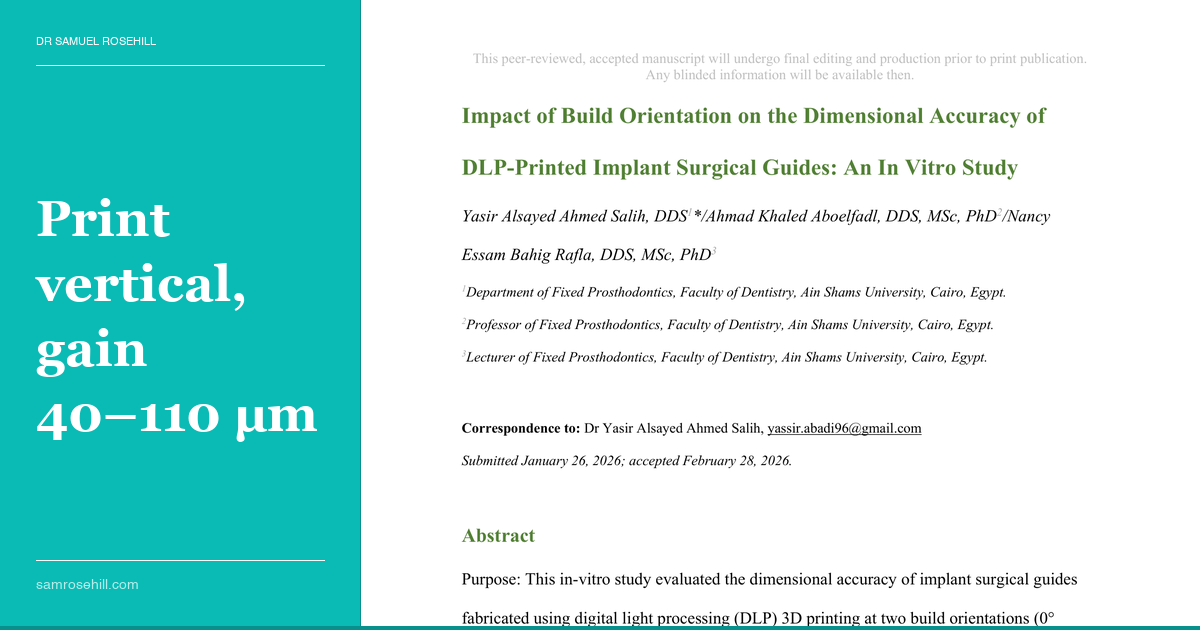
Source Paper
Impact of Build Orientation on the Dimensional Accuracy of DLP-Printed Implant Surgical Guides: An In Vitro Study
You have spent forty minutes on the digital plan — stitching CBCT to intraoral scan, adjusting the implant trajectory by fractions of a degree, nudging the sleeve until the angulation is precisely where you want it — and then you hit “export STL” and hand the file to a printer whose orientation settings you have never once questioned. It is, when you think about it, the dental equivalent of obsessing over the recipe and then letting someone else choose the oven temperature.
Salih, Aboelfadl and Rafla’s Impact of Build Orientation on the Dimensional Accuracy of DLP-Printed Implant Surgical Guides (International Journal of Oral and Maxillofacial Implants, 2026) is here to tell you that the oven temperature matters — and that vertical build orientation (90°) consistently outperforms horizontal (0°) by a clinically meaningful margin.
The Data Anchor
A single Nissin typodont was configured with edentulous spaces at the maxillary central incisor, canine, and first molar. Guides were planned in 3Shape Implant Studio and printed on a DLP Microdent 1pro using NextDent SG resin at 50 µm layer thickness (n = 7 per subgroup; total n = 42). One week after printing, all guides were scanned with a 3Shape D850 and superimposed onto the original design files using Geomagic Control X, with accuracy quantified as root mean square (RMS) deviation in micrometres.
Horizontal orientation produced mean RMS deviations of 203.57 ± 4.54 µm (central incisor), 143.71 ± 5.19 µm (canine), and 184.00 ± 5.60 µm (molar).
Vertical orientation brought those figures down to 93.71 ± 3.25 µm, 102.86 ± 4.91 µm, and 126.43 ± 4.96 µm respectively — a reduction of 40–110 µm across every region (p < 0.001 for the molar). The molar region, with its bulkier geometry, exhibited the greatest deviations regardless of orientation; a 40–50% elevation over anterior sites attributed to greater polymerisation shrinkage and structural complexity.
If you are printing guides in-house and defaulting to horizontal orientation because it is faster, you are trading 40–110 µm of accuracy for convenience — and in the cumulative error chain of guided surgery, that is a trade worth reconsidering.
Key Findings
- Vertical (90°) build orientation reduced RMS deviation by 40–110 µm compared with horizontal (0°) across all three anatomical regions — a 30–50% improvement in dimensional fidelity.
- Both orientations remained within the clinically acceptable threshold of 250 µm, but vertical orientation placed guides in the 93–126 µm range versus 143–204 µm for horizontal.
- The molar region was the worst performer regardless of orientation, with deviations 40–50% higher than anterior sites — geometric complexity and greater peeling forces are the likely culprits.
- Vertical orientation demonstrated superior reproducibility, with no significant inter-region variability (p > 0.05), reducing the risk of outlier guides.
- Caveat: This was an in vitro study on acrylic typodonts using a single DLP printer (Microdent 1pro) and one resin (NextDent SG). Clinical validation — soft tissue, saliva, patient variability — remains outstanding. Only two orientations (0° and 90°) were tested; intermediate angles may yet prove optimal.
💡 The Clinical Bottom Line
The next time you slice a surgical guide STL, rotate it to 90°. It takes five seconds, costs nothing, and — based on these data — buys you a meaningful accuracy buffer in a workflow where every micrometre of cumulative error compounds by the time the implant reaches bone. For anterior aesthetic cases and multi-implant plans, vertical orientation is not a preference; it is a protocol upgrade. And for molar sites, where geometry already conspires against you, it is the minimum you can do to keep the printer honest.
Dr Samuel Rosehill is a general dentist with a prosthodontic focus, practising at Ethical Dental in Coffs Harbour, NSW. He holds a BDSc (Hons) from the University of Queensland, an MBA, an MMktg, and an MClinDent in Fixed & Removable Prosthodontics (Distinction) from King’s College London.
Reference: Salih YAA, Aboelfadl AK, Rafla NEB. Impact of build orientation on the dimensional accuracy of DLP-printed implant surgical guides: an in vitro study. Int J Oral Maxillofac Implants. 2026;41:xxx–xxx. https://doi.org/10.11607/jomi.11747
Clinical Relevance
When fabricating DLP-printed surgical guides, specify vertical (90°) build orientation to your lab or in-house workflow. This is particularly important for anterior aesthetic cases, multi-implant plans, and molar sites where geometric complexity already inflates deviation. Both orientations remain clinically acceptable, but vertical printing buys you a meaningful 40–110 µm accuracy margin.
Disclosure: The author has no financial conflicts of interest related to the products or topics discussed in this review. This is an independent summary prepared for educational purposes.
Continue the conversation
This review is also published on Substack, where you can leave comments and join the discussion.
Read on Substack →