The Quiet Problem Nobody Measures: Denture-Tooth Wear and the 3D-Printing Wild Card
An in vitro chewing simulator study from Prince of Songkla University finds that 3D-printed methacrylate-based resin denture teeth wear significantly less than prefabricated or milled acrylic alternatives under 120,000 simulated chewing cycles — but the single unfilled resin tested and the absence of thermocycling limit how far these results generalise.
Printed teeth wear better
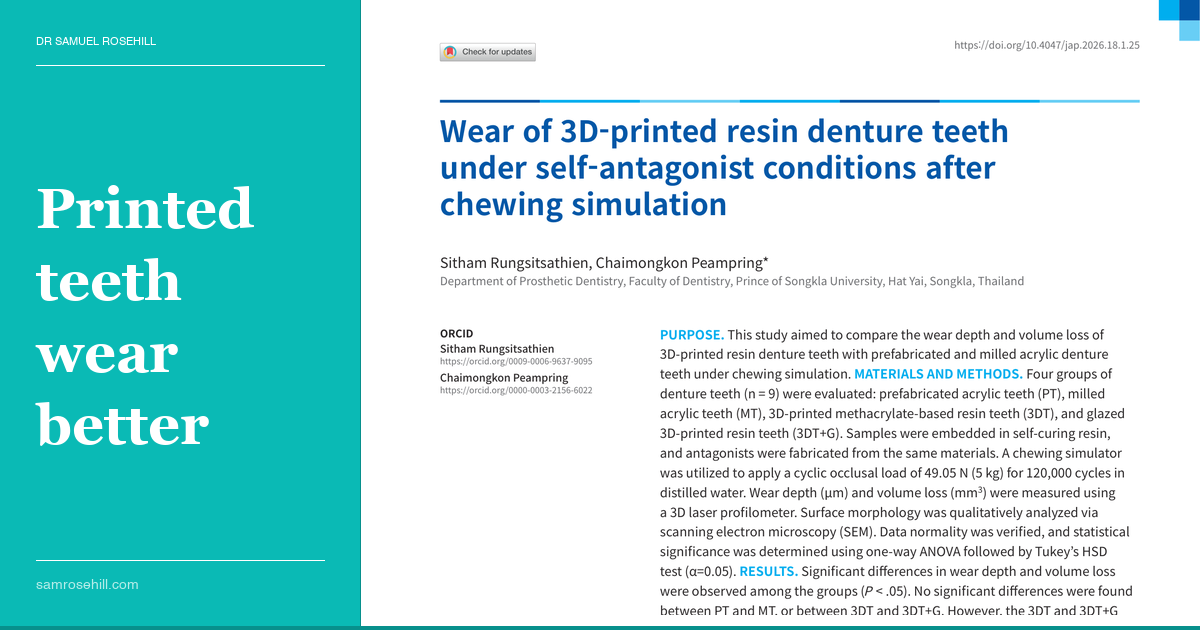
Source Paper
Wear of 3D-printed resin denture teeth under self-antagonist conditions after chewing simulation
Wear of 3D-printed resin denture teeth under self-antagonist conditions after chewing simulation, by Sitham Rungsitsathien and Chaimongkon Peampring from Prince of Songkla University, Thailand, addresses a clinical problem that announces itself in the patient’s language before it appears in anyone’s records. They return not six weeks after delivery but eighteen months later, saying the bite “feels different,” that food no longer cuts cleanly. The occlusal vertical dimension (OVD) may have collapsed by two millimetres with no entry in the notes.
The standard denture-tooth material has been prefabricated polymethyl methacrylate (PMMA): pressed, cross-linked, adequate. Milled acrylic offers a digital route to the same destination. The question is whether 3D-printed resin teeth change the wear story or merely reroute it.
The Data Anchor
The experiment ran a chewing simulator at 120,000 cycles, 49.05 N (5 kg), through distilled water — equated by convention to approximately six months of functional chewing. That mapping is a standard simulator assumption rather than proven clinical equivalence; thermal cycling, saliva, food particles, and parafunction go unrepresented in a laboratory water bath. Thermocycling was not performed (an equipment limitation), which the authors acknowledge bears particularly on the glazed-specimen results.
Four groups of nine specimens used a self-antagonist design: prefabricated acrylic teeth (PT; MajorDent, Major Prodotti Dentari), milled acrylic teeth (MT; Vipiblock, Vipi Ltd.), 3D-printed resin teeth (3DT; Optiprint Temp, DENTONA GmbH), and glazed 3D-printed teeth (3DT+G; 50 µm Vita Akzent LC Glaze). Printing used digital light processing (DLP) at 50 µm layer thickness with nitrogen-gas post-cure. Wear depth and volume loss were quantified by 3D laser profilometry; surface morphology assessed via scanning electron microscopy (SEM). Statistics used one-way analysis of variance (ANOVA) with Tukey’s honest significant difference test.
Only one resin was evaluated: Optiprint Temp, an unfilled, high-flow methacrylate formulation. Composite-reinforced printable resins behave differently and were not included; results do not generalise to the wider printable-resin market.
Key Findings
- The 3D-printed groups wore dramatically less. Mean wear depth: PT 0.197 mm, MT 0.235 mm, 3DT 0.070 mm, 3DT+G 0.081 mm. Volume loss: PT 0.259 mm³, MT 0.210 mm³, 3DT 0.082 mm³, 3DT+G 0.093 mm³. Both 3D-printed groups differed significantly from both acrylic groups (P < .05).
- Prefabricated and milled acrylic performed comparably — no significant difference between PT and MT on either metric, though MT showed greater variability, consistent with milling micro-surface irregularities.
- Glazing added nothing to wear resistance. 3DT and 3DT+G did not differ significantly; SEM showed the 50 µm glaze depleting early in the simulation. The authors note glazing may still reduce Candida albicans colonisation; it is not a wear shield.
- SEM revealed micro-cracks and layer delamination in the 3DT specimens, artefacts of layer-by-layer printing. The surface instability is real; it did not translate into greater mass loss under these conditions.
- Missing: thermocycling. The absence of thermal ageing is a declared limitation and may understate delamination risk for the glazed group under real intraoral temperature fluctuations.
💡 The Clinical Bottom Line
Every clinical implication here should wear its in vitro label. The “six-month” figure is a convention; the 3D-printed teeth wore to roughly a third of the depth of prefabricated acrylic under identical loading. If that advantage partially survives into clinical reality, the conversation about long-term OVD maintenance in complete denture wearers shifts meaningfully.
For dentists considering 3D-printed complete dentures in patients where OVD stability matters, the wear data points in the right direction without yet constituting a recommendation. The next necessary step is a prospective trial with measured OVD at scheduled review. Until then, it is worth knowing which direction the in vitro arrow points.
Dr Samuel Rosehill is a general dentist with a prosthodontic focus, practising at Ethical Dental in Coffs Harbour, NSW. He holds a BDSc (Hons) from the University of Queensland, an MBA, an MMktg, and an MClinDent in Fixed & Removable Prosthodontics (Distinction) from King’s College London.
Clinical Relevance
3D-printed methacrylate-based resin denture teeth (Optiprint Temp) produced significantly lower wear depth (0.070 mm) and volume loss (0.082 mm³) than prefabricated (0.197 mm depth, 0.259 mm³ loss) or milled acrylic teeth after 120,000 simulated chewing cycles. Milled and prefabricated acrylic wore comparably. A 50 µm surface glaze added no measurable wear benefit. These are in vitro findings from one unfilled 3D-printing resin; clinical durability in full-denture scenarios remains to be established by longitudinal study.
Disclosure: The author has no financial conflicts of interest related to the products or topics discussed in this review. This is an independent summary prepared for educational purposes.
Continue the conversation
This review is also published on Substack, where you can leave comments and join the discussion.
Read on Substack →