Asking the Wrong Question About Occlusal Splints
An in-vitro study from Ohio State University shows that the material opposing an occlusal splint, enamel, lithium disilicate, or zirconia, determines how fast the splint wears down, eclipsing the effect of whether the splint was milled, printed, or heat-polymerised.
Antagonist drives splint wear
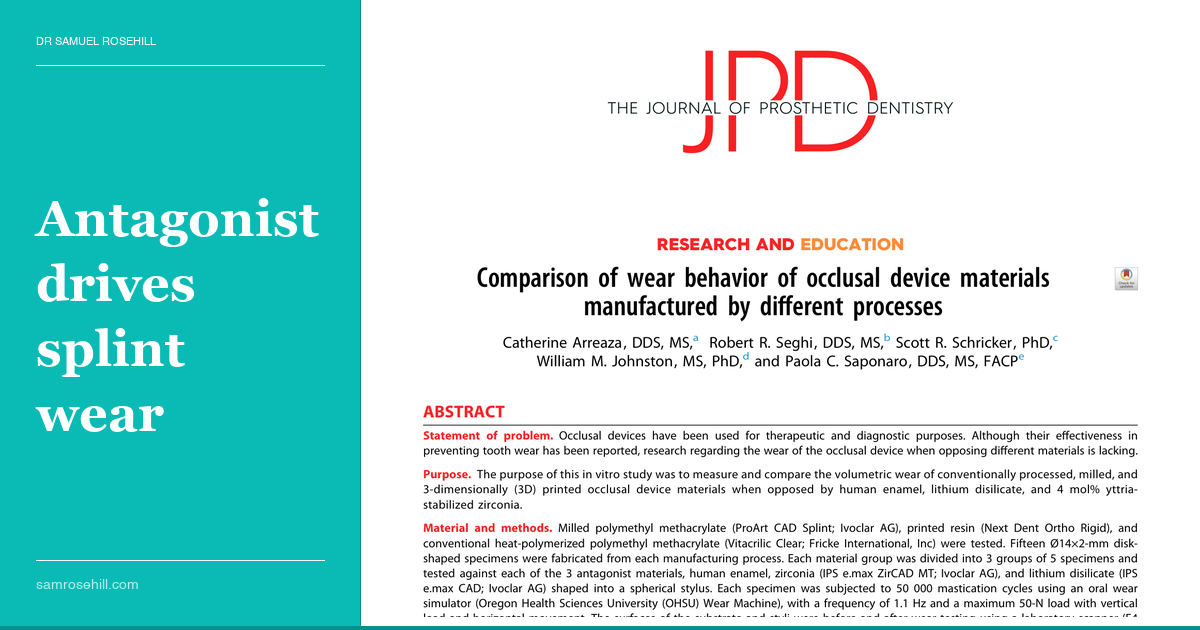
Source Paper
Comparison of wear behavior of occlusal device materials manufactured by different processes
Dentistry has a recurring habit of asking material questions about the named object when the more decisive variable is the system around it. The question the occlusal splint literature has patiently asked is: which splint material wears best? Milled PMMA, printed resin, or heat-polymerised? It is a reasonable question, and according to a controlled in-vitro study from Ohio State University, possibly the wrong one. “Comparison of wear behavior of occlusal device materials manufactured by different processes,” by Arreaza, Seghi, Schricker, Johnston, and Saponaro, asked instead what the splints were worn against. The answer reframes the conversation: the antagonist (enamel, lithium disilicate, zirconia) is the dominant variable, while the splint material is not.
The Data Anchor
The study tested three splint materials, milled PMMA (ProArt CAD Splint, Ivoclar AG), 3D-printed resin (NextDent Ortho Rigid), and heat-polymerised PMMA (Vitacrilic Clear, Fricke International), against three antagonists: human enamel, IPS e.max ZirCAD MT zirconia, and IPS e.max CAD lithium disilicate. Fifteen Ø14×2 mm discs were fabricated per material, then split into five-specimen subgroups for each antagonist (nine subgroups in total). The OHSU oral wear simulator delivered 50,000 mastication cycles at 1.1 Hz under a 50 N load, equivalent to roughly six to twelve months of clinical function. Volumetric wear was measured before and after using a 3Shape E4 scanner and WearCompare software. A 2-way ANOVA with Tukey-Kramer HSD post hoc testing was applied at α = .025. Antagonist material significantly influenced splint wear (P < .001); splint material did not reach the adjusted threshold (P = .029); the interaction term was non-significant (P = .42).
Key Findings
- Antagonist was the dominant variable in both substrate and antagonist wear analyses. Manufacturing method and chemistry of the splint itself did not.
- Human enamel caused the most splint wear, significantly more than lithium disilicate antagonists (P < .01). The abrasive surface mechanics of enamel matter more than its hardness ranking alone.
- Printed resin showed the least splint wear overall. Despite a lower degree of monomer conversion (~58%) than heat-polymerised PMMA (~95%), NextDent Ortho Rigid lost the least volume. The authors attribute this to crosslinking chemistry rather than conversion degree.
- Lithium disilicate suffered the most damage as an antagonist, losing significantly more volume than enamel (P < .001) and zirconia (P < .001). Lower fracture toughness and crack propagation under cyclic loading explain the result.
- Zirconia and enamel were statistically equivalent as antagonists (P = .993). Zirconia, despite its surface hardness, is not the aggressive antagonist it is sometimes assumed to be in splint wear contexts.
- Limitation: the OHSU simulator is well-validated but cannot reproduce parafunctional variability, saliva composition, or restoration surface finish.
The more provocative implication of these data belongs not to the splint but to the restoration it opposes. Lithium disilicate sustaining more antagonist wear than enamel or zirconia is a finding that bears on treatment planning long before a splint is ever considered.
💡 The Clinical Bottom Line
The selection question this paper challenges is “which splint material should I choose?” The data suggest a prior question is more consequential: what is the splint going to wear against? In patients with lithium disilicate restorations, printed resin splints (such as NextDent Ortho Rigid) appear to be the most wear-resistant option and represent a sensible default choice. The finding that lithium disilicate sustains the most antagonist wear is also worth holding in mind when selecting restorative materials for confirmed bruxers. Restorative dentistry keeps discovering that the named material performs differently depending on what surrounds it. Wear is not a property of a material; it is a property of a system.
Dr Samuel Rosehill is a general dentist with a prosthodontic focus, practising at Ethical Dental in Coffs Harbour, NSW. He holds a BDSc (Hons) from the University of Queensland, an MBA, an MMktg, and an MClinDent in Fixed & Removable Prosthodontics (Distinction) from King’s College London.
Clinical Relevance
In patients wearing occlusal splints, the antagonist material (enamel, lithium disilicate, or zirconia) is a stronger predictor of splint volumetric wear than the splint manufacturing method. Printed resin (NextDent Ortho Rigid) showed the least wear of the three splint materials tested. Lithium disilicate suffered the most volumetric loss among antagonists, driven by its lower fracture toughness relative to zirconia. When treatment planning bruxing patients with existing ceramic restorations, the wear ecology of the whole system deserves consideration, not just the splint material alone.
Disclosure: The author has no financial conflicts of interest related to the products or topics discussed in this review. This is an independent summary prepared for educational purposes.
Continue the conversation
This review is also published on Substack, where you can leave comments and join the discussion.
Read on Substack →