Stackable Guides: The Gap Between Conference Hype and Clinical Evidence
A scoping review of stackable surgical guides finds only 12 case-report-level studies in the literature, with just 4 reporting quantitative accuracy data — exposing a stark mismatch between the technique's prominence in implant conference programmes and the actual evidence base supporting it.
Promising, not yet proven
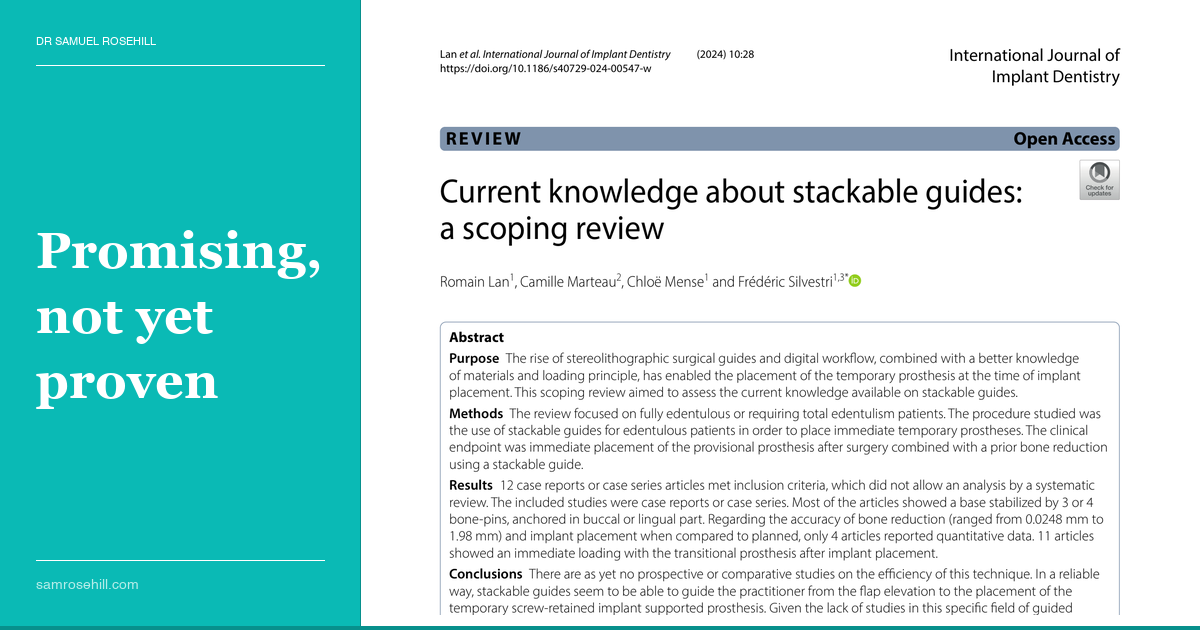
Source Paper
Current knowledge about stackable guides: a scoping review
There is a particular genre of conference session familiar to anyone who attends implant congresses: the technique showcase. The slides are polished, the case photographs are extraordinary, and the audience nods along with the air of people who intend to adopt the technique very shortly. Stackable guides have become a recurring feature of exactly this genre, appearing in manufacturer showcases and digital workflow symposia with a regularity that implies, gently but persistently, that the evidence base is settling in behind the technology.
Current knowledge about stackable guides: a scoping review, by Lan, Marteau, Mense and Silvestri from Aix-Marseille University and Karolinska Institute, tests that implication. Conducting a PRISMA-compliant search across Medline, they find rather less than the conference programme suggests.
The Data Anchor
The review targets fully edentulous patients in whom a stackable guide achieved both bone reduction and immediate provisional placement; dynamic navigation and non-stackable guided surgery were excluded. Searches ran March to May 2023 with no year restriction.
12 articles met the threshold: all case reports or case series; 25 patients, 27 arches, 173 implants. This is not a number that supports meta-analysis, and the authors said so, concluding that a systematic review was irrelevant. Guides were mostly 3D-printed acrylic resin (two used selective laser melting metal alloy), stabilised by 3 or 4 bone-pins. Eleven of 12 articles reported immediate loading.
Accuracy data, when it appears at all, shows bone reduction deviation ranging from 0.0248 mm to 1.98 mm. Implant apex accuracy ranged from 0.44 to 1.43 mm; neck accuracy from 0.887 to 1.90 mm; angular deviation from 2.4° to 4.14°. These figures come from four studies only, each using a different calculation methodology; cross-study comparison is essentially decorative.
Key Findings
- Twelve studies total, all case reports or case series; none prospective, none comparative. The evidence level cannot justify clinical recommendations.
- Only 4 of 12 studies reported quantitative accuracy data. Six of 12 lacked post-operative radiographic verification entirely.
- Bone reduction accuracy ranged from 0.0248 mm to 1.98 mm, but each study used a different calculation method; the range reflects inconsistent methodology as much as variable technique performance.
- Immediate provisional placement was achieved in 11 of 12 cases, the most consistently reported finding and the technique’s principal clinical claim.
- Connection mechanisms varied widely (screws, ball attachments, magnets, notches), reflecting the absence of any standardised design.
- No prospective or comparative data exist. The technique’s claimed advantages over conventional guided surgery remain unquantified.
The authors note that even the conventional stereolithographic guide, now widely used, carries an average overall angular deviation of approximately 4° from digital planning. Stackable guides may or may not perform differently; the current literature simply cannot say.
💡 The Clinical Bottom Line
The technique’s logic is sound. Conventional drill guides cannot accommodate unpredictable post-extraction anatomy; a modular system that first guides bone reduction, then locks in for osteotomies, then positions a pre-fabricated provisional, is addressing a genuine clinical problem. Eleven of twelve cases managed immediate loading. That is the headline finding — and it is also, almost entirely, the evidence.
What this scoping review delivers is a calibration. The appropriate clinical stance is that stackable guides are a promising technique supported by 25 patients, with accuracy data from 4 of them in non-comparable formats. At conferences they often appear already validated. They are not yet validated; as Lan and colleagues put it, this is developing practice in need of prospective and comparative investigation before clinical recommendations become defensible.
Dr Samuel Rosehill is a general dentist with a prosthodontic focus, practising at Ethical Dental in Coffs Harbour, NSW. He holds a BDSc (Hons) from the University of Queensland, an MBA, an MMktg, and an MClinDent in Fixed & Removable Prosthodontics (Distinction) from King’s College London.
Clinical Relevance
Stackable guides appear in implant conference programmes and manufacturer literature with frequency that implies an established technique. The actual evidence base in 2024 comprises 12 case reports or case series — 25 patients, 27 arches, 173 implants — with only 4 studies reporting quantitative accuracy data. No prospective or comparative studies exist. Clinicians considering stackable guides should treat the technique as promising but unvalidated at a population level.
Disclosure: The author has no financial conflicts of interest related to the products or topics discussed in this review. This is an independent summary prepared for educational purposes.
Continue the conversation
This review is also published on Substack, where you can leave comments and join the discussion.
Read on Substack →