When the Bench Test Disagrees With the Brochure
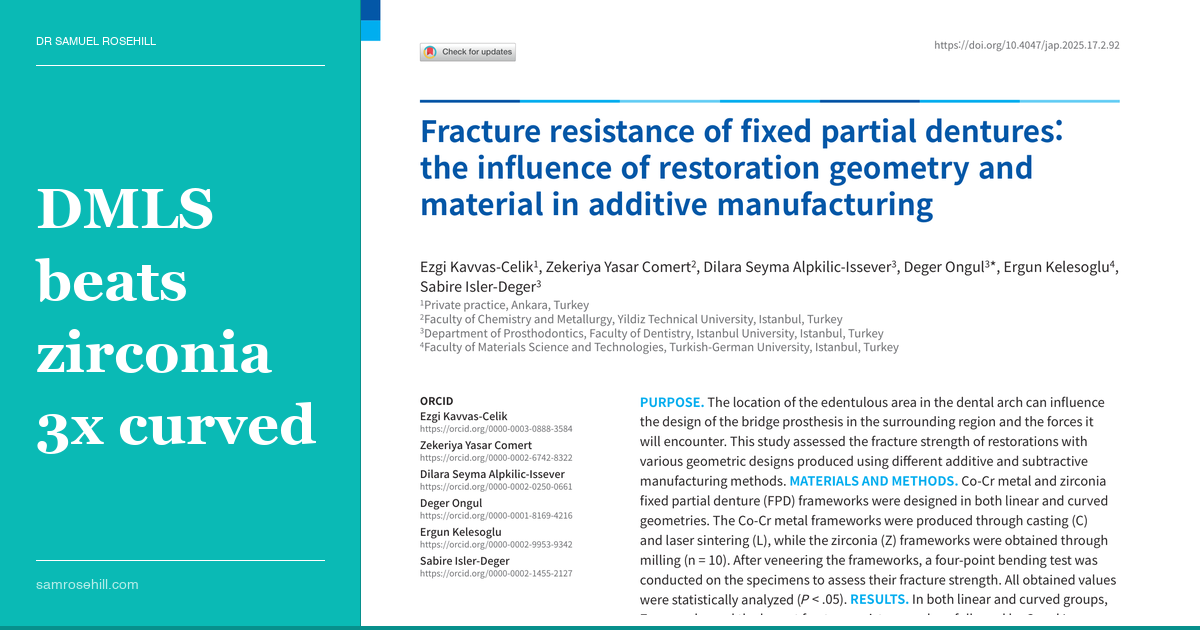
Kavvas-Celik and colleagues tested Co-Cr and zirconia fixed partial denture frameworks in both straight and curved geometries, finding that DMLS Co-Cr outperformed milled zirconia nearly threefold in curved-anterior designs — a result that the marketing narrative around metal-free ceramics does not prepare clinicians to expect.
DMLS beats zirconia 3x curved
Source Paper
Fracture resistance of fixed partial dentures: the influence of restoration geometry and material in additive manufacturing
There is a persuasive story told, with great confidence and excellent slide design, about zirconia being the strength material of modern prosthodontics — the one that finally liberated us from the grey metallic smile and the patient who wants “no metal, doctor.” The story is largely true. But strength claims are geometry-dependent, and the promotion tends to run ahead of that caveat with some enthusiasm.
“Fracture resistance of fixed partial dentures: the influence of restoration geometry and material in additive manufacturing,” published in the Journal of Advanced Prosthodontics by Ezgi Kavvas-Celik, Zekeriya Yasar Comert, and colleagues at Istanbul University, does not set out to be a corrective. It is an in-vitro study from Istanbul investigating how manufacturing technique and bridge geometry interact. The corrective emerges from the data anyway.
The Data Anchor
The team designed two anatomically faithful framework types: a four-unit posterior linear FPD (maxillary first premolar to second molar) and a six-unit anterior curved FPD (maxillary right canine to left canine). Both were produced in three versions (cast Co-Cr, DMLS Co-Cr, and milled zirconia), yielding six groups of ten specimens each (n = 10 per group).
Frameworks were veneered by one technician using standardised silicone keys. Specimens were cemented with glass ionomer cement and loaded via four-point bending at 0.5 mm per minute until fracture (zirconia) or maximum load without framework fracture (metal).
Non-normal distribution prompted non-parametric analysis (Kruskal-Wallis, Mann-Whitney U, Dunn-Bonferroni post-hoc).
Key Findings
- DMLS Co-Cr was the strongest framework in curved geometry by a substantial margin. Median fracture resistance: 2,633 N (Q1-Q3: 2,562–2,669 N), significantly higher than cast Co-Cr at 1,911.5 N and milled zirconia at 954 N in the same configuration (P < .001 for all pairwise comparisons).
- Curvature helped laser sintering and hurt everything else. DMLS curved FPDs outperformed their straight counterparts (2,633 N vs 2,268 N, P < .001). Cast Co-Cr and zirconia both showed significantly lower fracture resistance in curved than straight designs (P = .010 and P = .021 respectively).
- Zirconia’s straight-design advantage vanishes in the anterior arch. Straight zirconia (1,005.5 N) already trailed both metal groups significantly; curved zirconia (954 N) remained the weakest configuration tested, and showed statistically lower resistance than its straight counterpart.
- Half of curved cast Co-Cr specimens fractured at the metal substructure level. The authors attribute this to smaller connector areas in anterior designs and variability inherent in conventional casting; laser sintering addresses both by eliminating wax-pattern imprecision and optimising load distribution.
- Limitation: In-vitro conditions at idealised settings, no ageing protocol, and differing pontic counts between straight and curved subgroups (four units vs six units) make direct geometric comparison imperfect. Clinical loading environments will differ.
The fact that laser sintering benefits from curvature while casting is hurt by it points to something fundamental: digital fabrication eliminates the dimensional variability that becomes consequential precisely when a design is most demanding.
💡 The Clinical Bottom Line
For posterior bridges, the material choice conversation looks fairly familiar: both metal frameworks outperform zirconia, and the difference between cast and laser-sintered Co-Cr does not reach significance in a straight configuration. The clinical disruption happens when you move anteriorly.
A curved six-unit anterior span in laser-sintered Co-Cr resists fracture at nearly three times the load of a milled zirconia equivalent. That is not a marginal refinement; it is a mechanically different proposition. The finding should not be overread (this is bench data, not a clinical trial), but it does complicate the reflexive assumption that “zirconia” and “strength” are synonymous regardless of where in the arch the bridge lives. For extended anterior spans, geometry is a variable the material selection discussion needs to accommodate. The brochure, characteristically, has not caught up.
Dr Samuel Rosehill is a general dentist with a prosthodontic focus, practising at Ethical Dental in Coffs Harbour, NSW. He holds a BDSc (Hons) from the University of Queensland, an MBA, an MMktg, and an MClinDent in Fixed & Removable Prosthodontics (Distinction) from King’s College London.
Clinical Relevance
Under curved anterior geometry, laser-sintered Co-Cr frameworks achieved a median fracture resistance of 2,633 N — nearly three times the 954 N recorded for milled zirconia frameworks in the same configuration. The findings suggest geometry is not a neutral variable: curvature disadvantages cast Co-Cr and zirconia frameworks (both showing statistically significant reductions), while laser sintering is the only technique that converts curvature into a mechanical advantage. The in-vitro design limits direct clinical extrapolation, but the data should inform framework material selection discussions for anterior bridge spans.
Disclosure: The author has no financial conflicts of interest related to the products or topics discussed in this review. This is an independent summary prepared for educational purposes.
Continue the conversation
This review is also published on Substack, where you can leave comments and join the discussion.
Read on Substack →