The Grey Shadow That Kills a Ceramic Crown
An in vitro study by Alkhazaleh and colleagues at Oregon Health & Science University finds that lithium disilicate alone — even at 2.0 mm — cannot mask amalgam show-through to acceptable levels, but a single layer of resin-based opaquer changes everything, with IPS e.max CAD reaching excellent masking at 2.0 mm when the substrate is opaqued.
Opaquer is non-negotiable
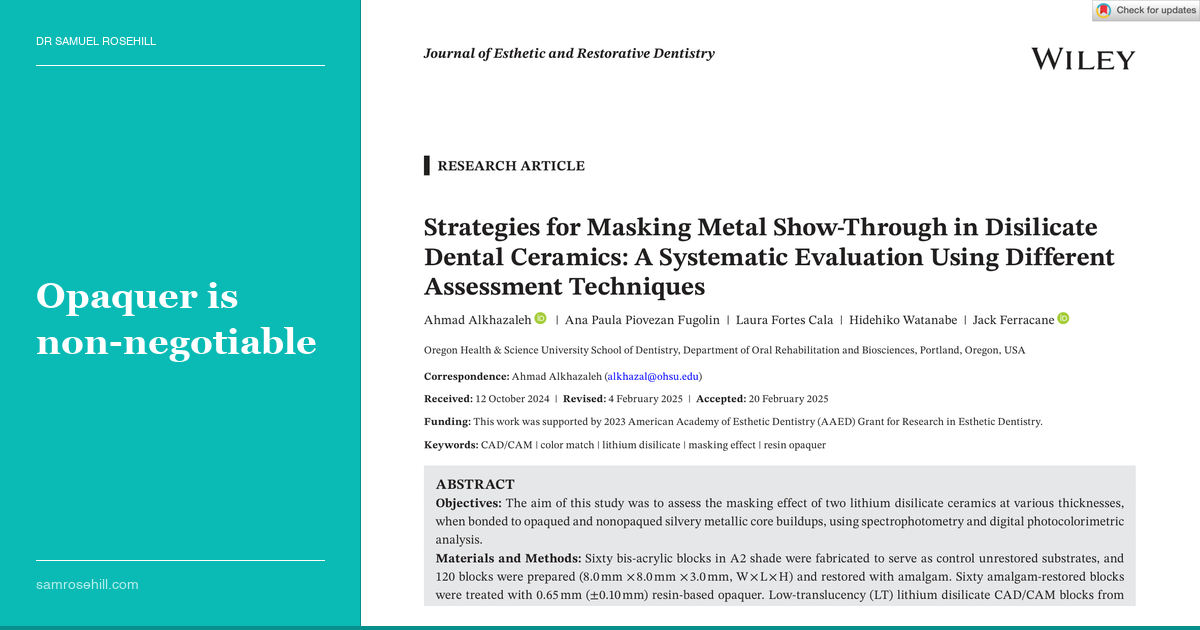
Source Paper
Strategies for Masking Metal Show-Through in Disilicate Dental Ceramics: A Systematic Evaluation Using Different Assessment Techniques
There is a particular quality to the grey shadow that shows through a ceramic crown: not dramatic enough to be immediately obvious at cementation, just present enough to announce itself under certain light, in the bathroom mirror, six months later. The patient notices it first. The crown is structurally sound, the margins are tight, the shade was matched to A2. And yet there it is — the ghost of an old amalgam filling, haunting the enamel it was supposed to disappear beneath.
This is exactly what Alkhazaleh and colleagues at Oregon Health & Science University set out to quantify in “Strategies for Masking Metal Show-Through in Disilicate Dental Ceramics: A Systematic Evaluation Using Different Assessment Techniques,” published in the Journal of Esthetic and Restorative Dentistry in 2025. Can lithium disilicate alone mask amalgam acceptably, and does a resin opaquer actually help? The answers: no, and yes — with nuance about which ceramic and at what thickness.
The Data Anchor
The team fabricated 180 bis-acrylic blocks (A2 shade), with 120 receiving amalgam restorations. Half were treated with IPS Empress Direct Opaque (Ivoclar) at 0.65 mm; the rest left unmasked. Two low-translucency lithium disilicate ceramics, IPS e.max CAD (Ivoclar) and Initial LiSi (GC America), were polished to 1.0, 1.5, and 2.0 mm (n = 30 per subgroup) and bonded with opaque-shade Panavia V5 dual-cure resin cement. Colour difference was assessed by spectrophotometry (Konica Minolta CM-700d) and polarised digital photocolorimetric (PDPC) analysis using the CIE ΔE₀₀ formula (acceptability ≤ 1.8; excellent match ≤ 0.8).
Key Findings
- Without opaquer, neither ceramic achieved acceptable masking at any thickness. Spectrophotometric ΔE₀₀ for e.max on non-opaqued amalgam ranged from 4.2 (1.0 mm) to 2.1 (2.0 mm); for LiSi, 3.8 to 2.7. All values exceeded the 1.8 acceptability threshold.
- Opaquer was transformative for e.max. On opaqued amalgam, e.max reached ΔE₀₀ = 1.3 at 1.5 mm (acceptable) and ΔE₀₀ = 0.8 at 2.0 mm (excellent match) — the only condition in the study to reach the perceptibility threshold.
- LiSi improved with opaquer but fell short of e.max. With opaquer, LiSi achieved ΔE₀₀ = 2.0 at 1.5 mm (mismatch type a) and ΔE₀₀ = 1.5 at 2.0 mm (acceptable). The ceramics diverged at greater thickness.
- The crystalline composition explains the gap. IPS e.max CAD contains 62.6 vol% Li₂Si₂O₅ particles (3–6 μm, interlocking needle-shaped); Initial LiSi has only 29.0 vol% with shorter particles (~1–1.5 μm) and more glass matrix; greater crystal density gives e.max the optical edge at increasing thickness.
- PDPC diverged markedly from spectrophotometry on non-opaqued specimens (ΔE₀₀ = 9.3 vs 4.2 for e.max at 1.0 mm). The methods converged when opaquer was applied, validating both the intervention and PDPC as a chairside monitoring tool.
- In-vitro caveat: Single shade (A2) only; ceramics polished, not stained and glazed; clinical results may vary.
💡 The Clinical Bottom Line
The takeaway is plain: opaquer is not optional when placing a lithium disilicate crown over an amalgam buildup. Two millimetres of lithium disilicate bonded directly to amalgam still fails the 1.8 acceptability threshold. A 0.65 mm opaquer layer after metal priming brings IPS e.max CAD to excellent masking (ΔE₀₀ = 0.8) at 2.0 mm; Initial LiSi reaches acceptable masking at the same thickness.
The sequence: prepare the amalgam, apply metal primer, cure the opaquer, proceed with the ceramic. The grey shadow is preventable. It requires one step that most clinical protocols currently leave out.
Clinical pearl: Both steps matter: primer (Alloy Primer, Kuraray) then opaquer (IPS Empress Direct Opaque, Ivoclar) at 0.65 mm. Skipping the primer compromises the opaquer’s adhesion to the metallic surface.
Dr Samuel Rosehill is a general dentist with a prosthodontic focus, practising at Ethical Dental in Coffs Harbour, NSW. He holds a BDSc (Hons) from the University of Queensland, an MBA, an MMktg, and an MClinDent in Fixed & Removable Prosthodontics (Distinction) from King’s College London.
Clinical Relevance
Lithium disilicate ceramics — both IPS e.max CAD and GC Initial LiSi at low-translucency — cannot achieve acceptable masking of amalgam core buildups without a resin-based opaquer, regardless of ceramic thickness up to 2.0 mm. A 0.65 mm layer of resin opaquer (IPS Empress Direct Opaque) transforms the outcome: IPS e.max CAD achieves acceptable masking at 1.5 mm and excellent masking (ΔE₀₀ = 0.8) at 2.0 mm. Initial LiSi achieves acceptable masking at 2.0 mm with opaquer. The clinical workflow implication is clear: when an existing amalgam restoration is being retained under a lithium disilicate crown, opaquer application after metal priming is a required step, not an optional enhancement.
Disclosure: The author has no financial conflicts of interest related to the products or topics discussed in this review. This is an independent summary prepared for educational purposes.
Continue the conversation
This review is also published on Substack, where you can leave comments and join the discussion.
Read on Substack →