When There's No Ferrule Left: Post-Core or Endocrown?
An in vitro study of 50 maxillary central incisors with no ferrule finds that CAD/CAM glass-fibre post-cores and hybrid ceramic endocrowns produce the highest fracture strength, while conventional glass-fibre posts achieve 100% repairable failures — making the choice less about strength and more about what happens when things go wrong.
Hybrid endocrown holds its own
Source Paper
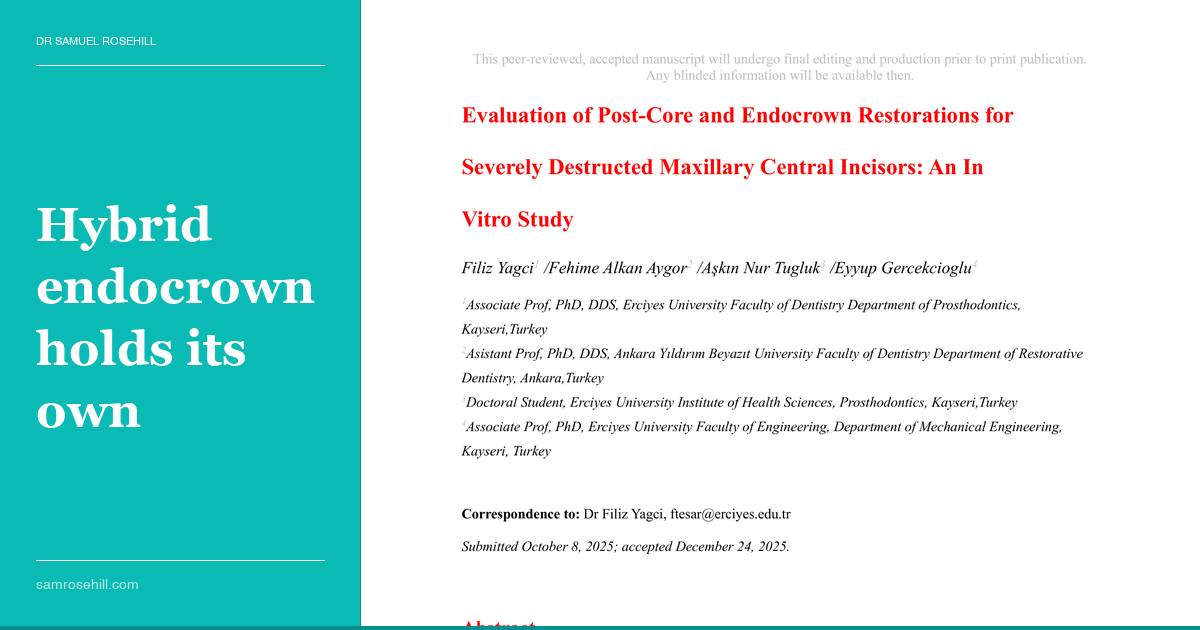
Evaluation of Post-Core and Endocrown Restorations for Severely Destructed Maxillary Central Incisors: An In Vitro Study
The tooth has been decoronated to 1 mm above the cemento-enamel junction. The endodontic treatment is complete, the access cavity is sealed, and the question in the room is a very old one with a surprisingly sparse evidence base: post-core or endocrown? Yagci and colleagues at Erciyes University address that question in “Evaluation of Post-Core and Endocrown Restorations for Severely Destructed Maxillary Central Incisors: An In Vitro Study,” asking which restoration holds up best when the ferrule simply is not there.
Crown lengthening would compromise the adjacent periodontium; orthodontic extrusion is an option the patient declined on account of the timeline. Surgeon preference, laboratory capability, and mostly molar-centred endocrown studies have been doing the heavy lifting that controlled data should be doing. Until now.
The Data Anchor
Fifty extracted maxillary central incisors were decoronated 1 mm above the CEJ and divided into five groups (n = 10 each): Group F, conventional glass-fibre post with composite core; Group CF, CAD/CAM single-piece glass-fibre post-core (Numerys GF, Itena-Clinical); Group CP, CAD/CAM PEEK post-core (CopraPeek Light, White-Peaks-Dental); Group HE, hybrid ceramic endocrown (Numerys HC, Itena-Clinical); Group LE, lithium disilicate endocrown (IPS e.max Press, Ivoclar Vivadent).
Post-core groups received adhesively cemented hybrid ceramic crowns. After thermocycling (5,000 cycles, 5–55°C), specimens were loaded at 135 degrees to the vertical axis (Instron) at 1 mm/minute. Failures were classified by stereomicroscope at ×40 magnification into Types I–III (repairable) and Type IV (irreparable: fracture below CEJ).
Key Findings
- CAD/CAM glass-fibre post-core (CF) produced the highest fracture strength at median 331.6 N, significantly higher than PEEK post-cores and lithium disilicate endocrowns (P < .05), though statistically equivalent to conventional glass-fibre posts and hybrid ceramic endocrowns.
- Hybrid ceramic endocrowns (HE) came close at 313.9 N, significantly outperforming conventional glass-fibre posts and PEEK post-cores (P < .05); the twofold advantage over LE is attributed to lithium disilicate’s higher Young’s modulus driving crack propagation.
- Lithium disilicate endocrowns (LE) underperformed markedly: median 128.9 N, lowest of any group. Clinicians who favour e.max for anterior aesthetics should take note.
- Conventional glass-fibre posts (F) achieved 100% repairable failures. Every specimen debonded without fracturing; being weak in a way that keeps options open is a meaningful attribute for a tooth already at the edge.
- PEEK post-cores (CP) produced 80% repairable failures despite the second-lowest fracture strength. PEEK’s lower elastic modulus (3.7 GPa versus glass-fibre’s 8.6 GPa) likely explains both outcomes.
- CF, HE, and LE all showed 60% repairable failure rates, but differently distributed: CF failures were predominantly Type I debonding, while LE failures tilted toward irreparable Type IV events.
- Limitation: in vitro only, n = 10 per group, no masticatory simulation. Treat these as clinical hypotheses, not revised protocols.
💡 The Clinical Bottom Line
For a severely destroyed anterior tooth without a ferrule, hybrid ceramic endocrowns offer fracture strength, a simplified workflow, and a majority-repairable failure pattern. The CAD/CAM glass-fibre post-core is marginally stronger, but the difference did not reach significance, and the endocrown removes post-space preparation and core build-up from the appointment.
The conventional glass-fibre post earns a quiet rehabilitation: every failure was repairable, and for a tooth already compromised, a 100% debond rate may be preferable to the alternative.
In the absence of a ferrule, the choice is not purely which restoration is strongest. It is which failure mode the tooth and its owner can tolerate.
What this study cannot resolve is whether in vitro fracture-strength differences translate to clinical survival. Until they do, the hybrid ceramic endocrown has earned its place in the conversation.
Dr Samuel Rosehill is a general dentist with a prosthodontic focus, practising at Ethical Dental in Coffs Harbour, NSW. He holds a BDSc (Hons) from the University of Queensland, an MBA, an MMktg, and an MClinDent in Fixed & Removable Prosthodontics (Distinction) from King’s College London.
Clinical Relevance
For severely destroyed anterior teeth with no ferrule, CAD/CAM single-piece glass-fibre post-cores deliver the highest fracture strength (median 331.6 N) and hybrid ceramic endocrowns are close behind (313.9 N) with similar repairable failure rates. Conventional glass-fibre posts are weaker but produce 100% repairable failures, clinically relevant when a rebondable debond is preferable to a root fracture. Lithium disilicate endocrowns underperformed markedly at 128.9 N and should be reconsidered in this context.
Disclosure: The author has no financial conflicts of interest related to the products or topics discussed in this review. This is an independent summary prepared for educational purposes.
Continue the conversation
This review is also published on Substack, where you can leave comments and join the discussion.
Read on Substack →