Anterior Prostheses Fail for Very Ordinary Reasons
A retrospective study of 569 anterior fixed prostheses found complications were less about material mythology and more about hygiene, support type, and prosthesis design.
Hygiene beats material hype
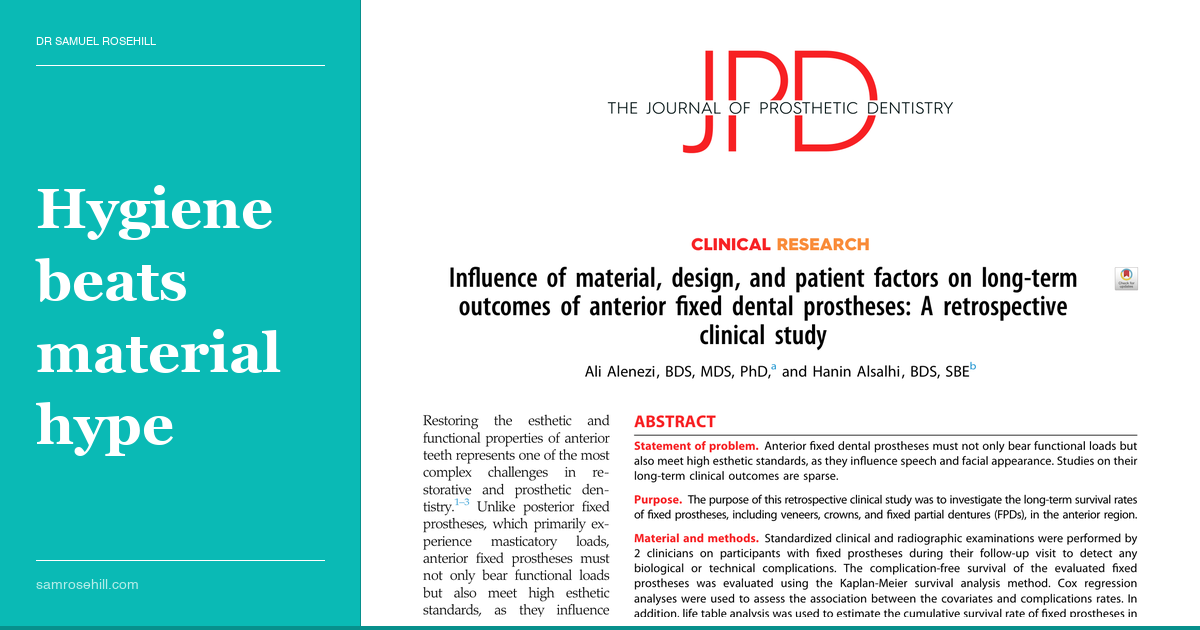
Source Paper
Influence of material, design, and patient factors on long-term outcomes of anterior fixed dental prostheses: A retrospective clinical study
Most clinicians have a private hierarchy of things they blame when an anterior restoration misbehaves. The ceramic was wrong. The margin was asking for trouble. The patient, mysteriously, has been “brushing well” in a way that leaves plaque with full diplomatic immunity. Alenezi and Alsalhi’s Influence of material, design, and patient factors on long-term outcomes of anterior fixed dental prostheses: A retrospective clinical study gives that familiar blame list some numbers, and the ordinary things do rather well.
The short version is this: anterior fixed prostheses did not live or suffer according to material choice alone. Over a mean 7.57-year follow-up, complications clustered around oral hygiene, support type, and prosthesis design, which is less glamorous than zirconia translucency charts but rather more useful on Monday morning.
The Data Anchor
The study assessed 569 anterior fixed prostheses in adult patients at Qassim University, using standardised clinical and radiographic examinations by two clinicians. The prostheses included veneers, single crowns, splinted crowns, cantilever fixed partial dentures (FPDs), and conventional fixed partial dentures, across ceramic, zirconia, and metal-ceramic materials.
Overall, 40.4% of prostheses had complications: 30.9% biological and 13.4% technical. Poor oral hygiene carried the most obvious penalty, with a 59.1% total complication rate compared with 25.0% in patients with good hygiene. In the Cox model, poor hygiene had a hazard ratio (HR) of 4.244 compared with good hygiene. Implant-supported fixed prostheses had a lower hazard than tooth-supported prostheses, with an HR of 0.122 and a 95% confidence interval of 0.029 to 0.515.
Key Findings
- Hygiene was not background scenery. Poor oral hygiene was associated with the highest biological complication rate, 50.5%, and the highest total complication rate, 59.1%.
- Support type mattered. Tooth-supported prostheses had a 41.9% total complication rate, while implant-supported prostheses had 8.0%, though the implant group was small at 25 prostheses.
- Design had clinical fingerprints. Splinted crowns and conventional fixed partial dentures had the highest total complication rates, 75.0% and 67.6% respectively.
- Material did not win the whole argument. Metal-ceramic prostheses had the highest total complication rate at 49.7%, but zirconia and ceramic subgroup sizes and follow-up times make simple material rankings risky.
- The caveat is built in. This was retrospective, single-centre data, so it can point to associations; it cannot neatly prove causation.
💡 The Clinical Bottom Line
For anterior fixed prostheses, the gold standard is still not a material. It is a patient, a design, a support strategy, and a maintenance plan all behaving themselves in the same room.
This paper reinforces a plain clinical truth: before we make the ceramic the main character, we should look at plaque control, abutment prognosis, splinting decisions, and recall. The prettiest anterior restoration still has to live with the patient who owns it.
Dr Samuel Rosehill is a general dentist with a prosthodontic focus, practising at Ethical Dental in Coffs Harbour, NSW. He holds a BDSc (Hons) from the University of Queensland, an MBA, an MMktg, and an MClinDent in Fixed & Removable Prosthodontics (Distinction) from King’s College London.
Clinical Relevance
This retrospective clinical study suggests that anterior fixed prosthesis risk is shaped by ordinary clinical maintenance factors as much as material choice. Poor oral hygiene and tooth-supported designs had higher complication rates, while implant-supported prostheses had lower complication hazard in this cohort. The result is a useful reminder to treatment plan the patient and maintenance environment before falling in love with the ceramic.
Disclosure: The author has no financial conflicts of interest related to the products or topics discussed in this review. This is an independent summary prepared for educational purposes.
Continue the conversation
This review is also published on Substack, where you can leave comments and join the discussion.
Read on Substack →