How Many Implants Does a Maxillary Full-Arch Prosthesis Actually Need?
A systematic review finds that maxillary full-arch fixed prostheses deliver high survival rates and patient satisfaction regardless of implant number — but direct comparative evidence remains surprisingly thin.
All roads lead to satisfaction
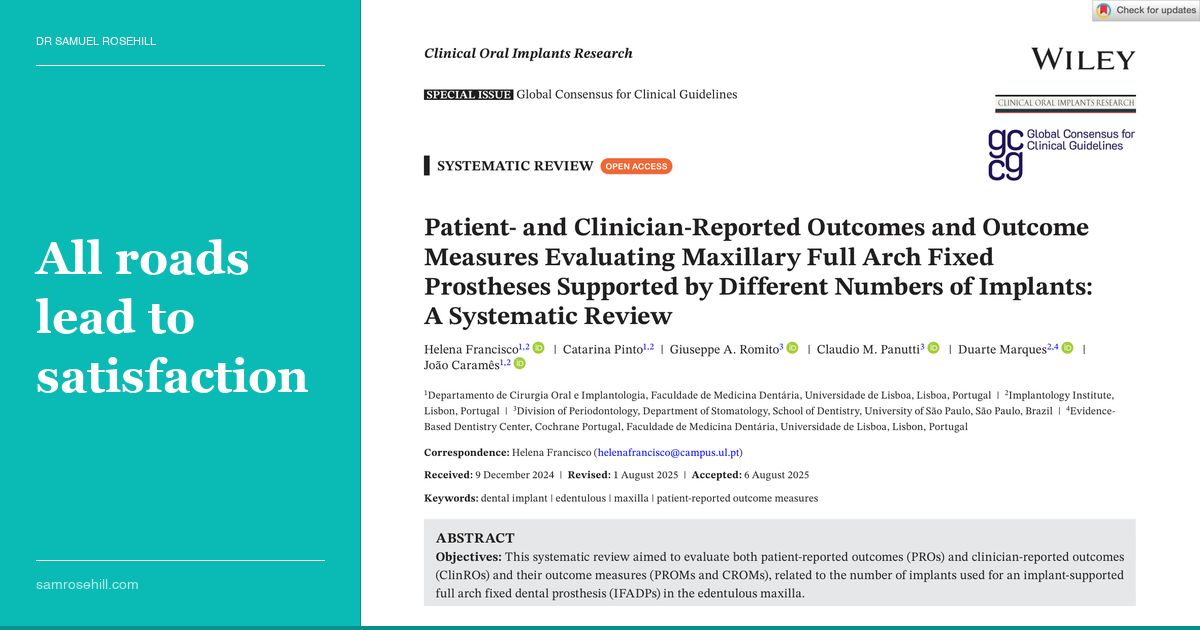
Source Paper
Patient- and Clinician-Reported Outcomes and Outcome Measures Evaluating Maxillary Full Arch Fixed Prostheses Supported by Different Numbers of Implants: A Systematic Review
Implant dentistry has spent four decades perfecting the full-arch fixed prosthesis and approximately five minutes agreeing on how many implants it should sit on. Four? Six? Eight, for the cautious among us? The debate has generated enough conference panel disagreements to fill a small auditorium, and yet the question persists with a cheerful stubbornness that suggests nobody has quite nailed the answer. Francisco and colleagues, in “Patient- and Clinician-Reported Outcomes and Outcome Measures Evaluating Maxillary Full Arch Fixed Prostheses Supported by Different Numbers of Implants” (Clinical Oral Implants Research, 2026), set out to find what the evidence actually says about whether the number of implants matters for patient and clinician outcomes in the edentulous maxilla. The short version: everything works rather well, and almost nothing has been properly compared.
The Data Anchor
This was a PRISMA-compliant systematic review searching five electronic databases from January 2014 to June 2024. From an initial pool of 1,466 articles, 31 reached full-text assessment and just 11 made the final cut — a ratio that tells its own story about the state of the literature. The included studies comprised RCTs and prospective clinical studies reporting patient-reported outcomes (PROs) and clinician-reported outcomes (ClinROs) for implant-supported full-arch fixed dental prostheses (IFADPs) in the edentulous maxilla. Risk of bias ranged from low to high for the RCTs (assessed via the Cochrane tool) and moderate to serious for the prospective studies (ROBINS-I). The implant configurations studied ranged from four to six or more implants per arch, with follow-up periods extending to five years in some cases.
Key Findings
- Implant and prosthesis survival rates were consistently high across all implant numbers, with one study reporting 98.6% implant survival and 100% prosthesis survival at one year for a six-implant protocol, and another finding no statistically significant difference between All-on-4 and All-on-6 at five years (p = 0.246)
- Patient satisfaction and oral health-related quality of life improved substantially regardless of implant number, with OHIP scores showing significant gains over baseline across all configurations
- Marginal bone loss was comparable between groups — one key study found mean bone level changes of just 0.20 mm difference between All-on-4 and All-on-6 at five years (95% CI 0.08–0.18, p = 0.117)
- Postoperative morbidity was mild across all protocols, with 93.7% of patients in one study showing no visible swelling after immediate loading of six implants
- The critical limitation: no study directly compared PROs or ClinROs as a function of implant number as its primary outcome. The evidence for linking specific implant numbers to specific outcome differences simply does not exist in any robust form
The most honest reading of this review is that clinicians have been making the “how many implants?” decision on biomechanical intuition and clinical experience rather than comparative outcome data — and, remarkably, patients have been doing just fine regardless of which number their clinician chose.
💡 The Clinical Bottom Line
If you are planning a maxillary full-arch fixed prosthesis, the available evidence suggests you can proceed with confidence whether your treatment plan calls for four, five, six, or more implants — survival rates are excellent and patient satisfaction is high across the board. What you cannot do, however, is cite a single well-designed comparative study that demonstrates one number is superior to another for patient-reported outcomes. The profession has been winning the game without quite knowing the score, which is either reassuring or mildly alarming depending on your relationship with evidence-based practice.
Dr Samuel Rosehill is a general dentist with a prosthodontic focus, practising at Ethical Dental in Coffs Harbour, NSW. He holds a BDSc (Hons) from the University of Queensland, an MBA, an MMktg, and an MClinDent in Fixed & Removable Prosthodontics (Distinction) from King’s College London.
Reference: Francisco H, et al. Patient- and Clinician-Reported Outcomes and Outcome Measures Evaluating Maxillary Full Arch Fixed Prostheses Supported by Different Numbers of Implants: A Systematic Review. Clin Oral Implants Res. 2026;37(Suppl. 30):S273–S301. DOI: 10.1111/clr.70020
Clinical Relevance
Clinicians choosing between 4, 5, 6, or more implants for maxillary full-arch fixed prostheses can reassure patients that all approaches deliver excellent survival and satisfaction — but should know that the evidence base for choosing one number over another remains remarkably weak.
Disclosure: The author has no financial conflicts of interest related to the products or topics discussed in this review. This is an independent summary prepared for educational purposes.
Continue the conversation
This review is also published on Substack, where you can leave comments and join the discussion.
Read on Substack →