One Abutment, One Time: The Evidence Says Yes, But Quietly
A systematic review and meta-analysis of 11 RCTs finds the 'one abutment one time' protocol produces statistically significant reductions in marginal bone loss at 6 months, with a consistent directional trend at 12 months that narrowly missed significance after sensitivity analysis — the absolute benefit is modest and best realised with platform switching and taller abutments.
OAOT preserves bone, modestly
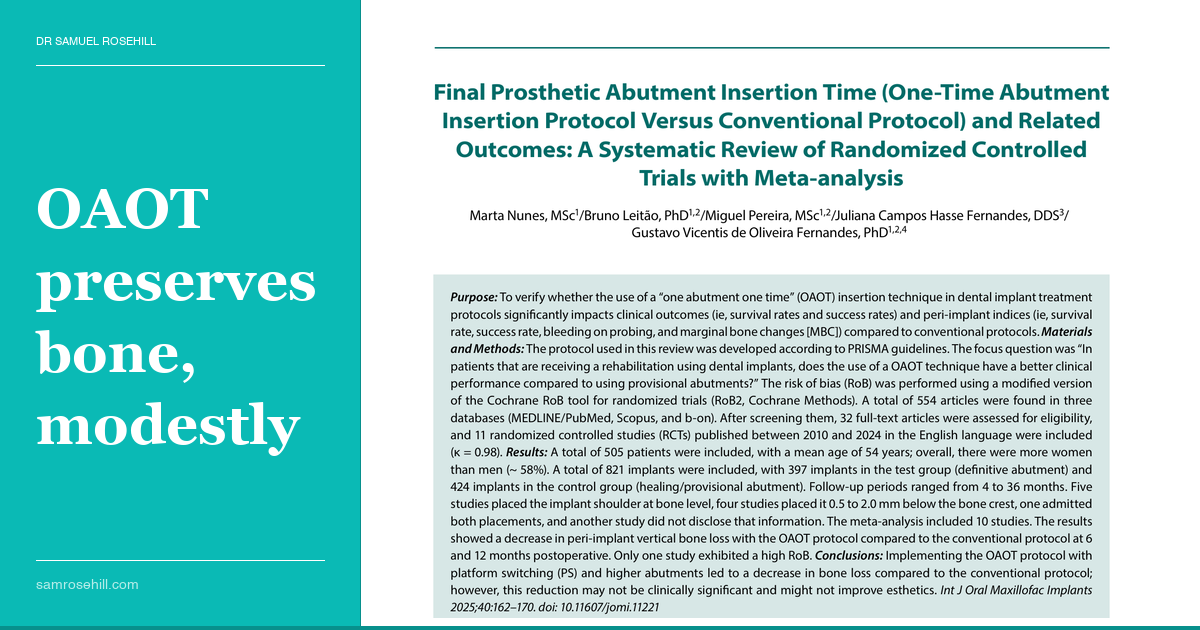
Source Paper
Final Prosthetic Abutment Insertion Time (One-Time Abutment Insertion Protocol Versus Conventional Protocol) and Related Outcomes: A Systematic Review of Randomized Controlled Trials with Meta-analysis
Everything we think we know about abutment disconnection and reconnection suggests it should not matter very much, and yet it does. Not dramatically, not in the way that makes headlines at implant congresses, but in the quiet, incremental, fraction-of-a-millimetre way that separates a stable crestal bone level from one that is slowly, politely retreating. Nunes and colleagues, in “Final Prosthetic Abutment Insertion Time (One-Time Abutment Insertion Protocol Versus Conventional Protocol) and Related Outcomes” (International Journal of Oral and Maxillofacial Implants, 2025), have now assembled the RCT evidence into a single meta-analysis, and the verdict is characteristically understated: yes, leaving the definitive abutment alone from day one does help. Just not as much as its most enthusiastic advocates might suggest.
The Data Anchor
This PRISMA-registered systematic review (PROSPERO: CRD42024493033) searched PubMed/MEDLINE, Scopus, and b-on for RCTs published between 2010 and January 2024 comparing the OAOT protocol (definitive abutment placed at surgery and left undisturbed) with conventional protocols involving provisional or healing abutments that were subsequently replaced. Eleven RCTs met inclusion criteria (inter-reviewer agreement κ = 0.98), encompassing 505 patients and 821 implants (397 OAOT, 424 conventional). Mean patient age was 54 years; approximately 58% were women. Follow-up ranged from 4 to 36 months. Risk of bias was assessed using a modified Cochrane RoB2 tool; 10 of 11 studies were classified as low risk. Statistical analysis used a random-effects model with standardised mean differences, heterogeneity assessed via Cochran Q-test and Higgins I² statistic.
Key Findings
- Marginal bone loss favoured OAOT at 6 months (sensitivity analysis excluding the Grandi 2012 outlier: SMD = 0.44, 95% CI 0.02–0.86, P = .04) and showed a consistent directional trend at 12 months (sensitivity analysis excluding both Grandi studies: SMD = 0.33, 95% CI −0.02 to 0.67, P = .06), narrowly short of significance but with heterogeneity resolved.
- Implant survival was equivalent between groups: no significant difference in risk of failure (risk difference = −0.05, 95% CI −0.14 to 0.04, P = 0.28; I² = 0%), with comparable success rates across all 11 RCTs.
- Platform switching amplified the OAOT benefit. Studies using PS connections reported more pronounced bone preservation, consistent with the known mechanism of displacing the inflammatory cell infiltrate away from the crestal bone.
- Taller abutments correlated with reduced bone loss. Ríos-Santos et al. reported that 1 mm abutment height produced 0.45 mm bone loss versus 0.41 mm for 2 mm abutments (P = .02), reinforcing the principle that abutment height reflects soft tissue thickness and influences force distribution.
- Limitations are real: small sample sizes in several studies, follow-up capped at 36 months (no long-term data beyond 3 years), and operator awareness of allocation in at least two trials. The absolute magnitude of the bone-sparing effect may not translate to detectable aesthetic or clinical differences in most scenarios.
The bone benefit is genuine but modest; this is a protocol that rewards those who were already doing it rather than one that punishes those who were not.
💡 The Clinical Bottom Line
The evidence now supports OAOT as a legitimate marginal bone preservation strategy, particularly when combined with platform switching and abutments of adequate height. If your workflow already allows placing the definitive abutment at surgery, you are likely gaining a small but consistent crestal bone advantage at no additional cost or complexity. Each step in the conventional sequence (healing abutment, impression coping, provisional, then final piece) disturbs the supracrestal tissue seal and invites a fraction more remodelling than is strictly necessary. The absolute numbers are small; the direction is consistent; and in the anterior maxilla, where every tenth of a millimetre of papilla height is a negotiation between biology and patient expectation, consistent and small may be exactly what you need.
Dr Samuel Rosehill is a general dentist with a prosthodontic focus, practising at Ethical Dental in Coffs Harbour, NSW. He holds a BDSc (Hons) from the University of Queensland, an MBA, an MMktg, and an MClinDent in Fixed & Removable Prosthodontics (Distinction) from King’s College London.
Reference: Nunes M, Leitão B, Pereira M, Fernandes JCH, Fernandes GVO. Final prosthetic abutment insertion time (one-time abutment insertion protocol versus conventional protocol) and related outcomes: A systematic review of randomized controlled trials with meta-analysis. Int J Oral Maxillofac Implants. 2025;40:162–170. doi:10.11607/jomi.11221
Clinical Relevance
OAOT with platform switching and taller abutments produces a statistically significant reduction in peri-implant marginal bone loss at 6 months, with a directionally consistent trend at 12 months. Survival rates are equivalent to conventional protocols. The absolute bone benefit is modest but consistent, favouring OAOT as a routine protocol — particularly in aesthetically sensitive zones.
Disclosure: The author has no financial conflicts of interest related to the products or topics discussed in this review. This is an independent summary prepared for educational purposes.
Continue the conversation
This review is also published on Substack, where you can leave comments and join the discussion.
Read on Substack →