Autoimmune Disease Is Not the Implant Contraindication You Think It Is
Hyldahl and colleagues review implant survival across autoimmune diseases: bullous disease, rheumatoid arthritis and lupus look more reassuring, while oral lichen planus flare-up and Crohn's disease carry sharper warnings.
Treat the flare first
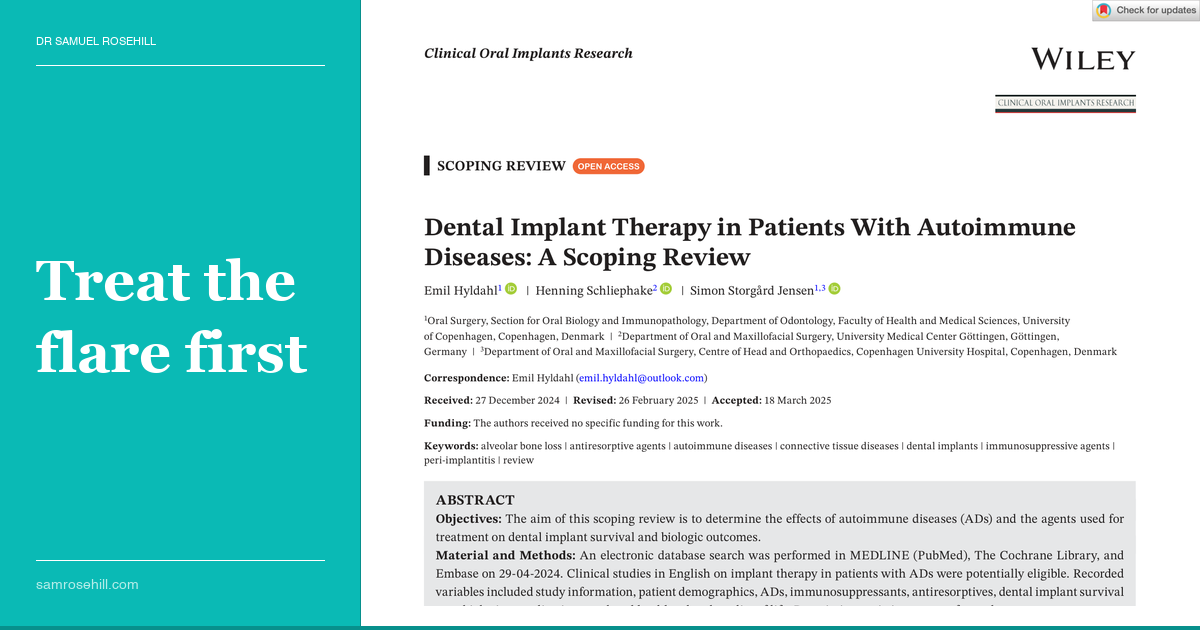
Source Paper
Dental Implant Therapy in Patients With Autoimmune Diseases: A Scoping Review
Medicine has a charming habit of turning complex patients into traffic lights. Green means routine. Red means do not proceed. Amber means ask a specialist, then write something heroic in the notes. Autoimmune disease has often lived in that amber zone for implant dentistry, wearing one high-vis vest over more than 80 different diseases.
Hyldahl, Schliephake and Storgård Jensen’s Dental Implant Therapy in Patients With Autoimmune Diseases: A Scoping Review is useful because it refuses that single traffic light. The clinical signal is not “autoimmune disease bad”. It is: Sjögren’s is not oral lichen planus, Crohn’s is not rheumatoid arthritis, and a flare is not remission in nicer shoes.
The Data Anchor
This scoping review searched MEDLINE, the Cochrane Library and Embase, then worked from 6319 records down to 87 included studies. The authors recorded implant survival, biological complications, oral health-related quality of life, immunosuppressant use and antiresorptive exposure.
The condition-level spread matters. On implant level, the more reassuring groups included bullous diseases at 98.8% survival, rheumatoid arthritis at 97.6%, systemic lupus erythematosus at 98.5%, dermatomyositis at 100% in only five implants, type 1 diabetes at 94.5%, hypothyroidism at 93.4%, and isolated Sjögren’s syndrome at 96.4%. Those numbers are not permission slips; many come from small, retrospective or case-report-heavy datasets. But they do stop the category from behaving like one large clinical fog machine.
The sharper warnings were specific. Oral lichen planus had 85.3% implant-level survival overall and 24.3% peri-implantitis on reported implants. In one untreated flare-up cohort, 42 of 55 implants were lost early; after remission and systemic treatment, the re-placed implants had 100% survival at 48 months. Crohn’s disease sat at 87% survival, mixed “other autoimmune diseases” at 88%, and one patient with hypothyroidism plus ulcerative colitis on adalimumab lost all 5 of 5 implants before loading. The paper is not whispering there.
Key Findings
- Lower-risk-looking groups were not disease-free groups. Bullous diseases, rheumatoid arthritis, systemic lupus erythematosus, dermatomyositis, type 1 diabetes, hypothyroidism, and many Sjögren’s cohorts showed high implant-level survival, but often on thin evidence.
- Sjögren’s is mixed, not simple. Isolated Sjögren’s showed 96.4% implant survival, but Sjögren’s with concomitant autoimmune disease dropped to 93.6%, and one secondary Sjögren’s cohort reported 87% survival.
- The highest-risk signal was active oral lichen planus. Overall OLP survival was 85.3%, but untreated flare-up produced 42 early losses from 55 implants.
- Crohn’s disease and mixed autoimmune cohorts deserve extra caution. Crohn’s disease showed 87% survival after short follow-up; the mixed “other autoimmune diseases” group showed 88%.
- Most losses were early. Across reported disease groups, 46.7% to 100% of implant losses occurred before loading, so osseointegration is the danger window.
💡 The Clinical Bottom Line
The practical answer is not “yes” or “no” to implants in autoimmune disease. It is: which autoimmune disease, active or quiet, isolated or accompanied, mucosal or systemic, biologic or glucocorticoid, and how much of this evidence is made of case reports wearing a laboratory coat?
For Monday morning, the lowest-anxiety cases are stable disease, controlled mucosa, clear medication history and a patient who can maintain the prosthesis. The cases that should make you sit up are active OLP, Crohn’s disease, mixed autoimmune burden, biologic therapy with prior complications, and anything likely to sabotage early healing. Amber does not mean stop. It means read the name on the disease before you read the colour of the light.
Dr Samuel Rosehill is a general dentist with a prosthodontic focus, practising at Ethical Dental in Coffs Harbour, NSW. He holds a BDSc (Hons) from the University of Queensland, an MBA, an MMktg, and an MClinDent in Fixed & Removable Prosthodontics (Distinction) from King’s College London.
Clinical Relevance
The useful question is not whether autoimmune disease is safe or unsafe for implants, but which disease pattern is in front of you. In this scoping review, bullous diseases, rheumatoid arthritis, lupus, dermatomyositis, and many Sjögren's cohorts showed relatively high implant survival, while active oral lichen planus flare-up, Crohn's disease, mixed autoimmune disease cohorts, and one hypothyroidism-ulcerative colitis case on adalimumab carried the sharpest warnings. Most losses occurred early, so pre-loading healing is the risk window to respect.
Disclosure: The author has no financial conflicts of interest related to the products or topics discussed in this review. This is an independent summary prepared for educational purposes.
Continue the conversation
This review is also published on Substack, where you can leave comments and join the discussion.
Read on Substack →