Peri-Implantitis Reconstruction Has a Seven-Year Hangover
Isler and colleagues report 7-year follow-up from a randomised clinical trial of peri-implantitis reconstructive therapy, finding limited long-term success despite early improvements.
Relapse catches up
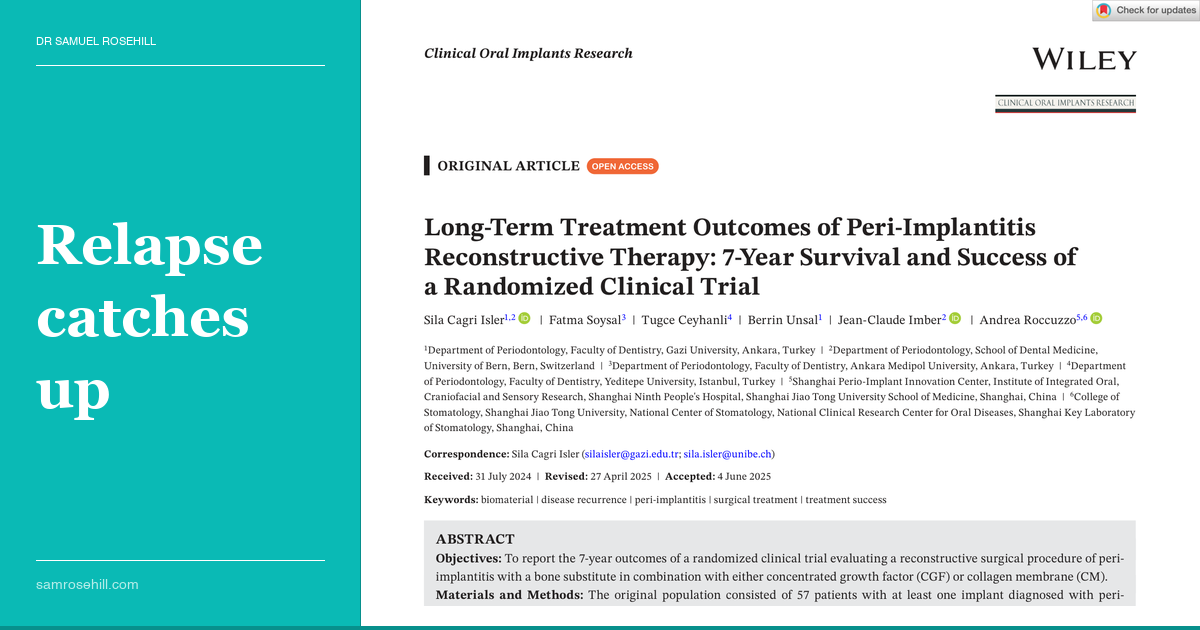
Source Paper
Long-Term Treatment Outcomes of Peri-Implantitis Reconstructive Therapy: 7-Year Survival and Success of a Randomized Clinical Trial
Peri-implantitis is the diagnosis that refuses to stay inside the tidy borders of the surgical appointment. You raise a flap, remove the granulation tissue, decontaminate the implant surface, pack the intrabony defect, cover it neatly, and the postoperative radiograph offers that brief, dangerous feeling that a chronic disease has agreed to become a construction problem.
Isler and colleagues’ Long-Term Treatment Outcomes of Peri-Implantitis Reconstructive Therapy: 7-Year Survival and Success of a Randomized Clinical Trial is a useful antidote to that optimism. It follows reconstructive peri-implantitis surgery long enough for early radiographic improvement to meet the less photogenic business of recurrence, retreatment and implant loss. The question is not whether grafts and membranes can make the numbers look better. It is whether the patient is still stable when the calendar has finished asking follow-up questions.
The Data Anchor
The original randomised clinical trial included 57 patients with at least one implant diagnosed with peri-implantitis and an intrabony defect of at least 3 mm. Defects were filled with a xenogenic bone graft and covered with either concentrated growth factor (CGF) or a collagen membrane (CM). Patients then entered supportive periodontal and peri-implant care.
At the seven-year follow-up, 16 patients with 24 implants remained in the CGF group and 18 patients with 25 implants remained in the CM group. The collagen membrane group showed more favourable implant-level deepest probing pocket depth and radiographic vertical defect depth (p = 0.040 and p = 0.043), but this did not translate into a triumphant success story.
At patient level, treatment success was achieved in 23.1% of CGF patients and 30.8% of CM patients. Disease recurrence occurred in 34.6% and 30.8%, respectively. Baseline suppuration was the only significant patient-level predictor of treatment failure, with an odds ratio of 15.45 (95% CI: 1.42-168.5; p = 0.02).
Key Findings
- Seven-year success was limited. Fewer than one-third of patients met treatment success criteria in either group.
- Recurrence remained common. Disease recurrence affected roughly one-third of patients in both protocols, despite supportive care.
- Collagen membrane looked better on some measures. CM improved deepest PPD and radiographic vertical defect depth compared with CGF, but overall success was not significantly different.
- Suppuration is the warning light. Baseline suppuration increased the odds of failure dramatically, making it a useful clinical risk marker before promising too much.
- The limitations matter. There was no graft-only comparison group, the primary outcome was set at one year, drop-out influenced the seven-year data, and implant-level clustering was not fully accounted for.
💡 The Clinical Bottom Line
Reconstructive peri-implantitis therapy should be discussed as disease management with guarded expectations, not as a tidy rebuilding project. A membrane and graft may improve local parameters, but biology keeps a longer appointment book than the post-operative radiograph.
The Monday morning change is in consent and case selection. When suppuration is present at baseline, the conversation should shift from “we can regenerate this” to “we may be able to control this, but relapse is very much in the room.” That is less glamorous than regeneration. It is also more honest.
Dr Samuel Rosehill is a general dentist with a prosthodontic focus, practising at Ethical Dental in Coffs Harbour, NSW. He holds a BDSc (Hons) from the University of Queensland, an MBA, an MMktg, and an MClinDent in Fixed & Removable Prosthodontics (Distinction) from King’s College London.
Clinical Relevance
Reconstructive peri-implantitis surgery can produce short-term clinical and radiographic improvement, but this 7-year follow-up shows that long-term success is limited and relapse remains common. Baseline suppuration was the clearest warning sign for treatment failure. Clinicians should present reconstructive peri-implantitis therapy as guarded disease control rather than predictable regeneration, especially when suppuration is present.
Disclosure: The author has no financial conflicts of interest related to the products or topics discussed in this review. This is an independent summary prepared for educational purposes.
Continue the conversation
This review is also published on Substack, where you can leave comments and join the discussion.
Read on Substack →