Harvesting Bone From Your Own Backyard: In-Situ Onlay Grafts Outperform the Traditional Approach
A retrospective study of 125 patients finds that in-situ bone onlay grafting — harvesting from the apical area of the implant site itself — produces significantly less resorption than ex-situ grafts from the chin or external oblique line during initial healing.
Same site, less resorption
Source Paper
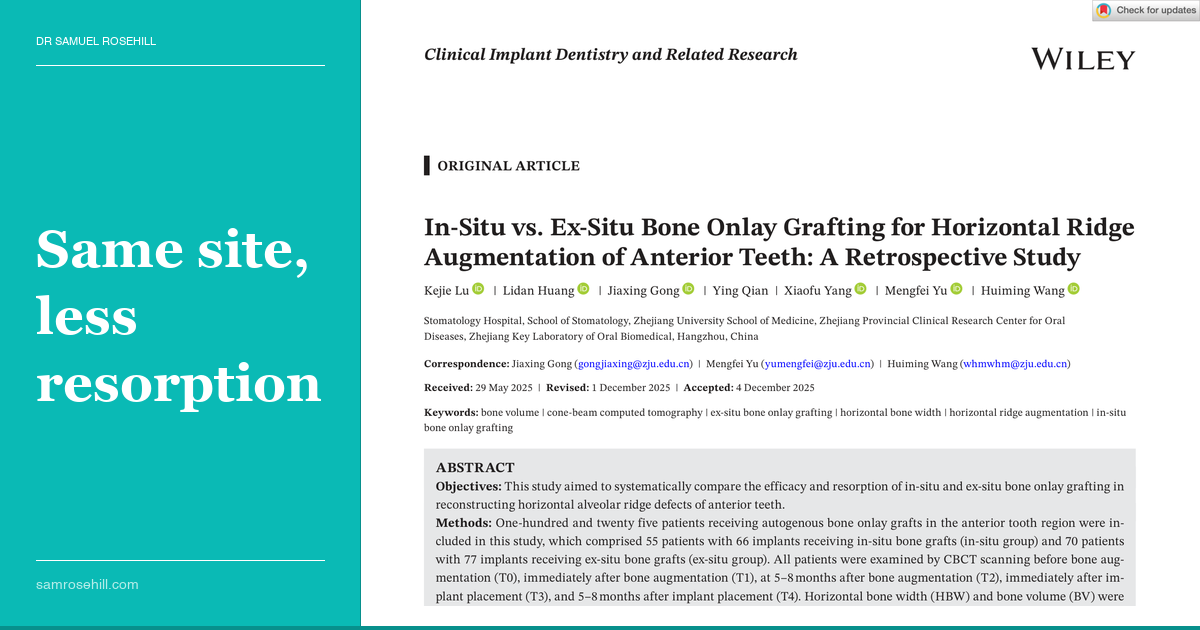
In-Situ vs. Ex-Situ Bone Onlay Grafting for Horizontal Ridge Augmentation of Anterior Teeth: A Retrospective Study
There is a principle in architecture that the best renovation material is the stone you find on site. Shipping in marble from Carrara looks spectacular on the plans, but by the time it has survived the journey, the handling, and the inevitable argument about whether it matches the existing facade, you begin to wonder whether the local quarry might have been the smarter call all along. Bone grafting for horizontal ridge augmentation operates on a strikingly similar logic, and Lu and colleagues, in “In-Situ vs. Ex-Situ Bone Onlay Grafting for Horizontal Ridge Augmentation of Anterior Teeth” (Clinical Implant Dentistry and Related Research, 2025), have now produced the largest retrospective comparison to date showing that harvesting bone from the apical area of the implant site itself outperforms traditional remote donor sites in the metric that matters most: how much bone survives.
The Data Anchor
This retrospective cohort study from Zhejiang University included 125 patients receiving autogenous bone onlay grafts in the anterior region: 55 patients (66 implants) in the in-situ group and 70 patients (77 implants) in the ex-situ group. In-situ grafting involved harvesting a round bone block with a trephine from the apical area of the defect site, then fixing it laterally with a titanium screw. Ex-situ grafting used blocks from the chin or external oblique line. All cases received simultaneous GBR with Bio-Oss and Bio-Gide. Serial CBCT scans were taken at five time points over a mean follow-up exceeding 12 months, with automated 3D image registration in 3D Slicer ensuring consistent volumetric measurement across visits.
Key Findings
- In-situ grafts resorbed significantly less during initial healing: horizontal bone width resorption was 23.8% vs 38.8% (p < 0.0001) and bone volume resorption was 20.0% vs 28.2% (p < 0.05) from immediately post-grafting to 5–8 months
- After implant placement, the difference disappeared: resorption rates from T3 to T4 showed no significant intergroup difference, suggesting both techniques stabilise comparably once loaded
- Absolute bone gains were clinically adequate in both groups: mean horizontal width gain at healing was 4.0 mm (in-situ) vs 3.3 mm (ex-situ), both well above the threshold for standard-diameter implant placement
- Zero complications were recorded across either group: no infections, no wound dehiscence, no graft exposures, no graft separations during drilling, and 100% implant survival
- The biological rationale is compelling: in-situ harvesting directly exposes the medullary cavity, releasing osteoprogenitor cells and angiogenic growth factors adjacent to the graft, which may explain the superior early bone maintenance
- Key limitation: retrospective design with non-randomised group allocation. The in-situ group had more mandibular cases (16% vs 4%), though multivariate analysis found no significant effect of jaw location on resorption rates
The elegance of in-situ grafting is that it converts a liability (insufficient bone at the implant site) into an asset (the donor material) without ever leaving the neighbourhood. One surgical site instead of two; one recovery instead of two; and, it turns out, less resorption to boot.
💡 The Clinical Bottom Line
For anterior horizontal ridge defects requiring autogenous bone augmentation, in-situ onlay grafting deserves serious consideration as a first-line approach. It eliminates the morbidity of a second surgical site (no chin numbness, no ramus donor wound), produces less early resorption than remote harvesting, and delivers equivalent implant-stage outcomes. The trephine technique is straightforward, the bone block volume is adequate for most single-tooth defects, and the simultaneous GBR with xenograft and membrane provides the volumetric safety net. In bone grafting, as in architecture, sometimes the best material is the one that was there all along.
Dr Samuel Rosehill is a general dentist with a prosthodontic focus, practising at Ethical Dental in Coffs Harbour, NSW. He holds a BDSc (Hons) from the University of Queensland, an MBA, an MMktg, and an MClinDent in Fixed & Removable Prosthodontics (Distinction) from King’s College London.
Reference: Lu K, Huang L, Gong J, et al. In-Situ vs. Ex-Situ Bone Onlay Grafting for Horizontal Ridge Augmentation of Anterior Teeth: A Retrospective Study. Clin Implant Dent Relat Res. 2025;27:e70107. doi:10.1111/cid.70107
Clinical Relevance
In-situ bone onlay grafting from the apical area of the implant site offers lower early resorption rates and eliminates donor site morbidity compared to traditional chin or ramus harvesting — with equivalent outcomes once implants are placed.
Disclosure: The author has no financial conflicts of interest related to the products or topics discussed in this review. This is an independent summary prepared for educational purposes.
Continue the conversation
This review is also published on Substack, where you can leave comments and join the discussion.
Read on Substack →