Closed Sleeves, Smaller Errors: A Guided Surgery Trade-Off
Chung and colleagues compare seven surgical-guide sleeve designs. Closed sleeves produced smaller placement errors, but every design remained within a modest laboratory range.
Closed sleeves, smaller errors
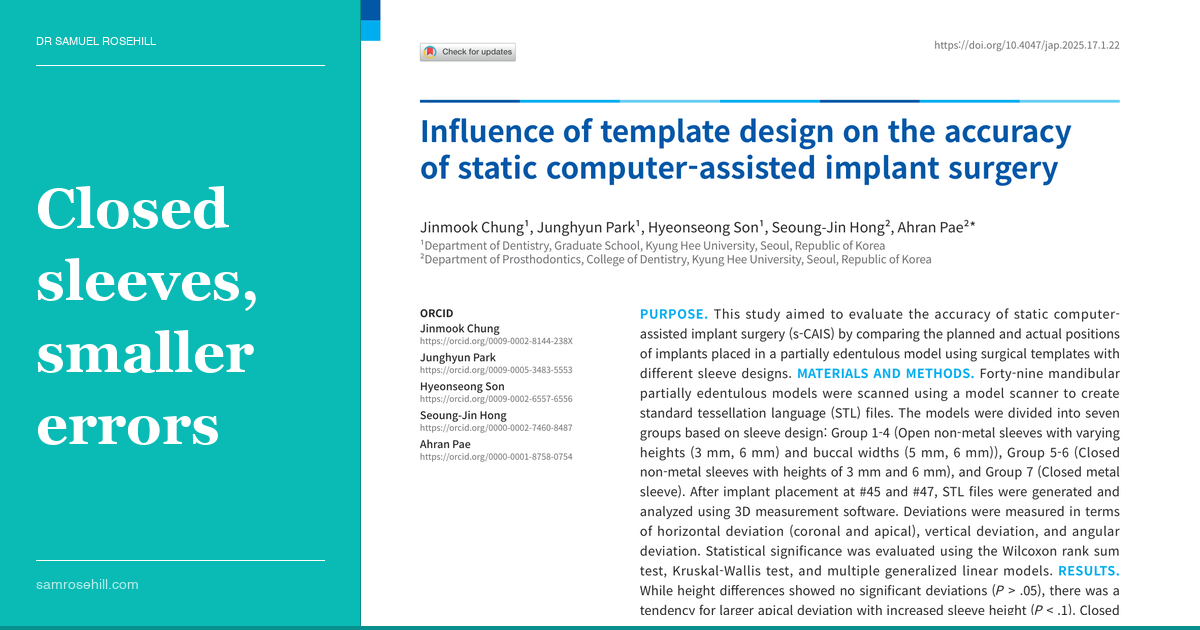
Source Paper
Influence of template design on the accuracy of static computer-assisted implant surgery
In posterior sites with limited interocclusal space, an open sleeve allows the drill to enter the guide through a lateral buccal window. The access advantage is obvious; the accuracy trade-off is not. Chung and colleagues’ Influence of template design on the accuracy of static computer-assisted implant surgery asks what that access costs. In 49 models, open sleeves produced larger coronal, apical and angular errors than closed designs, although the differences were small and often statistical trends rather than firm victories.
The Data Anchor
The team placed Osstem TS III implants at sites 45 and 47 in 49 identical partially edentulous mandibular models, giving 98 placements across seven guide designs. Static computer-assisted implant surgery (s-CAIS) templates were printed in RAYDENT Surgical Guide Resin after planning in Exoplan. The groups varied sleeve material, open or closed geometry, height at 3 or 6 mm, and lateral-window width at 5 or 6 mm.
Planned and placed implant files were superimposed. The investigators measured coronal, apical and vertical deviation in millimetres, plus angular deviation in degrees. Among 6-mm designs, closed metal and closed non-metal sleeves were almost twins: mean coronal error was 0.36 mm for both, apical error was 0.39 and 0.40 mm, and angular error was 1.04° and 1.05°. Open non-metal sleeves reached 0.47 mm, 0.57 mm and 1.65°, respectively.
Vertical error was the awkward cousin at the family photograph: 0.49 mm for both closed designs and 0.71 mm for open sleeves, without a corrected pairwise difference. Every placement came from one operator under controlled laboratory conditions — a small republic from which saliva, mucosal movement, limited mouth opening and patient-level improvisation had been politely excluded.
The closed sleeve won the measurement contest; the clinical verdict is less theatrical than the graph.
Key Findings
-
Closed geometry reduced mean error. Closed metal and non-metal sleeves performed similarly, while open sleeves had larger coronal, apical and angular deviations.
-
Extra sleeve height offered a hint, not a verdict. Mean apical deviation fell from 0.61 mm at 3 mm height to 0.51 mm at 6 mm, but this reached only P < .1.
-
A wider lateral window changed little. The 5- and 6-mm openings produced no significant difference in any deviation measure.
-
The laboratory scale remained reassuringly small. Group means stayed within 1 mm linearly and 2° angularly, but plastic models cannot reproduce soft tissue, movement, restricted access or the many small surprises supplied by patients.
💡 The Clinical Bottom Line
When access permits, a closed sleeve is the more conservative accuracy choice. When limited interocclusal space demands an open sleeve, this study does not make it clinical contraband; preserve the safety margin and treat the guide as a guide, rather than an instrument of destiny.
Dr Samuel Rosehill is a general dentist with a prosthodontic focus, practising at Ethical Dental in Coffs Harbour, NSW. He holds a BDSc (Hons) from the University of Queensland, an MBA, an MMktg, and an MClinDent in Fixed & Removable Prosthodontics (Distinction) from King’s College London.
Clinical Relevance
Closed metal and non-metal sleeves produced smaller mean coronal, apical and angular deviations than open sleeves in this model study. If posterior access requires an open sleeve, its mean errors were still modest; maintain the planned safety margin and remember that these were laboratory placements, not patient outcomes.
Disclosure: The author has no financial conflicts of interest related to the products or topics discussed in this review. This is an independent summary prepared for educational purposes.
Continue the conversation
This review is also published on Substack, where you can leave comments and join the discussion.
Read on Substack →