The Collagen Matrix Won at Three Months. Then the Graft Fought Back.
Ashurko et al. pit a xenogeneic volume-stable collagen matrix against the subepithelial connective tissue graft for buccal soft tissue augmentation at simultaneous implant placement — and the results flip between three and six months.
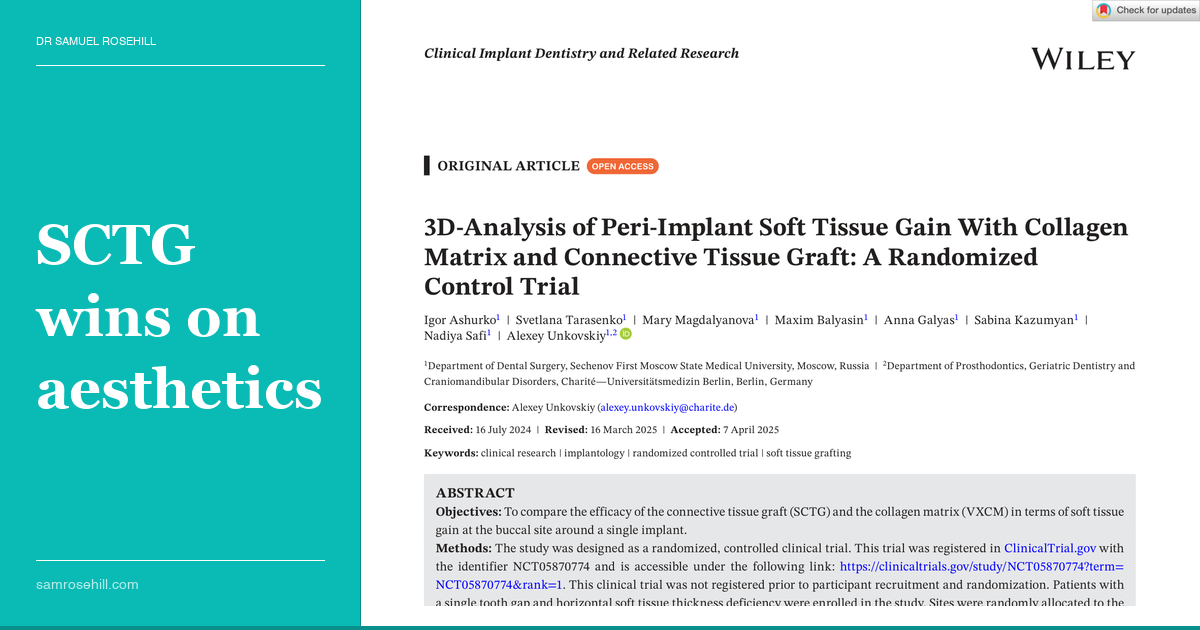
SCTG wins on aesthetics
Source Paper
3D-Analysis of Peri-Implant Soft Tissue Gain With Collagen Matrix and Connective Tissue Graft: A Randomized Control Trial
There is a particular kind of optimism that takes hold in the implant clinic when a new off-the-shelf material promises to do the job of a palatal harvest — same result, less suffering, no second surgical site. The xenogeneic volume-stable collagen matrix has been riding that wave for several years now, and the question is no longer whether it works but whether it works well enough.
Ashurko and colleagues, in a randomised controlled trial published in Clinical Implant Dentistry and Related Research, decided to find out — using 3D intraoral scanning to measure buccal soft tissue gain after simultaneous implant placement in the posterior mandible, comparing Geistlich Fibro-Gide (VXCM) against the subepithelial connective tissue graft (SCTG) harvested from the maxillary tuberosity.
The Data Anchor
Thirty-two patients with single posterior mandibular tooth gaps and buccal mucosal thickness deficiency were randomised 1:1 to receive SCTG (n = 16) or VXCM (n = 16) at the time of single-stage Astra Tech implant placement. Soft tissue thickness was measured via 3D analysis of intraoral scans (Primescan, Dentsply Sirona) at baseline, 3 months, and 6 months post-operatively.
Pain was tracked by VAS on days 1, 3, 5, and 7; NSAID consumption, oedema, OHIP-14 quality of life, and pink esthetic scores (PES) were assessed by blinded, calibrated examiners. The groups were comparable at baseline for age, gender, bone dimensions, and implant characteristics.
Key Findings
- At 3 months, the collagen matrix won on volume: VXCM achieved greater mean soft tissue thickness gain than SCTG (1.77 +/- 0.61 mm vs 1.26 +/- 0.41 mm, p = 0.0003) — a result that will surprise clinicians who default to autogenous grafts.
- At 6 months, the graft caught up and overtook: SCTG surpassed VXCM (1.43 +/- 0.81 mm vs 1.11 +/- 0.44 mm, p = 0.0459), likely because the collagen matrix underwent ongoing resorption while the autogenous tissue stabilised.
- SCTG delivered superior aesthetics: Total PES was higher for SCTG (11.86 vs 9.17, p < 0.001), driven by better soft tissue contour (75% scored “natural” vs 0% in VXCM) and absence of alveolar process deficiency (68.75% scored “none” vs 0%).
- The pain–swelling trade-off was not straightforward: SCTG patients reported more pain on days 1 and 3 (p = 0.002 and p = 0.024) and consumed more NSAIDs on day 3 (p = 0.027). But VXCM patients had more severe oedema on day 1 (62.5% severe vs 6.25%), and by day 3 still showed more swelling (75% vs 18.8% moderate edema, p < 0.001) — likely due to the larger graft volume displacing the flap.
- No difference in keratinised mucosa width or quality of life at any time point — both groups converged by 6 months on these secondary outcomes.
- Limitation: Small sample (n = 32), short follow-up, and the 6-month scan was taken after final crown placement — meaning crown pressure may have displaced tissue and confounded the thickness measurements.
💡 The Clinical Bottom Line
The collagen matrix is not a like-for-like replacement for the connective tissue graft — it is a trade-off. If your priority is long-term soft tissue volume and optimal pink aesthetics, SCTG harvested from the tuberosity remains the more reliable choice.
If your patient’s priority is a less painful recovery and you are treating a posterior site where a PES of 9 rather than 12 is clinically acceptable, VXCM earns its place.
The interesting wrinkle here is timing: the matrix outperforms the graft at three months but loses ground by six, which means the window in which you assess your outcome may determine which material you think is better.
Dr Samuel Rosehill is a general dentist with a prosthodontic focus, practising at Ethical Dental in Coffs Harbour, NSW. He holds a BDSc (Hons) from the University of Queensland, an MBA, an MMktg, and an MClinDent in Fixed & Removable Prosthodontics (Distinction) from King’s College London.
Reference: https://doi.org/10.1111/cid.70043
Clinical Relevance
SCTG remains the gold standard for buccal soft tissue thickness gain at single implant sites, delivering significantly better tissue volume and pink esthetic scores at six months. However, VXCM produces comparable tissue gain at three months with less pain and swelling — making it a defensible alternative when donor site morbidity is a primary concern.
Disclosure: The author has no financial conflicts of interest related to the products or topics discussed in this review. This is an independent summary prepared for educational purposes.
Continue the conversation
This review is also published on Substack, where you can leave comments and join the discussion.
Read on Substack →