A Connective Tissue Graft, 37 Years Later
Cabrera and Fernandes report a rare 37-year follow-up after connective tissue grafting for maxillary gingival recession, showing durable root coverage with a measured 1.5 mm relapse and a pointed reminder about thin periodontal phenotype.
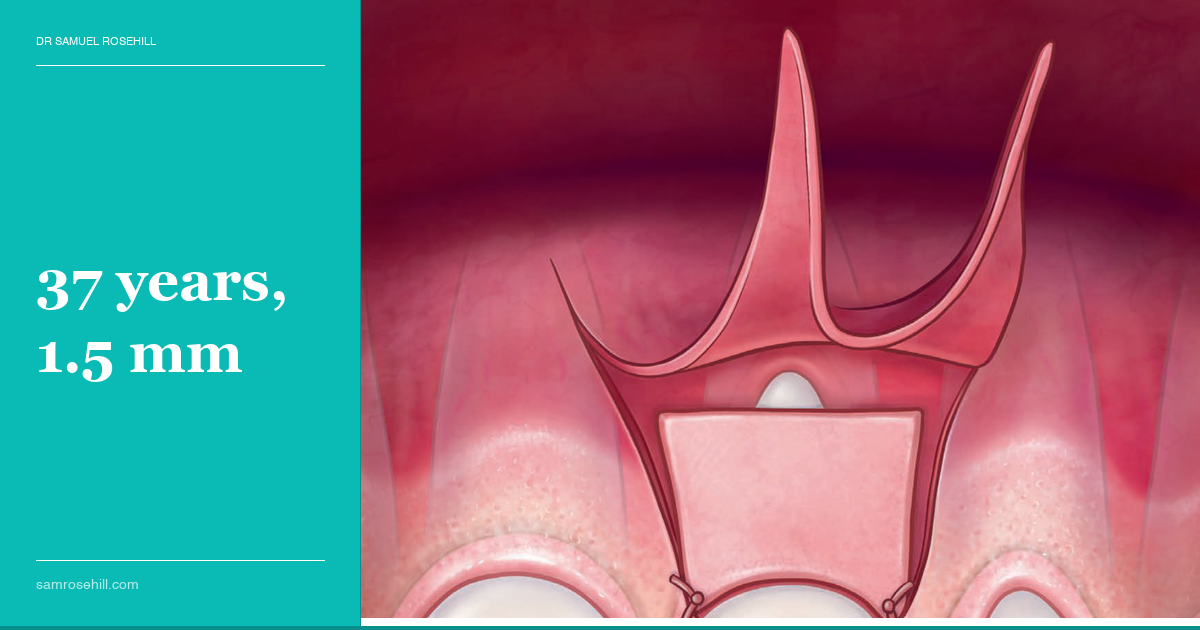
37 years, 1.5 mm
Source Paper
A 37-Year Retrospective Assessment of Connective Tissue Grafting: What Have We Learned? A Case Report
Some clinical photographs age like family albums. The hairstyle changes, the camera improves, and the tooth, with unnerving composure, remains there waiting to tell you whether your youthful surgical confidence was justified. Cabrera and Fernandes’ A 37-Year Retrospective Assessment of Connective Tissue Grafting: What Have We Learned? A Case Report is one of those rare periodontal stories in which the follow-up interval is almost old enough to have a mortgage.
The finding is both reassuring and wonderfully human: the graft worked, then time had a say. After 37 years, the treated maxillary central incisor still looked like a clinical success, but not a frozen one. That distinction is the paper’s gift; dentistry often asks whether a result lasts, when the better question is how it changes while lasting.
The Data Anchor
In 1987, a healthy 20-year-old woman presented with 4 mm facial gingival recession on tooth 21, classified as Miller class I, now recession type 1. Probing depth was 1 mm, with no bleeding on probing, occlusal trauma, hypersensitivity, or parafunctional habit reported.
The clinicians used a partial-thickness flap and a subepithelial connective tissue graft following the Langer and Langer protocol. The palatal graft was 2 mm thick and approximately 10 mm long. At six months, the site showed complete root coverage, recorded as -0.5 mm gingival recession. At 27 years, recession measured 1.0 mm. At 37 years, it measured 1.5 mm, with CBCT and clinical assessment pointing to a thin periodontal phenotype and a broader lifelong tendency toward root exposure.
Key Findings
- The early result was excellent. A 4 mm recession defect achieved complete root coverage within six months.
- The long-term result was stable, not static. The site showed 1.0 mm recession at 27 years and 1.5 mm at 37 years.
- Phenotype remained the plot twist. Thin periodontal phenotype and later orthodontic treatment were plausible contributors to relapse.
- The evidence level is intentionally modest. This is one case report, valuable because of duration, not because it estimates average outcomes.
💡 The Clinical Bottom Line
This paper is not telling you what percentage of connective tissue grafts will look good in 2063. It is telling you that root coverage can endure for decades, while still ageing with the patient and the periodontium around it.
For young patients with thin phenotype and visible recession, the lesson is to think in decades. A graft may solve the defect in front of you, but the phenotype keeps writing in the margins long after the sutures are gone.
Dr Samuel Rosehill is a general dentist with a prosthodontic focus, practising at Ethical Dental in Coffs Harbour, NSW. He holds a BDSc (Hons) from the University of Queensland, an MBA, an MMktg, and an MClinDent in Fixed & Removable Prosthodontics (Distinction) from King’s College London.
Clinical Relevance
This single case report cannot quantify the predictability of connective tissue grafting, but its 37-year follow-up is clinically valuable because it shows both durability and relapse. The treated site moved from a 4 mm recession defect to complete early root coverage, then settled at 1.5 mm recession after decades. Thin periodontal phenotype and orthodontic movement remain important long-term risk considerations.
Disclosure: The author has no financial conflicts of interest related to the products or topics discussed in this review. This is an independent summary prepared for educational purposes.
Continue the conversation
This review is also published on Substack, where you can leave comments and join the discussion.
Read on Substack →