The Conometric Prosthesis Let Go More Often.
A retrospective study of 203 patients and 1,356 implants found similar survival and overall prosthetic success for immediate-loading conometric and screw-retained full-arch prostheses, but conometric restorations detached more often.
Detachment shadowed the conometrics
Source Paper
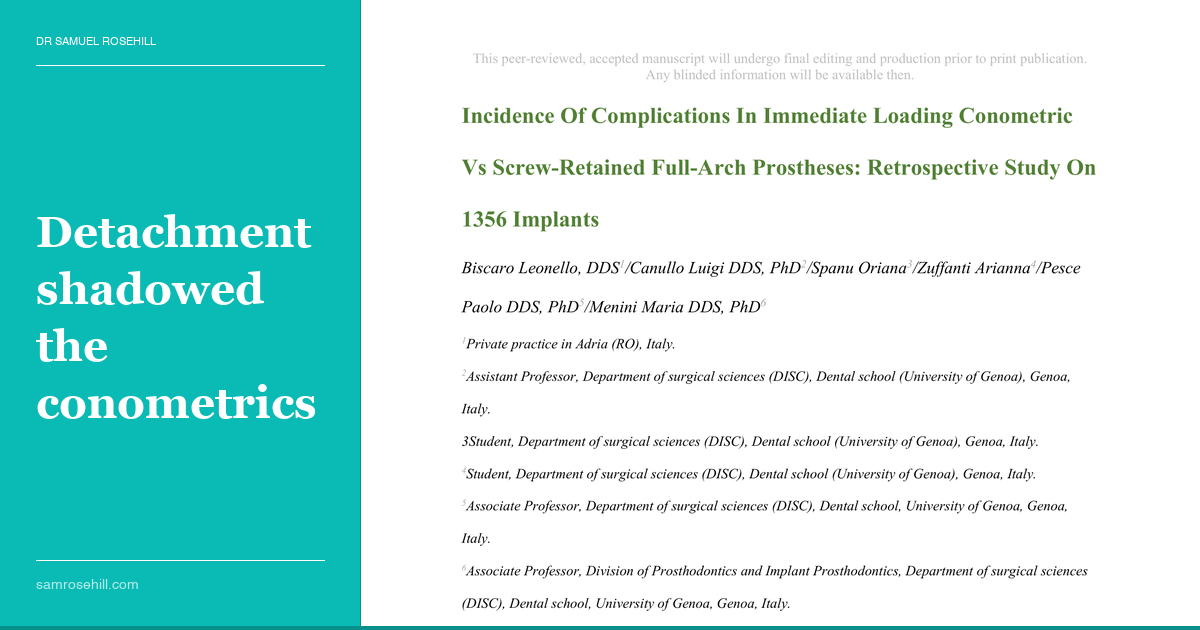
Incidence Of Complications In Immediate Loading Conometric Vs Screw-Retained Full-Arch Prostheses: Retrospective Study On 1356 Implants
Retention systems in implant prosthodontics tend to acquire reputations the way politicians do: one is praised for its discipline, another for its elegance, and both become exhausting the moment something falls off. In Incidence Of Complications In Immediate Loading Conometric Vs Screw-Retained Full-Arch Prostheses: Retrospective Study On 1356 Implants, Leonello Biscaro and colleagues ask the sensible question lurking beneath the marketing language. When a complete immediate-loading rehabilitation is retained conometrically rather than with screws, what actually happens in practice?
The answer is not dramatic, which is often a relief. Survival and overall prosthetic success were broadly similar. The awkwardness arrived elsewhere: conometric prostheses detached more often.
The Data Anchor
This was a retrospective study of 203 patients treated with complete immediate-loading prostheses supported by 1,356 implants and 261 fixed prostheses. Of those restorations, 65 used conometric retention and 196 were screw-retained. The mean follow-up was 28.5 months, with a range of 12 to 80 months.
The authors evaluated implant survival, prosthesis success, and both technical and biologic complications. That matters because immediate full-arch prosthodontics is not improved by airy declarations that a system is “promising.” It is improved by knowing which kind of nuisance is most likely to turn up later, preferably before the nuisance introduces itself chairside.
Key Findings
- Implant survival stayed high, regardless of retention choice. During follow-up, 27 implants failed, which amounted to an overall implant failure rate of 2%, with no statistically significant difference between conometric and screw-retained groups.
- Overall prosthetic success was respectable but not immaculate. The global prosthetic success rate was 89.3%, again without a significant difference between the two retention systems.
- Screw loosening remained the profession’s dependable houseguest. It was the most frequent complication, occurring in 4.2% of cases, followed by chipping or fracture of the veneering material.
- The conometric catch was detachment. Prosthesis loss of retention occurred in 9.2% of conometric prostheses, and this was the signal that separated the groups in a clinically meaningful way.
- So the trade is not survival versus failure, but nuisance versus nuisance. The conometric approach did not collapse the treatment model; it simply came with a greater tendency to let the prosthesis part company with its appointed position.
💡 The Clinical Bottom Line
If you are choosing between conometric and screw-retained retention for an immediately loaded full-arch case, this paper suggests you should stop expecting a morality play. One system is not saintly and the other wicked. Both can work. But conometric retention appears to buy its screwdriver-free neatness with a higher chance of detachment.
That is the sort of trade-off a clinician can live with, provided it is named honestly beforehand. Nothing ruins a prosthodontic romance faster than discovering that the thing which looked elegantly simple in theory has become intermittently detachable in real life.
Dr Samuel Rosehill is a general dentist with a prosthodontic focus, practising at Ethical Dental in Coffs Harbour, NSW. He holds a BDSc (Hons) from the University of Queensland, an MBA, an MMktg, and an MClinDent in Fixed & Removable Prosthodontics (Distinction) from King’s College London.
Clinical Relevance
Both conometric and screw-retained immediate-loading full-arch prostheses appear clinically workable from a survival standpoint. The practical distinction is retention behaviour: if you choose conometric retention, you should do so with open eyes about the higher risk of prosthesis detachment.
Disclosure: The author has no financial conflicts of interest related to the products or topics discussed in this review. This is an independent summary prepared for educational purposes.
Continue the conversation
This review is also published on Substack, where you can leave comments and join the discussion.
Read on Substack →