When the Splint Doesn't Earn Its Place: TMD, Neck Pain, and the Quiet Case for Less
A randomised trial by Cimino et al. found that adding a hard stabilisation splint to counselling produced no additional benefit on neck pain or cervical disability over three months in TMD patients — suggesting clinicians can reasonably defer the splint when conservative self-management is already moving the numbers.
Splint adds nothing for neck pain
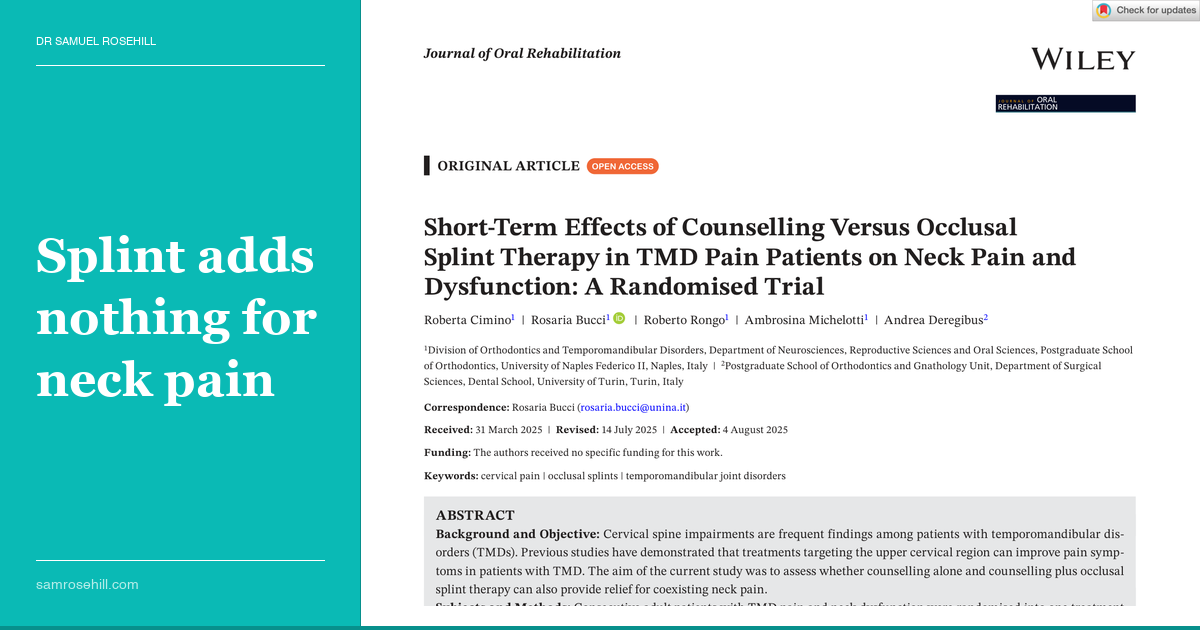
Source Paper
Short-Term Effects of Counselling Versus Occlusal Splint Therapy in TMD Pain Patients on Neck Pain and Dysfunction: A Randomised Trial
Clinical medicine has a complicated relationship with the things it adds. Every year, the evidence base politely walks back some intervention that accumulated consensus not because it worked but because it seemed reasonable, fitted a plausible mechanism, and nobody had yet run the trial to check. The negative trial is, in this sense, a public service: less glamorous than a breakthrough, but arguably more useful.
Cimino and colleagues, writing in the Journal of Oral Rehabilitation, have delivered one of those trials. “Short-Term Effects of Counselling Versus Occlusal Splint Therapy in TMD Pain Patients on Neck Pain and Dysfunction: A Randomised Trial” asks whether, in patients with temporomandibular disorders (TMD) and concurrent neck pain, adding a hard stabilisation occlusal splint to counselling improves neck pain or cervical disability beyond counselling alone. The answer, at three months, is no.
The Data Anchor
Sixty-seven patients with pain-related TMD and concurrent neck pain were recruited at the University of Turin and randomised into counselling only (group C, n = 35; 27 completed) or counselling plus a Michigan-type hard resin stabilisation occlusal splint (group OS, n = 32; 24 completed). Eight patients per group were lost to follow-up, leaving 52 in the per-protocol analysis.
Counselling covered TMD aetiology, jaw muscle relaxation, avoidance of parafunctional habits, soft diet, and a home practice programme with audio-visual reminders. The occlusal splint (OS) group received identical counselling plus a full-coverage upper hard resin splint worn nightly.
Neck pain was assessed via the visual analogue scale (VAS), a 100 mm horizontal scale, and cervical disability via the Neck Disability Index (NDI), a 10-item questionnaire scored to 50.
The statistician was blinded to group allocation throughout. What they found was, by most clinical definitions, unremarkable — and therefore rather important.
Key Findings
- Both groups showed significant neck pain reductions at three months. Group C: −7.0 mm (p = 0.006); group OS: −8.0 mm (p = 0.02). Between-group difference: p = 0.69. The splint moved nothing further.
- NDI improved in both groups. Group C: −3.3 points (p = 0.007); group OS: −4.2 points (p = 0.001); between-group difference p = 0.57. Both remained in the “mild disability” category; the absolute magnitudes fall below typical thresholds for clinically noticeable change.
- Effect sizes were small throughout (Cohen’s d < 0.5), confirming the null result rather than underpowering a real difference.
- Counselling-only patients gained more in pain-free maximum mouth opening (2.6 ± 5.8 mm, p = 0.03); the splint group did not reach significance, suggesting device reliance may reduce engagement with self-management behaviours.
- A baseline TMD pain imbalance warrants note: the counselling group entered with significantly higher TMD pain (p = 0.043), a potential confounder for pain comparisons, though not for the primary neck outcomes.
- Caveats: 3-month follow-up is short; dropout reduced statistical power; no splint adherence data collected; per-protocol analysis only.
💡 The Clinical Bottom Line
The practical implication repays precise reading. This trial does not tell us the splint is useless in TMD; it tells us the splint does not appear to add anything to counselling when neck pain is the presenting complaint over three months. That is a different, more useful, finding.
For the clinician whose patient presents with TMD and neck pain as the dominant concern, the data offer quiet permission to start conservative: self-management education, parafunctional habit modification, soft diet, jaw rest. The cervical numbers moved without the splint.
There is something quietly liberating about a negative trial well conducted. It does not tell you what to do next; it tells you what you do not have to do first.
Dr Samuel Rosehill is a general dentist with a prosthodontic focus, practising at Ethical Dental in Coffs Harbour, NSW. He holds a BDSc (Hons) from the University of Queensland, an MBA, an MMktg, and an MClinDent in Fixed & Removable Prosthodontics (Distinction) from King’s College London.
Clinical Relevance
In TMD patients presenting with concurrent neck pain, adding a hard stabilisation splint to counselling produced no additional benefit on visual analogue scale neck pain scores or Neck Disability Index scores compared to counselling alone over three months. Clinicians can reasonably defer splint fabrication as an initial step, particularly when structured self-management is already producing cervical improvement — reserving the splint for cases where counselling alone proves insufficient.
Disclosure: The author has no financial conflicts of interest related to the products or topics discussed in this review. This is an independent summary prepared for educational purposes.
Continue the conversation
This review is also published on Substack, where you can leave comments and join the discussion.
Read on Substack →