The 30-Minute Conversation That Beats the Splint Alone
A randomised controlled trial of 426 patients by Haggag and colleagues found that adding a structured doctor–patient communication protocol to splint therapy produced dramatically better pain, psychological distress, and satisfaction outcomes than splint therapy alone — with a 12-month satisfaction gap too large to dismiss.
30 minutes changes everything
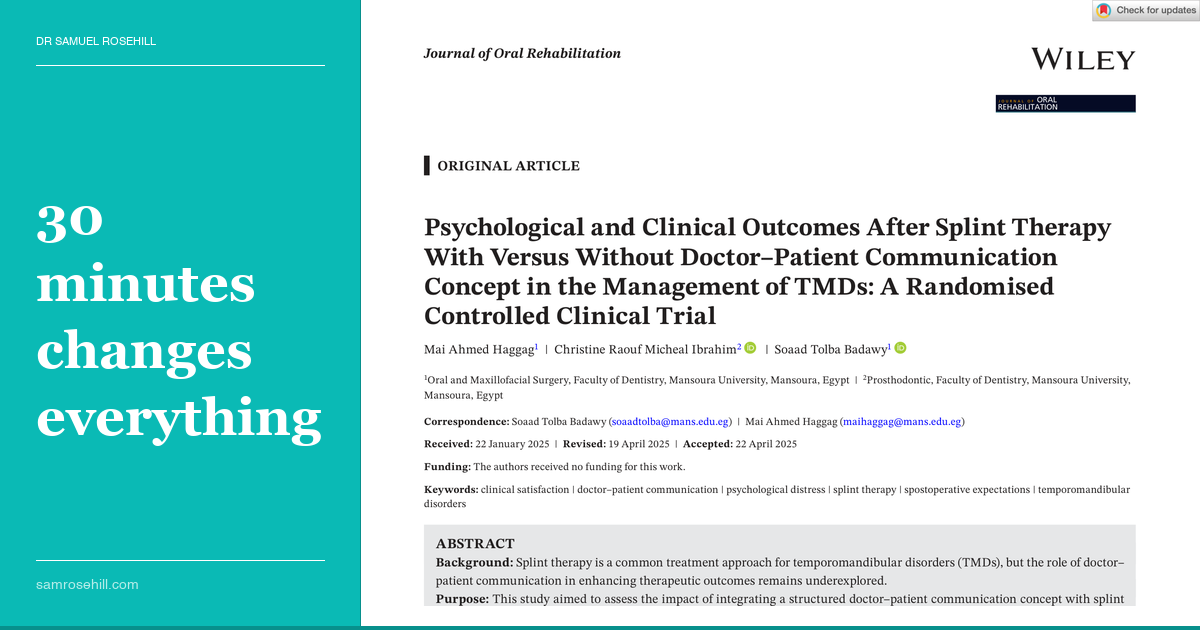
Source Paper
Psychological and Clinical Outcomes After Splint Therapy With Versus Without Doctor–Patient Communication Concept in the Management of TMDs: A Randomised Controlled Clinical Trial
Dentistry has spent forty years refining its approach to the temporomandibular joint: the condylar cartilage research, the occlusal splint designs, the vertical dimension debate, the argument about repositioning versus stabilisation. All of it earnest, much of it genuinely useful. And then Haggag and colleagues conduct a randomised controlled trial and find that the single most powerful adjunct to splint therapy is, apparently, a proper conversation.
Psychological and Clinical Outcomes After Splint Therapy With Versus Without Doctor–Patient Communication Concept in the Management of TMDs: A Randomised Controlled Clinical Trial is a study that should sit slightly uncomfortably on the lunch-room table of every temporomandibular disorders (TMD) clinic running fifteen-minute review appointments.
The Data Anchor
The trial enrolled 435 patients at Mansoura University, Egypt, randomised 1:1, and retained 426 in final analysis: 212 controls (splint therapy with standard factual counselling) and 214 in the study group (splint therapy plus a structured doctor–patient communication (DPC) protocol requiring a minimum 30-minute consultation per visit). Both groups received the same occlusal splint from thermo-polymerisable acrylic resin with mutually protected occlusion.
Psychological distress was measured using the Depression Anxiety Stress Scale-10 (DASS-10), a validated 10-item instrument scored 0–30; clinical outcomes included intra-articular pain via the Visual Analog Scale (VAS), maximal interincisal mouth opening (MO) in millimetres, joint sounds, and muscular palpation pain. Patient satisfaction was collected at 6 and 12 months on a 10-point Likert scale. Both groups were well matched at baseline: DASS-10 scores of 10.92 versus 10.84, VAS pain of 4.16 versus 4.21, MO of 26.68 mm versus 26.89 mm.
Both groups improved. The divergence was not subtle.
Key Findings
- Psychological distress at 6 months fell dramatically further in the communication group. DASS-10: study 2.31 ± 2.29 versus control 7.06 ± 4.18 (P < .001). The control group still met criteria for mild-to-moderate distress; the DPC group had largely exited the symptomatic range.
- Pain and mouth opening both favoured structured communication. VAS intra-articular pain: 0.74 versus 1.17 (P = .001); MO at 6 months: 42.18 mm versus 40.67 mm (P = .001).
- Joint sounds were eliminated more completely. DPC group reached a median score of 0 at 6 months; control remained at 1 (P < .001).
- The satisfaction gap became alarming by 12 months. Overall satisfaction: study 8.75 ± 0.97 versus control 4.72 ± 0.64 (P < .001). Postoperative expectation fulfilment: 8.25 versus 3.95. The control group’s score had essentially halved; the DPC group’s was unchanged (within-group P = .104 for study, P < .001 for control).
- Limitations are real. Single-centre, clinical diagnosis only (no MRI confirmation, ruled out by feasibility), and 12-month follow-up does not yet resolve questions about durability. The sample was predominantly young adult females, consistent with TMD epidemiology but not universally generalisable.
💡 The Clinical Bottom Line
The appointment-length pressure that pushes clinicians away from extended consultation is, according to this trial, pushing them away from their most effective tool. A structured approach — empathic listening, open questions, space for the patient to articulate concerns without interruption — produced outcomes that acrylic and articulating paper alone simply cannot replicate. Whether a 30-minute block fits every practice is a fair question; whether the evidence supports it is not.
There is something quietly clarifying about a randomised trial that randomises conversation. The control group received a splint and correct information, delivered efficiently and factually. The study group received the same splint, the same information, and someone who listened. At 12 months, one group’s satisfaction had collapsed to 4.72 out of 10 and the other’s sat at 8.75. The splint was identical.
Dr Samuel Rosehill is a general dentist with a prosthodontic focus, practising at Ethical Dental in Coffs Harbour, NSW. He holds a BDSc (Hons) from the University of Queensland, an MBA, an MMktg, and an MClinDent in Fixed & Removable Prosthodontics (Distinction) from King’s College London.
Clinical Relevance
For patients with temporomandibular disorders presenting with pain and psychological distress, structuring at least 30 minutes of empathic, open-ended discussion alongside standard splint therapy produced dramatically better outcomes than splint therapy with routine counselling alone. At 12 months, the satisfaction gap between groups was nearly double; the data make a compelling case for booking longer appointments rather than better materials.
Disclosure: The author has no financial conflicts of interest related to the products or topics discussed in this review. This is an independent summary prepared for educational purposes.
Continue the conversation
This review is also published on Substack, where you can leave comments and join the discussion.
Read on Substack →