The Three-Month Rule Gets an RCT
A randomised controlled trial from Ain Shams University finds no significant difference in survival, stability, or marginal bone loss between immediate molar implants loaded at six weeks versus three months, provided primary stability is confirmed with fully guided placement.
Early loading holds up
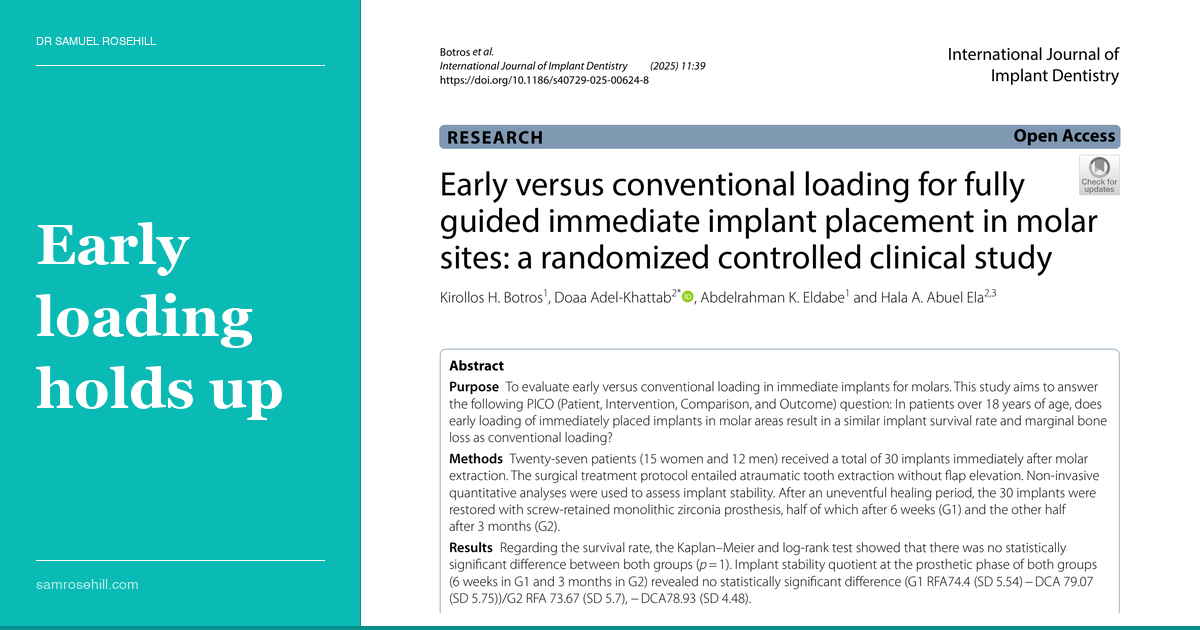
Source Paper
Early versus conventional loading for fully guided immediate implant placement in molar sites: a randomized controlled clinical study
The three-month molar healing wait is one of implant dentistry’s most durable orthodoxies. It traces to Brånemark’s original protocols from the 1970s; it has survived surface modifications and torque thresholds; and it continues to organise the molar implant timeline for clinicians who absorbed it in dental school without anyone running a controlled trial to test whether it is actually necessary for immediately placed implants.
Early versus conventional loading for fully guided immediate implant placement in molar sites: a randomized controlled clinical study, by Botros, Adel-Khattab, Eldabe, and Abuel Ela from Ain Shams University and Assiut University, is a proper RCT that tests exactly this. For the thirty implants in this study, the null hypothesis won.
The Data Anchor
Twenty-seven patients (15 women, 12 men) received 30 implants immediately following atraumatic molar extraction, without flap elevation, across maxillary and mandibular molar sites. All placements were fully guided using Exoplan software (CBCT merged with intraoral scan), with both osteotomy and fixture insertion performed through the surgical guide. Implants with a final torque below 30 Ncm were replaced or excluded.
Patients were then randomised to receive their monolithic zirconia screw-retained crowns at either six weeks (G1, early loading) or three months (G2, conventional loading). Stability was measured non-invasively at placement and at the prosthetic phase using the Penguin RFA (ISQ values) and Anycheck (DCA values). Marginal bone loss was assessed radiographically at placement and twelve months using the long-cone paralleling technique.
Key Findings
- 100% survival rate in both groups at twelve months; the Kaplan-Meier log-rank test returned p = 1, and the null hypothesis was not rejected.
- Stability at the prosthetic phase was statistically identical: G1 RFA 74.4 (SD 5.54), DCA 79.07 (SD 5.75) versus G2 RFA 73.67 (SD 5.7), DCA 78.93 (SD 4.48); p = 0.724 and p = 0.944.
- Marginal bone loss was clinically negligible and equivalent: G1 mean MBL 0.17 mm (SD 0.07) versus G2 0.18 mm (SD 0.08), maximum 0.34 mm across the cohort; p = 0.639. All implants met Albrektsson radiographic success criteria.
- Patient satisfaction: all 27 patients said they would undergo the same procedure again, at both prosthesis delivery and twelve-month follow-up. No significant differences in functional or aesthetic satisfaction between groups.
- Caveats worth holding: small sample (n = 30 across 27 patients), single-centre, twelve months of follow-up only, no soft tissue assessment, heterogeneous socket morphology. Notably, this appears to be the first RCT comparing type 1B versus type 1C protocols for molars with non-splinted prostheses.
💡 The Clinical Bottom Line
If you are placing immediately into a fresh molar socket with a fully guided protocol and routinely achieving insertion torques at or above 30 Ncm, this trial suggests the patient does not need to wait three months to receive their crown. Six weeks produced the same bone and stability outcomes as the conventional protocol, and the patient satisfaction data adds an irresistible footnote: everyone in both groups said yes, they would do it again.
The operative word is “fully.” Fully guided placement is doing considerable work in this protocol — it guarantees both ideal position and primary stability in a way that freehand extraction-socket placement simply does not. This data does not travel beyond that context.
The honest position is that a single RCT with thirty implants does not overturn four decades of convention. But the data lines up with the view that the three-month rule, for well-stabilised immediate implants, is a threshold we have been clearing when we could have been stopping earlier. The question worth asking is not whether six weeks is safe; it is whether anyone is still waiting for a reason to revisit the orthodoxy.
Dr Samuel Rosehill is a general dentist with a prosthodontic focus, practising at Ethical Dental in Coffs Harbour, NSW. He holds a BDSc (Hons) from the University of Queensland, an MBA, an MMktg, and an MClinDent in Fixed & Removable Prosthodontics (Distinction) from King’s College London.
Clinical Relevance
For immediately placed molar implants with confirmed primary stability (≥30 Ncm insertion torque) and fully guided placement, loading at six weeks produced the same survival rate, stability measurements, and marginal bone loss as the conventional three-month wait. Both groups achieved 100% survival at twelve months. The caveat is that the study is small and single-centre, with twelve months of follow-up — but the directionality is clear enough to revisit your default timeline.
Disclosure: The author has no financial conflicts of interest related to the products or topics discussed in this review. This is an independent summary prepared for educational purposes.
Continue the conversation
This review is also published on Substack, where you can leave comments and join the discussion.
Read on Substack →