One Implant May Carry the Mandibular Denture Better Than Expected
Ye and colleagues review 11 randomised trials comparing one- and two-implant mandibular overdentures, finding no clear disadvantage for single implants in marginal bone loss or common prosthetic complications, with implant-failure results that deserve careful wording.
One may be enough
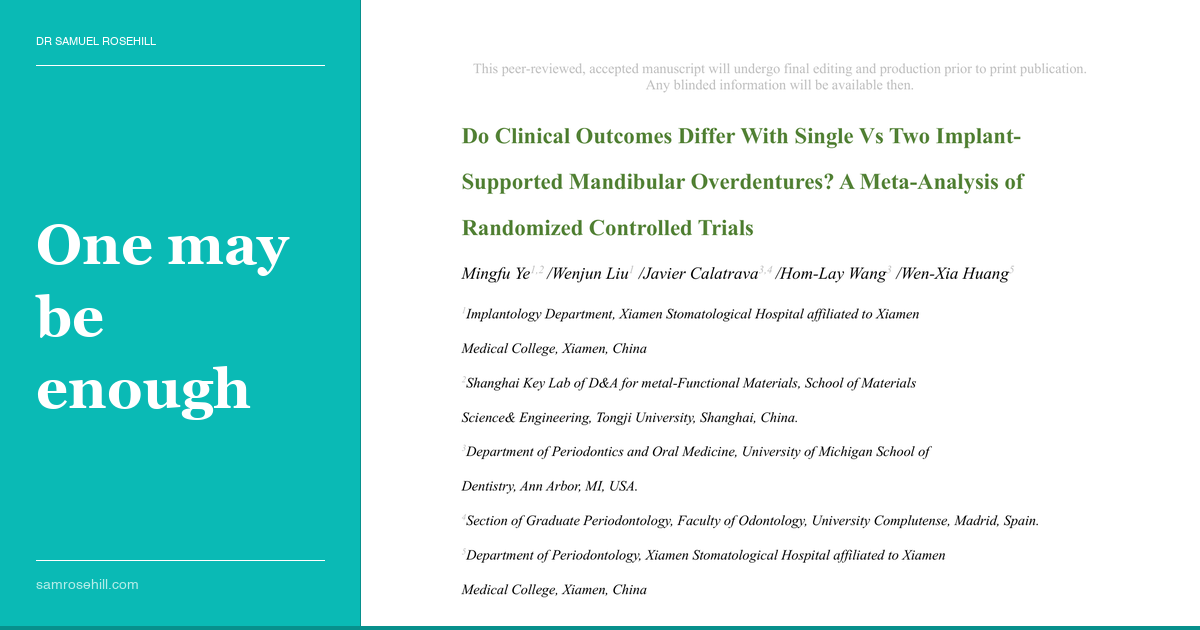
Source Paper
Do Clinical Outcomes Differ With Single Vs Two Implant-Supported Mandibular Overdentures? A Meta-Analysis of Randomized Controlled Trials
The edentulous mandible has a way of turning consensus statements into invoices. Two implants may be the tidy professional answer, but patients arrive with budgets, bone, transport problems, and a private wish not to spend the rest of the year eating soup. Ye and colleagues’ Do Clinical Outcomes Differ With Single Vs Two Implant-Supported Mandibular Overdentures? A Meta-Analysis of Randomized Controlled Trials asks the uncomfortable practical question: what if one implant is not the compromise we assume it is?
The answer is not a manifesto for doing less. It is a carefully worded permission slip. Across the available RCTs, single-implant overdentures did not show a clear disadvantage for marginal bone loss or the prosthetic complications the authors could pool.
The Data Anchor
The review searched PubMed, Embase, Scopus, Web of Science, and the Cochrane Library to October 6, 2024, retaining 11 randomised controlled trials. The pooled clinical dataset included 190 patients in the single-implant group, receiving 192 implants, and 192 patients in the two-implant group, receiving 384 implants.
At one year, implant failure affected 4 of 134 single-implant patients and 13 of 137 two-implant patients, a difference that favoured the single implant but did not reach statistical significance. At 2 to 3 years, the subgroup result did reach significance: 3 of 63 failures in the single-implant group compared with 12 of 60 in the two-implant group. At five years, the difference again was not significant.
Key Findings
- One implant did not look biologically reckless. Overall marginal bone loss did not differ significantly between groups (MD -0.15 mm; 95% CI -0.31 to 0.01).
- The failure signal favoured single implants in one subgroup. At 2 to 3 years, failure was lower with single implants, but the authors rightly emphasise the limited number of RCTs and small samples.
- Common maintenance events were not clearly worse. Overdenture fracture, relining, and metal housing reattachment did not differ significantly between designs.
- The caveat is power, not plausibility. Attrition bias, varied loading protocols, and sparse longer-term data keep the conclusion cautious.
💡 The Clinical Bottom Line
For the patient who cannot afford two implants, a single midline implant-supported mandibular overdenture deserves a serious conversation rather than a patronising sigh. The evidence does not show that one implant automatically buys the patient more biological or prosthetic trouble.
But economy is not magic. A single-implant overdenture still needs careful loading decisions, sensible maintenance planning, and a denture base designed as though physics has been invited to the appointment.
Dr Samuel Rosehill is a general dentist with a prosthodontic focus, practising at Ethical Dental in Coffs Harbour, NSW. He holds a BDSc (Hons) from the University of Queensland, an MBA, an MMktg, and an MClinDent in Fixed & Removable Prosthodontics (Distinction) from King’s College London.
Clinical Relevance
For edentulous mandibular patients who cannot access a two-implant overdenture, this meta-analysis supports cautious consideration of a single midline implant as a lower-cost option. The evidence does not show a clear marginal bone loss or common prosthetic complication penalty, but the available RCTs remain limited and small. The decision should still account for denture reinforcement, maintenance access, loading protocol, and patient expectations.
Disclosure: The author has no financial conflicts of interest related to the products or topics discussed in this review. This is an independent summary prepared for educational purposes.
Continue the conversation
This review is also published on Substack, where you can leave comments and join the discussion.
Read on Substack →