The Digital Immediate Implant Workflow: Beautiful Results, Uncomfortable Failure Rate
Donker and colleagues test a fully digital workflow for immediate implant placement and provisionalization in the maxillary aesthetic zone — prefabricated temporaries, guided surgery, excellent aesthetics — but a 10% early failure rate complicates the narrative.
Beautiful but fragile
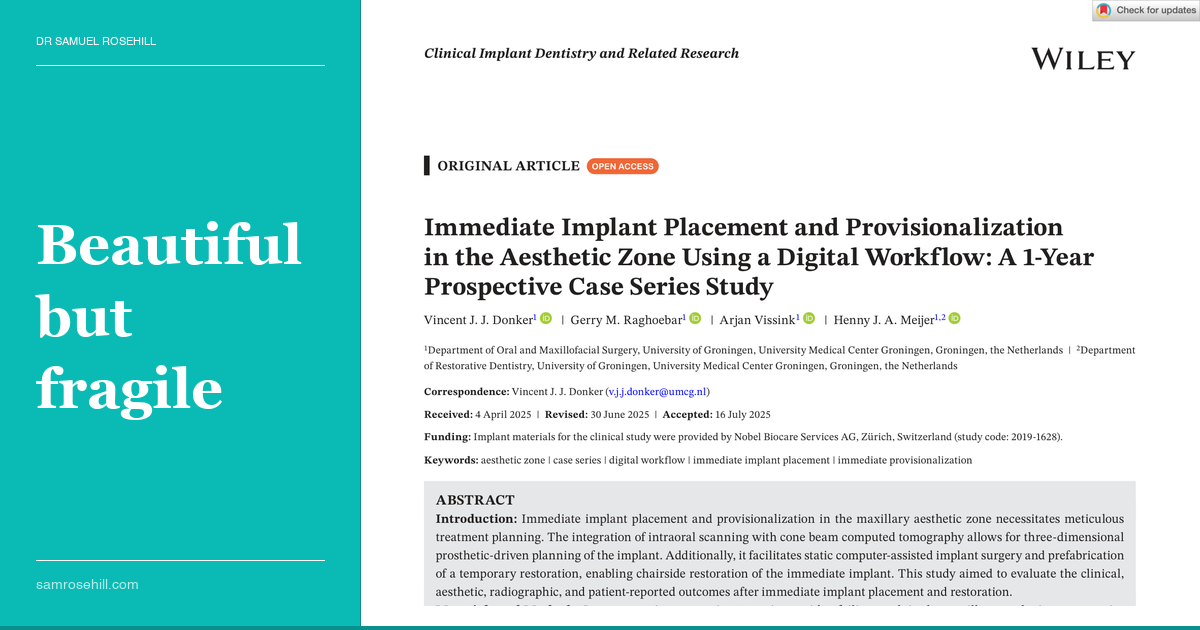
Source Paper
Immediate Implant Placement and Provisionalization in the Aesthetic Zone Using a Digital Workflow: A 1-Year Prospective Case Series Study
In architecture, the term “prefabrication” conjures images of efficiency and precision: components manufactured off-site, delivered to specification, slotted into place with satisfying exactness. The appeal of applying this philosophy to immediate implant placement in the aesthetic zone is obvious. Scan the patient, merge the CBCT, plan the implant in three dimensions, print the surgical guide, mill the temporary crown, and arrive at surgery with everything ready to go. Donker and colleagues, writing in Clinical Implant Dentistry and Related Research, tested exactly this workflow in a prospective case series of 30 patients at the University Medical Center Groningen, and the results are simultaneously encouraging and sobering.
The Data Anchor
Each patient presented with a failing tooth in the maxillary aesthetic zone and received a NobelActive TiUltra implant placed flaplessly using a 3D-printed surgical guide, followed by immediate provisionalization with a prefabricated PMMA temporary shell bonded to a trimmed snap abutment. The definitive restoration (a zirconia abutment with buccal porcelain veneer) was delivered three months later. Clinical, aesthetic, radiographic, and patient-reported outcomes were assessed at baseline, six weeks post-temporary, and one month and one year post-definitive. All surgeries were performed by a single oral and maxillofacial surgeon, all restorations by two prosthodontists, and all laboratory work by one dental laboratory.
Key Findings
- Three of 30 implants failed early (survival rate 90% at placement), all before definitive restoration. The remaining 27 implants showed 100% survival and 96% success at one year.
- Aesthetic outcomes were strong: the mean Pink Esthetic Score/White Esthetic Score was 15.4 out of 20 at one year, with papilla preservation and stable soft tissue contours in most cases.
- Marginal bone loss was minimal: mean changes of −0.18 mm mesially and −0.44 mm distally between placement and one-year follow-up, with median buccal bone thickness remaining stable after grafting.
- Patient satisfaction averaged 9.2 out of 10, and the prefabricated temporary could be placed chairside in all 30 cases without modification of the surgical plan.
- The digital workflow eliminated the need for a conventional impression at the provisional stage, reducing clinical time and the number of patient visits.
The 10% early failure rate in this series is notably higher than the 2–5% typically reported for immediate placement protocols. All three failures occurred in the first months, suggesting that patient selection or the specific implant-bone interface in flapless guided placement warrants closer scrutiny. This is a case series without a control group, which limits causal interpretation.
💡 The Clinical Bottom Line
The digital workflow for immediate anterior implants delivers what it promises for the patients who clear the early healing hurdle: efficient chairside provisionalization, excellent aesthetics, minimal bone loss, and high satisfaction. But the 10% failure rate is the elephant in the operatory. For clinicians adopting this protocol, the conversation with the patient needs to be as precisely engineered as the surgical guide: the technology is elegant, the biology remains unpredictable, and one in ten may need to start again.
Dr Samuel Rosehill is a general dentist with a prosthodontic focus, practising at Ethical Dental in Coffs Harbour, NSW. He holds a BDSc (Hons) from the University of Queensland, an MBA, an MMktg, and an MClinDent in Fixed & Removable Prosthodontics (Distinction) from King’s College London.
Reference: Donker VJJ, Raghoebar GM, Vissink A, Meijer HJA. Immediate Implant Placement and Provisionalization in the Aesthetic Zone Using a Digital Workflow: A 1-Year Prospective Case Series Study. Clin Implant Dent Relat Res. 2025;27:e70079. doi:10.1111/cid.70079
Clinical Relevance
A fully digital workflow for immediate anterior implants delivers excellent aesthetics and patient satisfaction for those who survive the early phase, but the 10% early failure rate demands honest patient consent conversations.
Disclosure: The author has no financial conflicts of interest related to the products or topics discussed in this review. This is an independent summary prepared for educational purposes.
Continue the conversation
This review is also published on Substack, where you can leave comments and join the discussion.
Read on Substack →