Composite vs Zirconia Socket Sealers: Pick Your Trade-Off
A randomised clinical trial compares chairside composite and prefabricated zirconia sealing socket abutments for posterior immediate implants — finding that composite preserves buccal volume while zirconia delivers shallower probing depths.
Composite saves contour
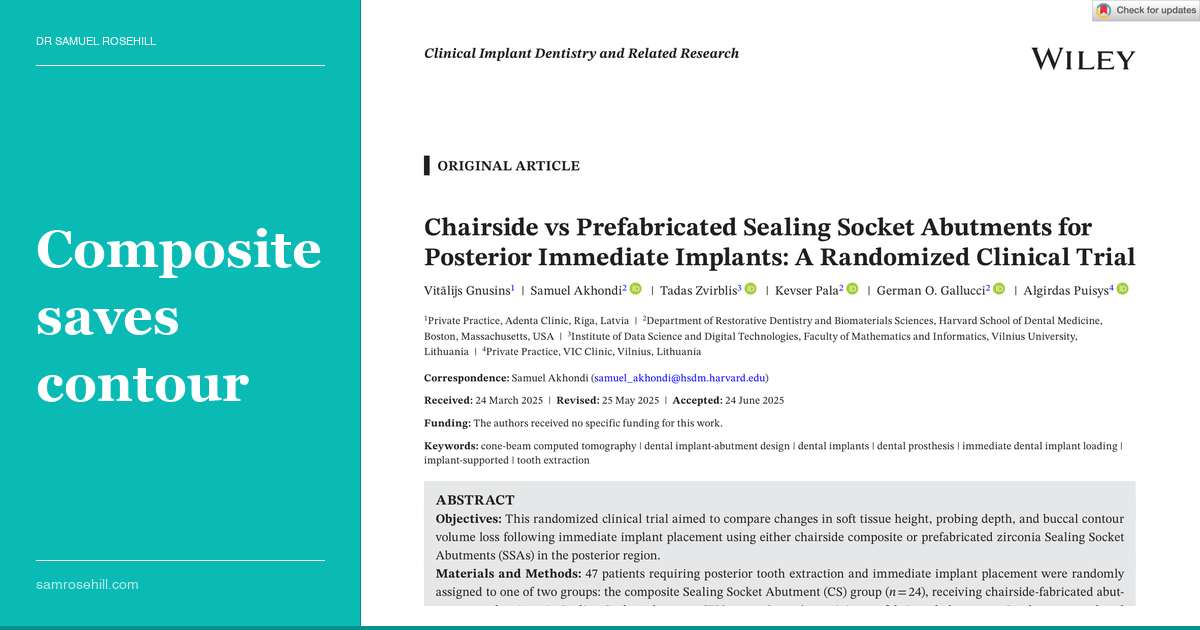
Source Paper
Chairside vs Prefabricated Sealing Socket Abutments for Posterior Immediate Implants: A Randomized Clinical Trial
You have just placed an immediate implant in a lower first molar socket, the allograft is tucked into the jumping distance, and now comes the question that separates you from your coffee break: do you seal this socket with chairside composite or that prefabricated zirconia abutment you had milled from the digital plan?
Gnusins, Akhondi, and colleagues finally put the question to a randomised clinical trial in Chairside vs Prefabricated Sealing Socket Abutments for Posterior Immediate Implants (Clinical Implant Dentistry and Related Research, 2025) — and the answer depends entirely on which compromise you can live with.
The Data Anchor
Forty-seven patients were randomised to receive either a chairside composite SSA (CS group, n = 24) or a prefabricated zirconia SSA (ZR group, n = 23) at a single centre in Riga. All implants were Straumann BLX platforms placed via guided surgery, with allogeneic bone graft (Maxgraft) filling the buccal gap. The primary outcome — supra-platform tissue height (SPTH) on CBCT — was assessed at baseline and three months.
Both groups held their vertical tissue height admirably: SPTH changed by just −0.17 mm in the composite group and −0.44 mm in the zirconia group, with no statistically significant difference between them (p > 0.05). Horizontal tissue, however, told a less forgiving story.
Total horizontal tissue decreased by 1.00 mm in the CS group and 1.17 mm in the ZR group (p < 0.001 for both over time) — a reminder that extraction-socket remodelling remains stubbornly indifferent to our best intentions.
The real divergence appeared in the secondary outcomes; the zirconia group achieved significantly shallower probing depths at three months (palatal/lingual: 2.7 mm vs 3.7 mm; buccal: 2.7 mm vs 3.2 mm; p = 0.001 and p = 0.026 respectively), while the composite group demonstrated significantly less buccal volumetric shrinkage (p = 0.036).
Bleeding on probing dropped dramatically in the CS group — from 42.3% to 7.7% (p = 0.009) — whereas the ZR group started lower and stayed low (17.4% to 4.4%). Implant survival was 95.8% in the composite group (one early failure) and 100% in the zirconia group.
Ultra-polished zirconia appears to create a more favourable soft tissue seal — but composite’s ability to be sculpted chairside to the patient’s unique socket anatomy preserves more buccal contour where it counts.
Key Findings
- Vertical tissue height held in both groups: SPTH changes of −0.17 mm (composite) and −0.44 mm (zirconia) were not statistically significant — neither material compromised the supracrestal tissue complex.
- Horizontal remodelling is inevitable: Both groups lost approximately 1 mm of horizontal tissue. Connective tissue grafting may still be warranted in thin-phenotype cases.
- Zirconia wins on probing depths: Significantly shallower PPD at three months, likely reflecting the biocompatibility of polished zirconia over composite resin.
- Composite wins on volume preservation: Chairside customisation of the critical and subcritical contours delivered significantly less buccal volumetric shrinkage (p = 0.036).
- Caveat: Three-month follow-up only — both SSA types are replaced with definitive zirconia crowns at that point. Single-operator study; modest sample size (n = 47).
💡 The Clinical Bottom Line
There is no universally superior sealing socket abutment material — only a trade-off worth understanding. If buccal contour preservation is the priority, reach for the composite and invest the chairside minutes. If periodontal indices matter more and the buccal plate is robust, the prefabricated zirconia SSA offers efficiency and a cleaner soft tissue response. Either way, plan for approximately 1 mm of horizontal shrinkage — because neither material has yet figured out how to argue with biology.
Dr Samuel Rosehill is a general dentist with a prosthodontic focus, practising at Ethical Dental in Coffs Harbour, NSW. He holds a BDSc (Hons) from the University of Queensland, an MBA, an MMktg, and an MClinDent in Fixed & Removable Prosthodontics (Distinction) from King’s College London.
Reference: Gnusins V, Akhondi S, Zvirblis T, Pala K, Gallucci GO, Puisys A. Chairside vs prefabricated sealing socket abutments for posterior immediate implants: A randomized clinical trial. Clin Implant Dent Relat Res. 2025;27:e70076. https://doi.org/10.1111/cid.70076
Clinical Relevance
When placing immediate posterior implants with sealing socket abutments, clinicians face a genuine trade-off. Chairside composite SSAs preserve significantly more buccal volume, while prefabricated zirconia SSAs deliver shallower probing depths and lower baseline bleeding. Neither material prevents horizontal remodelling entirely — expect approximately 1 mm of buccal shrinkage regardless of approach.
Disclosure: The author has no financial conflicts of interest related to the products or topics discussed in this review. This is an independent summary prepared for educational purposes.
Continue the conversation
This review is also published on Substack, where you can leave comments and join the discussion.
Read on Substack →