Khalifah's Technique Has Data to Back the Name
Khalifah's 2025 RCT pits his novel double expansion technique against conventional ridge splitting for immediate implant placement in narrow ridges, finding meaningfully lower marginal bone loss, better primary stability, and a more comfortable early postoperative course — though the single-author, single-centre design means independent replication is the essential next step.
Less bone loss, needs replication
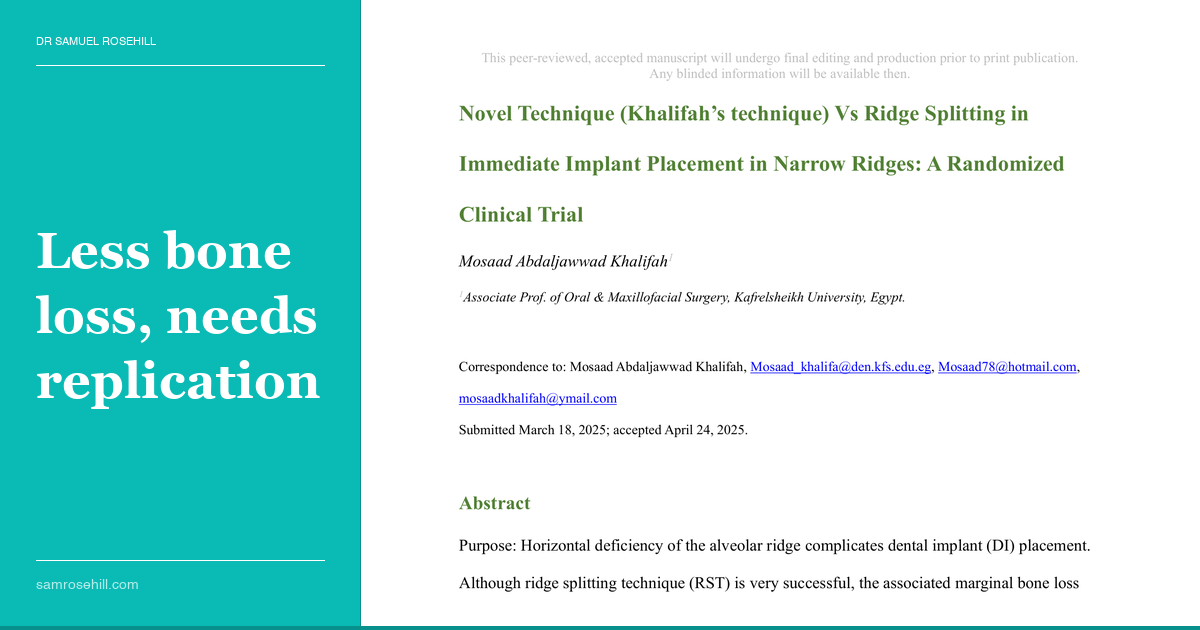
Source Paper
Novel Technique (Khalifah's technique) Vs Ridge Splitting in Immediate Implant Placement in Narrow Ridges: A Randomized Clinical Trial
There is a quiet expectation in surgical research that a technique carrying its inventor’s name arrives with especially rigorous evidence — a tacit acknowledgement that naming something after yourself raises the evidentiary bar rather than clearing it. The cheerful news about “Novel Technique (Khalifah’s technique) Vs Ridge Splitting in Immediate Implant Placement in Narrow Ridges: A Randomized Clinical Trial,” published in the International Journal of Oral and Maxillofacial Implants, is that Mosaad Abdaljawwad Khalifah of Kafrelsheikh University has, to a meaningful degree, delivered.
The clinical backdrop: ridges narrower than 3 to 4 mm complicate implant placement, and the ridge splitting technique (RST), the workhorse since Tatum described it in 1986, carries a persistent liability. Marginal bone loss (MBL) runs higher than in standard placements, and the vertical buccal osteotomies needed to mobilise the buccal plate compromise periosteal blood supply in ways that are difficult to offset.
The Data Anchor
Khalifah’s double expansion technique (DET) addresses RST’s vascular problem structurally. Rather than splitting to full width in one pass, DET proceeds in two stages: generalised partial expansion along the osteotomy using a hand osteotome (approximately 1 to 1.5 mm, no vertical osteotomies), then localised full-width expansion at the implant site only, via successively larger screw-type expanders. The buccal plate is lateralised without being detached.
The trial enrolled 40 patients (57 Biohorizons Tapered Pro implants) with ridges of 3 to 4 mm, randomised 1:1 to RST or DET, with 12-month follow-up from definitive restoration placement. The statistician and outcome-assessing clinician were blinded to group allocation.
Primary implant stability (ISQ at placement) was 58.6 ± 6.9 (DET) versus 40.07 ± 7.7 (RST) (P < 0.01), reflecting the bone condensation effect of screw-type expansion without prior drilling. Secondary stability at three months followed: 78.2 ± 1.4 versus 74.2 ± 3.6 (P < 0.01), with the groups converging by six months.
Key Findings
- MBL significantly lower in DET at every time point. At 12 months: 0.68 ± 0.08 mm (DET) versus 1.63 ± 0.91 mm (RST) (P < 0.01 at all time points). The RST figures are consistent with previous literature; the DET margin is clinically meaningful, not merely statistical.
- Early postoperative pain favoured DET on days 1 and 2 (VAS 5.89 versus 6.71 on day 1; 4.25 versus 5.35 on day 2; both P < 0.01). Analgesic consumption was also lower for the first three days. By day 4, no significant difference.
- Keratinised mucosa width better maintained in DET at 6 and 12 months (P = 0.0048 and P = 0.0023). The control group showed progressive KMW reduction; the DET group did not, consistent with lower MBL preserving the mucosal scaffold.
- Plaque index, bleeding index, and probing depth comparable between groups throughout, both within clinically acceptable ranges.
- Limitation: single-centre, single-author trial for a technique bearing the author’s name. This is not a disqualifying flaw, but it does make independent replication the essential next step rather than a formality.
Eponymous techniques benefit enormously from trials conducted by someone other than their originator. The results here are coherent and mechanistically plausible; the next question is whether they hold when a different surgeon, at a different institution, runs the protocol.
💡 The Clinical Bottom Line
A 12-month MBL of 0.68 mm is not merely statistically better than 1.63 mm; it is better by a margin that matters at the bone-implant interface. The mechanistic argument — two-stage expansion preserving vascularisation, bone condensation improving primary stability, no vertical osteotomies reducing buccal plate trauma — is coherent and maps onto the observed outcomes consistently.
For surgeons managing narrow ridges and looking beyond RST, DET warrants genuine attention. But “warrants attention” and “adopt immediately” are different things; the distance between them is a multicentre trial. The technique has passed the first test: its inventor’s own rigorous randomised data. Whether it passes the second, in someone else’s hands, is the question the field should now put to it.
Dr Samuel Rosehill is a general dentist with a prosthodontic focus, practising at Ethical Dental in Coffs Harbour, NSW. He holds a BDSc (Hons) from the University of Queensland, an MBA, an MMktg, and an MClinDent in Fixed & Removable Prosthodontics (Distinction) from King’s College London.
Clinical Relevance
The double expansion technique (DET) produced significantly lower marginal bone loss at all time points over 12 months compared with conventional ridge splitting, with a 12-month mean of 0.68 mm versus 1.63 mm. Primary implant stability was also substantially higher (ISQ 58.6 versus 40.1). The technique avoids vertical osteotomies, which the author attributes to the graduated two-stage expansion preserving buccal plate vascularisation. The results are promising but come from a single-centre trial with the technique's inventor as sole author; independent multicentre replication is needed before routine adoption.
Disclosure: The author has no financial conflicts of interest related to the products or topics discussed in this review. This is an independent summary prepared for educational purposes.
Continue the conversation
This review is also published on Substack, where you can leave comments and join the discussion.
Read on Substack →