The Rules of the Atrophic Maxilla, Finally Agreed Upon
The 1st Global Consensus for Clinical Guidelines on edentulous maxilla rehabilitation has formalised expert agreement on CBCT imaging, membrane fixation, soft tissue augmentation, and sinus membrane perforation management — giving clinicians a practical, evidence-backed playbook for full-arch implant cases.
Global consensus, finally
Source Paper
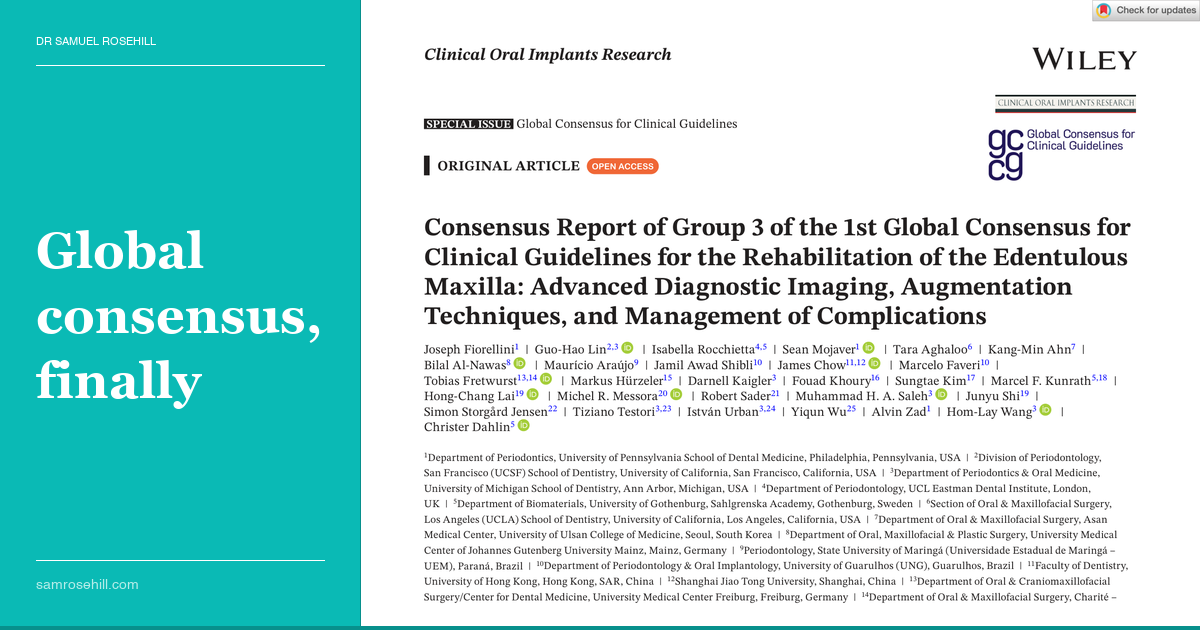
Consensus Report of Group 3 of the 1st Global Consensus for Clinical Guidelines for the Rehabilitation of the Edentulous Maxilla: Advanced Diagnostic Imaging, Augmentation Techniques, and Management of Complications
There is the resorbed posterior maxilla with three millimetres of subantral bone. There is the patient who wants fixed teeth, not a removable plate. There is the question of whether to graft first or place simultaneously, whether to fix the membrane with tacks or sutures or wishful thinking. There is the sinus membrane, fragile as wet tissue paper, which may or may not perforate. And then there is the patient in the chair, hoping that the people responsible for her upper jaw have arrived at some sort of agreement. They hadn’t. Until now. Fiorellini, Lin, Rocchietta, and 26 co-authors have published the “Consensus Report of Group 3 of the 1st Global Consensus for Clinical Guidelines for the Rehabilitation of the Edentulous Maxilla” in Clinical Oral Implants Research (2026), formalising expert agreement on the domains that matter most.
The Data Anchor
Working Group 3 comprised 27 of 105 participating experts (periodontics, oral surgery, prosthodontics), convened in Boston in June 2025. Consensus required 75–95% agreement; strong consensus required greater than 95%. Voting participation ranged from 68 to 88 per recommendation. The evidence base drew on two systematic reviews and surveys of 217 clinicians from 43 countries, 68 patients, and 68 cross-disciplinary experts. All four recommendations reached consensus.
Key Findings
- Routine CBCT is formally endorsed for all edentulous maxilla cases, enabling accurate bone assessment and prosthetically driven implant positioning. Agreement: 81%.
- Fix the membrane. Barrier membranes in vertical GBR must be mechanically secured (tacks, pins, sutures, or screws). Agreement: 80%.
- Soft tissue augmentation belongs in the workflow when keratinised mucosa is insufficient. This reached 91% agreement, the highest of all four recommendations, reflecting the view that keratinised mucosa is a biological necessity, not a cosmetic nicety.
- Continue through sinus membrane perforations of 10 mm or less, covering with a resorbable collagen membrane. Tears under 5 mm: 94.8% agreement; 5–10 mm: 84.4% agreement.
- No consensus was reached on timing of placement after grafting, preferred graft materials, biologics, or guided surgery modality. These remain genuinely open questions.
💡 The Clinical Bottom Line
Order the CBCT, fix the membrane, graft the soft tissue if it’s insufficient, and if the sinus membrane tears under 10 mm, repair it with collagen and carry on. These are now the formally agreed positions of 105 implant experts from across the globe, not merely the confident opinions of whichever specialist trained you. What this consensus does not resolve is as instructive as what it does. The field agrees on the scaffolding. The interior fittings remain up for debate.
Dr Samuel Rosehill is a general dentist with a prosthodontic focus, practising at Ethical Dental in Coffs Harbour, NSW. He holds a BDSc (Hons) from the University of Queensland, an MBA, an MMktg, and an MClinDent in Fixed & Removable Prosthodontics (Distinction) from King’s College London.
Clinical Relevance
Use CBCT routinely for all edentulous maxilla cases, fix barrier membranes mechanically in vertical GBR, augment soft tissue when keratinized mucosa is insufficient, and continue sinus augmentation through membrane perforations of 10 mm or less using collagen repair.
Disclosure: The author has no financial conflicts of interest related to the products or topics discussed in this review. This is an independent summary prepared for educational purposes.
Continue the conversation
This review is also published on Substack, where you can leave comments and join the discussion.
Read on Substack →