Your Guided Immediate Implant Will Drift Buccally. Every Time.
Doliveux and colleagues show that 95% of guided immediate implants in the anterior maxilla deviate buccally, and that planning outside the socket's long axis makes it significantly worse.
Buccal drift is the norm
Source Paper
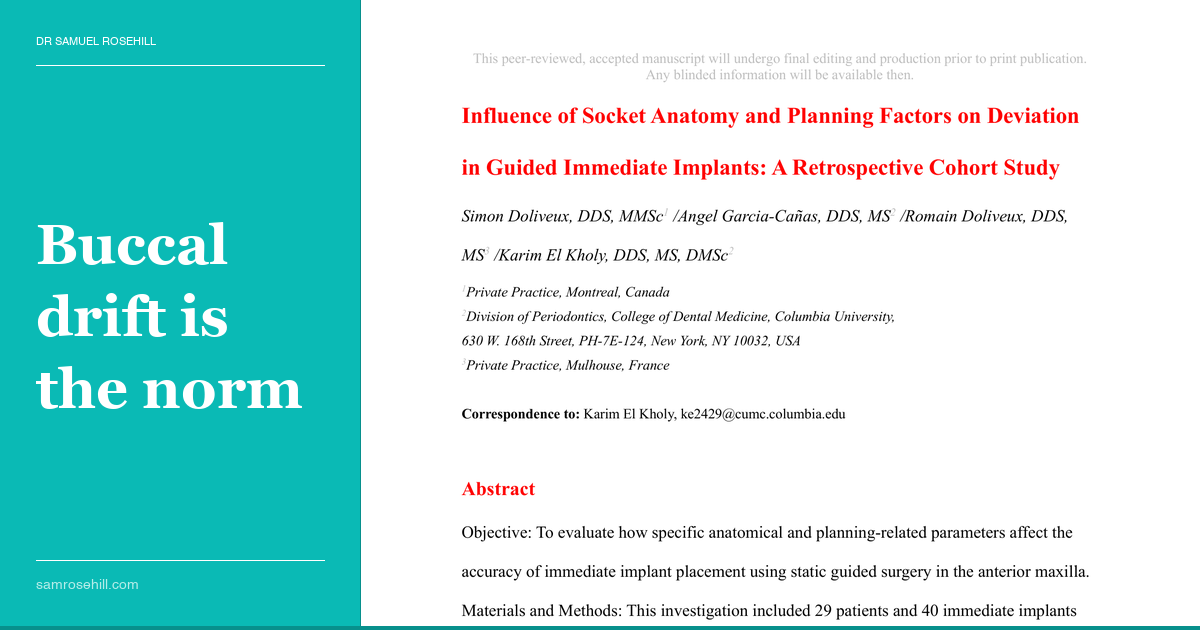
Influence of Socket Anatomy and Planning Factors on Deviation in Guided Immediate Implants: A Retrospective Cohort Study
Ninety-five per cent of guided immediate implants in the anterior maxilla deviate buccally. Not some of them. Not most. Ninety-five per cent. Which rather suggests that what we’ve been calling a “complication” might actually be a feature of the physics, one that static guides can constrain but apparently cannot eliminate. Doliveux and colleagues, in “Influence of Socket Anatomy and Planning Factors on Deviation in Guided Immediate Implants: A Retrospective Cohort Study” published in the International Journal of Prosthodontics, set out to understand precisely which anatomical and planning variables drive this buccal drift in guided surgery, and their findings reframe how we ought to think about digital planning in fresh extraction sockets.
The Data Anchor
The study examined 40 immediate implants placed in 29 patients across the anterior maxilla (central incisors, lateral incisors, and canines) using a fully digital static guided protocol. All implants were Straumann BLT Roxolid SLActive; surgical guides were tooth-supported and 3D-printed with metallic sleeves. Planning was performed in coDiagnostiX using CBCT and intraoral scan data aligned via AI-based registration. Postoperative intraoral scans were superimposed onto the original virtual plan to measure angular deviation, 3D offset at platform and apex, and directional vectors. Three predictor variables were tested: the number of socket walls contacting the drill, drilling depth into residual bone, and alignment of the planned implant relative to the socket’s natural long axis. A single experienced clinician performed all procedures in a Montreal private practice between 2020 and 2024.
Key Findings
- 38 of 40 implants (95%) deviated buccally at the platform level; the directional trend dissipated somewhat at the apex (72.5% buccal), consistent with a drill-tip deflection mechanism.
- Mean angular deviation was 3.03° ± 1.7° (range 0.8°–7.5°); mean 3D offset was 0.98 mm at the platform and 1.23 mm at the apex. These values fall within published clinical benchmarks but remain clinically meaningful in the aesthetic zone.
- Planning outside the socket’s long axis was significantly associated with greater angular deviation (r = 0.47, p = 0.02) and apical 3D offset (r = 0.49, p = 0.001). Respecting the socket’s native geometry meaningfully reduces deviation.
- More socket walls contacting the drill correlated with greater deviation (r = 0.779, p < 0.0001 for angular deviation with the first drill), a counterintuitive finding suggesting that multiple angled walls deflect the drill rather than stabilise it.
- The first drill sets the trajectory. Standardised beta analysis showed the first drill was the primary determinant of angular deviation (β = 0.63 vs β = 0.21 for the final drill); subsequent drills reinforce rather than correct the initial path.
- Drilling depth showed only a weak, non-significant correlation with deviation.
This is a single-centre, single-operator retrospective study without bone density or volumetric socket data. The modest sample size (n = 40) limits statistical power for subgroup analyses, and only trueness (not precision) was assessed. Generalisability to posterior sites or multi-operator settings remains unconfirmed.
💡 The Clinical Bottom Line
When planning guided immediate implants in the anterior maxilla, align the implant with the socket’s long axis wherever prosthetically feasible. Fighting the socket’s native geometry creates measurably more deviation, particularly at the apex. And accept that buccal drift is not a failure of your guide; it is the predictable consequence of drilling inside a sloped bony funnel. The question is not whether the implant will drift, but whether your plan has already accounted for the fact that it will.
Dr Samuel Rosehill is a general dentist with a prosthodontic focus, practising at Ethical Dental in Coffs Harbour, NSW. He holds a BDSc (Hons) from the University of Queensland, an MBA, an MMktg, and an MClinDent in Fixed & Removable Prosthodontics (Distinction) from King’s College London.
Reference: Doliveux S, Garcia-Cañas A, Doliveux R, El Kholy K. Influence of Socket Anatomy and Planning Factors on Deviation in Guided Immediate Implants: A Retrospective Cohort Study. International Journal of Prosthodontics. 2026. DOI: 10.11607/ijp.9578
Clinical Relevance
Buccal deviation is near-universal in guided immediate anterior implants, and respecting the socket's native long axis during planning significantly reduces angular and apical deviation.
Disclosure: The author has no financial conflicts of interest related to the products or topics discussed in this review. This is an independent summary prepared for educational purposes.
Continue the conversation
This review is also published on Substack, where you can leave comments and join the discussion.
Read on Substack →