Flowable and Sandblasted: A Better Combination Than You Assumed
An in vitro study from Phenikaa University tests sixteen combinations of sandblasting, adhesive system, and composite viscosity on extracted premolars, finding that flowable composites outperform packable ones on sandblasted dentin, and that Single Bond Universal in etch-and-rinse mode leads overall — but that the best outcomes depend heavily on which factors are combined, not which single factor is 'best'.
Combination beats individual factors
Source Paper
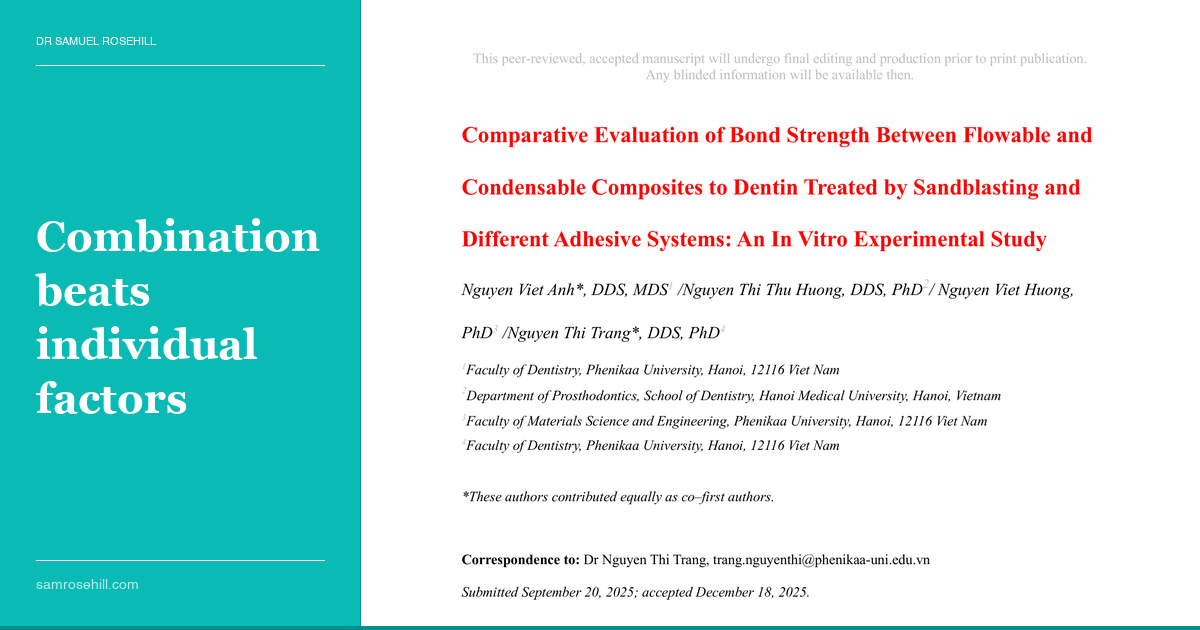
Comparative Evaluation of Bond Strength Between Flowable and Condensable Composites to Dentin Treated by Sandblasting and Different Adhesive Systems: An In Vitro Experimental Study
Most of us, if we are honest, have treated sandblasting as a material-specific tool rather than a routine one. You reach for the air abrasion unit when you’re conditioning a zirconia surface, or refreshing a contaminated preparation before seating an indirect restoration. For direct bonding to dentin, the adhesive goes on, the composite goes in, and the whole thing gets cured within minutes — no air abrasion needed.
The flowable composite, meanwhile, is the liner: the stress-absorbing intermediary you inject to help the packable sit right. Neither assumption is entirely wrong. But “Comparative Evaluation of Bond Strength Between Flowable and Condensable Composites to Dentin Treated by Sandblasting and Different Adhesive Systems: An In Vitro Experimental Study,” by Nguyen Viet Anh and colleagues from Phenikaa University, Vietnam, quietly complicates both.
The Data Anchor
A total of 160 extracted first premolars were allocated to 16 groups (n = 10) across three variables: sandblasting (50 µm aluminium oxide, 0.3 MPa, 10 s) versus none; three adhesive systems (Single Bond 2, 3M; Palfique Bond, Tokuyama; Single Bond Universal, 3M, in etch-and-rinse and self-etch modes); and composite type (EsFlow flowable versus EsCom 100 packable, both Spident). All specimens were thermocycled for 10,000 cycles between 5 °C and 55 °C, then tested for shear bond strength (SBS); bonding interfaces were examined by SEM.
The headline: sandblasting significantly increased SBS (p < 0.001); flowable composite outperformed packable (p = 0.04); Single Bond Universal in etch-and-rinse mode led all adhesives (p < 0.01). But the three-way interaction was significant (F = 5.12, p = 0.01) — those main effects are not simply additive.
Key Findings
- Best combination: Group 8 (sandblasted dentin + flowable composite + Single Bond Universal two-step) achieved the highest mean SBS (15.88 ± 5.39 MPa; Weibull σ₀ = 18.26 MPa). Group 13 (non-sandblasted + packable + Single Bond Universal two-step) followed closely (12.90 ± 4.98 MPa; σ₀ = 14.62 MPa).
- Flowable outperforms packable on sandblasted dentin, likely because lower viscosity composites adapt more readily to the micro-roughened surface; interfacial contact is measurably better. The authors note no prior study has directly compared this combination.
- Self-etch plus sandblasting is not a contradiction. Group 1 (sandblasted + flowable + Single Bond Universal self-etch, 11.47 ± 6.44 MPa) was among the top three; etch-and-rinse is not mandatory after air abrasion.
- Single Bond Universal outperformed Single Bond 2 regardless of surface treatment, attributed to 10-MDP’s chemical bonding with hydroxyapatite in dentine.
- In-vitro limitation: flat dentin, single tooth type, and thermocycling alone do not replicate clinical cavity geometry, occlusal load, or long-term chemical ageing.
💡 The Clinical Bottom Line
Air abrasion of dentin is not only for indirect work. Sandblasting, combined with a flowable composite and Single Bond Universal in either mode, produced bond strengths within the clinically acceptable range (above 12 MPa) after simulated ageing.
The study incorporated 10,000 thermocycles to simulate one year of intraoral ageing, a design choice that makes the bond strength figures more clinically honest than many comparative studies, even if it also pulls them toward the lower end of the acceptable range.
What this study keeps insisting is that adhesive dentistry’s components are not individually optimisable. The best outcome depended on the right combination of surface treatment, adhesive mode, and composite viscosity. Flowable composites have long been understood as structurally inferior to packable ones; this study at least offers grounds to reconsider what “inferior” means when the bonding surface has been appropriately prepared.
Dr Samuel Rosehill is a general dentist with a prosthodontic focus, practising at Ethical Dental in Coffs Harbour, NSW. He holds a BDSc (Hons) from the University of Queensland, an MBA, an MMktg, and an MClinDent in Fixed & Removable Prosthodontics (Distinction) from King’s College London.
Clinical Relevance
Air abrasion of dentin with 50 µm aluminium oxide significantly improves shear bond strength and is worth considering in direct restorations, not just indirect work. Flowable composites bond more effectively than packable composites to sandblasted dentin, challenging the convention that flowables are a liner choice rather than a structural preference. Single Bond Universal in etch-and-rinse mode produced the highest bond strengths overall, but the study's most important finding is that the best result depends on the right combination of all three factors — surface treatment, adhesive mode, and composite type — rather than any single variable optimised in isolation.
Disclosure: The author has no financial conflicts of interest related to the products or topics discussed in this review. This is an independent summary prepared for educational purposes.
Continue the conversation
This review is also published on Substack, where you can leave comments and join the discussion.
Read on Substack →