Guided Surgery vs Freehand: The Numbers Are In — And They're Not Equal
A 2026 network meta-analysis of 18 studies and 780 immediately placed implants finds that every guided surgical protocol significantly outperforms freehand placement in angular, platform, and apex deviation — with robotic and dynamic navigation ranking highest, though their advantage over fully-guided static approaches narrows under RCT-restricted sensitivity analysis.
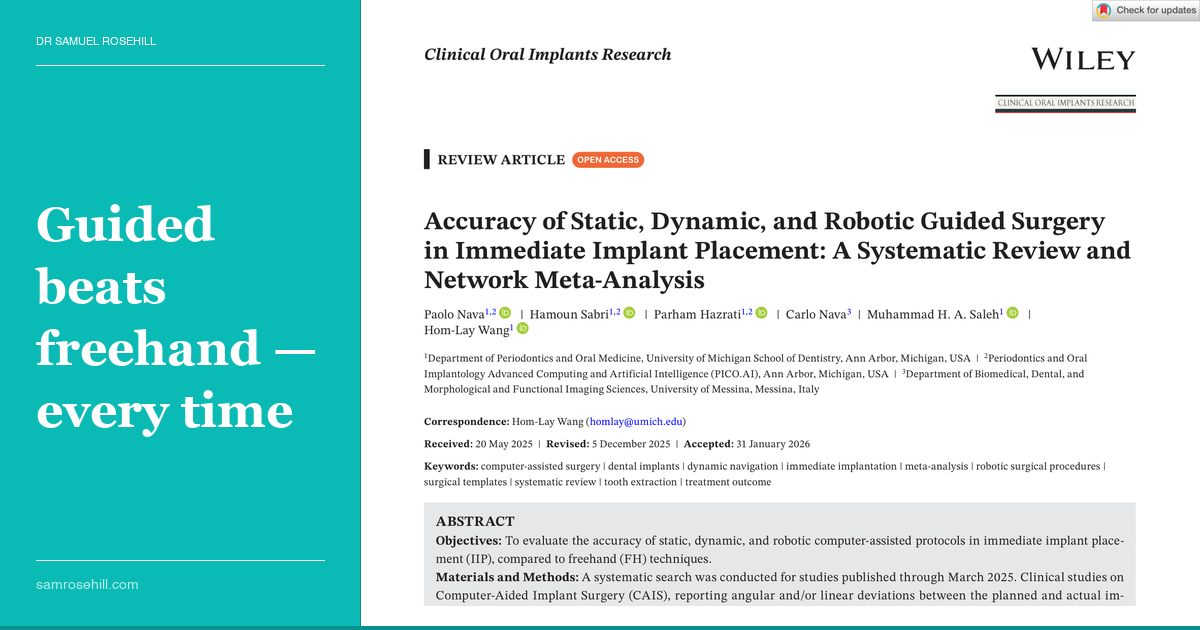
Guided beats freehand — every time
Source Paper
Accuracy of Static, Dynamic, and Robotic Guided Surgery in Immediate Implant Placement: A Systematic Review and Network Meta-Analysis
Guided surgery is more accurate than freehand. Everyone knows that. What nobody had cleanly quantified was by how much, whether all guided approaches deliver the same advantage, and whether the immediate post-extraction socket changes the calculus in ways the literature on healed ridges couldn’t tell us.
The paper “Accuracy of Static, Dynamic, and Robotic Guided Surgery in Immediate Implant Placement: A Systematic Review and Network Meta-Analysis,” by Nava, Sabri, Hazrati, Nava, Saleh, and Wang, published in Clinical Oral Implants Research in 2026, is the evidence-base’s attempt to answer that properly. Eighteen studies, 780 immediately placed implants, five protocols assessed head-to-head. The numbers are specific; the clinical implications are worth sitting with.
The Data Anchor
Five protocols were compared: freehand (FH), half-guided static (HG-sCAIS), fully-guided static (FG-sCAIS), dynamic navigation (dCAIS), and robotic (rCAIS). The 18 studies comprised six RCTs, nine case series (two prospective, seven retrospective), and three retrospective cohorts, covering 541 patients and 780 immediately placed implants. A mixed-effects network meta-analysis was fitted using REML, adjusting for jaw location, anterior proportion, open-ended sites, study design, and risk of bias.
Compared with FH, mean angular deviation was reduced by 3.36° with rCAIS (p = 0.0002), 2.66° with dCAIS (p = 0.0004), 1.85° with FG-sCAIS (p = 0.001), and 1.73° with HG-sCAIS (p = 0.036). Platform deviations fell by 0.68, 0.71, 0.54, and 0.27 mm respectively; apex deviations by 1.43, 1.32, 0.81, and 1.23 mm. All were statistically significant. FH ranked last on every outcome.
Key Findings
- Every guided protocol significantly outperformed freehand on all three accuracy metrics (angular, platform, and apex deviation). The primary model left no scenario in which FH matched any guided approach.
- rCAIS and dCAIS ranked highest. rCAIS led on angular and apex deviation; dCAIS led on platform. The margin between them was not significant on platform (p = 0.853) or apex (p = 0.679).
- FG-sCAIS outperformed HG-sCAIS on platform deviation (–0.26 mm, p = 0.007); the angular difference (–0.30°) was not significant. Full guidance beats partial, but modestly.
- RCT-restricted sensitivity analyses narrowed differences among guided protocols. With rCAIS excluded (no eligible RCTs), dCAIS, FG-sCAIS, and HG-sCAIS performed more comparably; pairwise differences lost significance. rCAIS and dCAIS rankings are hypothesis-generating, not definitive.
- Limitations: Most evidence is retrospective or case series; CINeMA rated confidence as low across most comparisons. No cost-effectiveness data. rCAIS findings derive almost exclusively from single-arm retrospective studies.
💡 The Clinical Bottom Line
The immediate read is unambiguous: if you are placing implants into fresh extraction sockets, use guidance. The empty socket creates a geometric trap (the drill follows the path of least resistance, not the path of the plan), and every guided modality in this review mitigated that risk decisively relative to freehand technique.
Which guided modality is where clinical judgement must do more work than the data can. rCAIS and dCAIS hold the theoretical edge; real-time feedback catches intraoperative drift that a static template cannot detect. But RCT-restricted sensitivity analyses suggest the performance gap among guided systems is smaller than the primary model implies. In experienced hands with a well-supported static guide, FG-sCAIS is not dramatically inferior.
The appropriate read of this paper is not “buy a robot.” It is: “use a guide, every time, for every immediate placement.” The choice among guides is a clinical and logistical question; the use of one is not.
A 3.36° angular advantage sounds abstract until you model the prosthetic consequences of a 3° deviation in the anterior maxilla, at which point it sounds rather urgent.
Dr Samuel Rosehill is a general dentist with a prosthodontic focus, practising at Ethical Dental in Coffs Harbour, NSW. He holds a BDSc (Hons) from the University of Queensland, an MBA, an MMktg, and an MClinDent in Fixed & Removable Prosthodontics (Distinction) from King’s College London.
Clinical Relevance
Every guided protocol — static, dynamic, or robotic — significantly reduces angular, platform, and apex deviation compared to freehand placement in immediate implant sites. Robotic and dynamic navigation ranked highest overall, but sensitivity analyses limited to RCTs showed that differences among guided protocols narrowed considerably. For immediate placement specifically, where the empty socket creates a natural bias toward positional error, clinicians should default to guided approaches; the choice among guided modalities is a secondary consideration.
Disclosure: The author has no financial conflicts of interest related to the products or topics discussed in this review. This is an independent summary prepared for educational purposes.
Continue the conversation
This review is also published on Substack, where you can leave comments and join the discussion.
Read on Substack →