MRI and Ultrasound for Implant Planning — The Radiation-Free Alternative Arrives
Zhang et al.'s systematic review finds MRI and ultrasound produce clinically acceptable measurements for implant planning, challenging CBCT's monopoly on preoperative imaging.
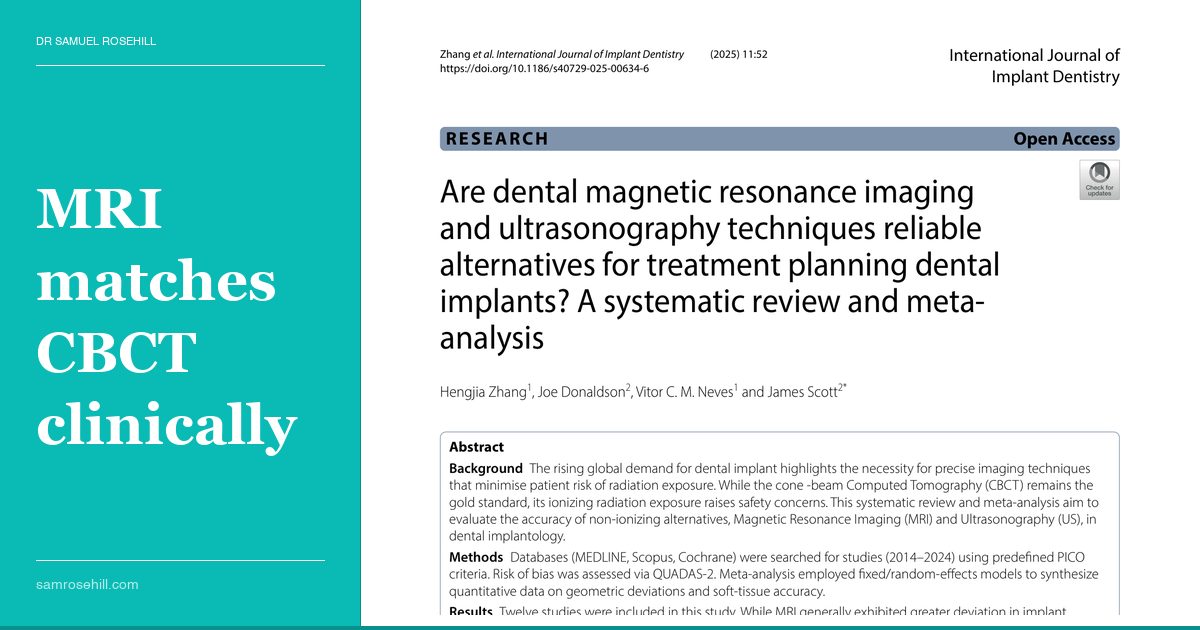
MRI matches CBCT clinically
Source Paper
Are dental magnetic resonance imaging and ultrasonography techniques reliable alternatives for treatment planning dental implants? A systematic review and meta-analysis
There is something faintly absurd about the fact that planning a dental implant — a procedure we perform to restore health — routinely involves directing ionising radiation at a patient’s head. Wilhelm Rontgen discovered X-rays in 1895 by accident (he noticed his cathode ray tube was making a nearby fluorescent screen glow), and here we are, more than a century later, still relying on his accidental discovery’s descendants for preoperative imaging. Zhang et al.’s systematic review and meta-analysis, “Are dental magnetic resonance imaging and ultrasonography techniques reliable alternatives for treatment planning dental implants?”, asks whether we might finally have radiation-free alternatives worth taking seriously for dental implant planning.
The paper arrives as a welcome piece of evidence. With over nine million implants placed globally in 2021 and a market exceeding four billion dollars, the sheer volume of CBCT scans accumulating across the profession is not trivial. Single scans pose minimal risk; cumulative exposure is another matter entirely. The question is not whether we should want alternatives, but whether any are accurate enough to trust.
The Data Anchor
Zhang and colleagues searched MEDLINE, Scopus, and the Cochrane Library for studies published between 2014 and 2024, identifying 687 potentially relevant articles before whittling the pool down to 12 that met inclusion criteria. Risk of bias was assessed via QUADAS-2; meta-analysis used fixed and random-effects models.
The headline numbers are encouraging. For MRI versus CBCT, pooled deviations came in at 0.30 mm at the implant tip (95% CI: -0.08 to 0.68), 0.38 mm at the entry level (95% CI: 0.04 to 0.71), and 0.81 degrees for implant angulation (95% CI: -0.50 to 2.12). For context, a previous meta-analysis reported CBCT-guided placement errors of 1.30 mm at the tip, 1.00 mm at entry, and 3.80 degrees for angulation. MRI’s deviations, in other words, sit comfortably within the range we already accept. Ultrasonography, meanwhile, demonstrated remarkable soft tissue accuracy — a mean difference of just 0.04 mm compared to CBCT (95% CI: -0.04 to 0.13). That is a genuinely impressive number for a modality that costs less and is more accessible than MRI.
Key Findings
- MRI deviations for implant planning fell within clinically acceptable ranges compared to CBCT across tip position, entry point, and angulation
- Ultrasonography demonstrated superior soft tissue accuracy (0.04 mm deviation), making it particularly valuable for aesthetic planning and peri-implant tissue assessment
- Both modalities offer viable radiation-free alternatives, especially relevant for serial post-operative evaluations and high-risk patients
- Approximately 50% of included studies failed to clarify randomisation protocols, introducing potential sampling bias; 60% lacked clear timelines between index tests and reference measurements
- The evidence base remains small (12 studies, median 18 participants) with substantial heterogeneity (I-squared = 72% for nerve-canal distance), and standardised imaging protocols are still needed
💡 The Clinical Bottom Line
MRI and ultrasonography are no longer speculative alternatives to CBCT — they are clinically plausible ones, with accuracy data that sits within the error margins we already tolerate in guided surgery. Ultrasonography’s soft tissue precision makes it especially compelling for aesthetic zone assessment and longitudinal peri-implant monitoring without repeated radiation exposure.
Rontgen’s accidental discovery has served dentistry extraordinarily well. But there is something quietly satisfying about the possibility that, for implant planning at least, we might eventually stop pointing ionising radiation at people in the name of helping them.
Dr Samuel Rosehill is a general dentist with a prosthodontic focus, practising at Ethical Dental in Coffs Harbour, NSW. He holds a BDSc (Hons) from the University of Queensland, an MBA, an MMktg, and an MClinDent in Fixed & Removable Prosthodontics (Distinction) from King’s College London.
Reference: Zhang H et al. “Are dental magnetic resonance imaging and ultrasonography techniques reliable alternatives for treatment planning dental implants? A systematic review and meta-analysis.” International Journal of Implant Dentistry (2025). DOI: 10.1186/s40729-025-00634-6
Clinical Relevance
MRI and ultrasound produce measurements within clinically acceptable ranges compared to CBCT for implant planning, offering radiation-free alternatives
Disclosure: The author has no financial conflicts of interest related to the products or topics discussed in this review. This is an independent summary prepared for educational purposes.
Continue the conversation
This review is also published on Substack, where you can leave comments and join the discussion.
Read on Substack →