Immediate Implants: Strong Evidence, Narrow Territory
Dias and colleagues map 28 systematic reviews of immediate implant placement and restoration. The evidence supports selected single anterior sites far more confidently than posterior or multi-unit treatment.
Strong anterior, thin elsewhere
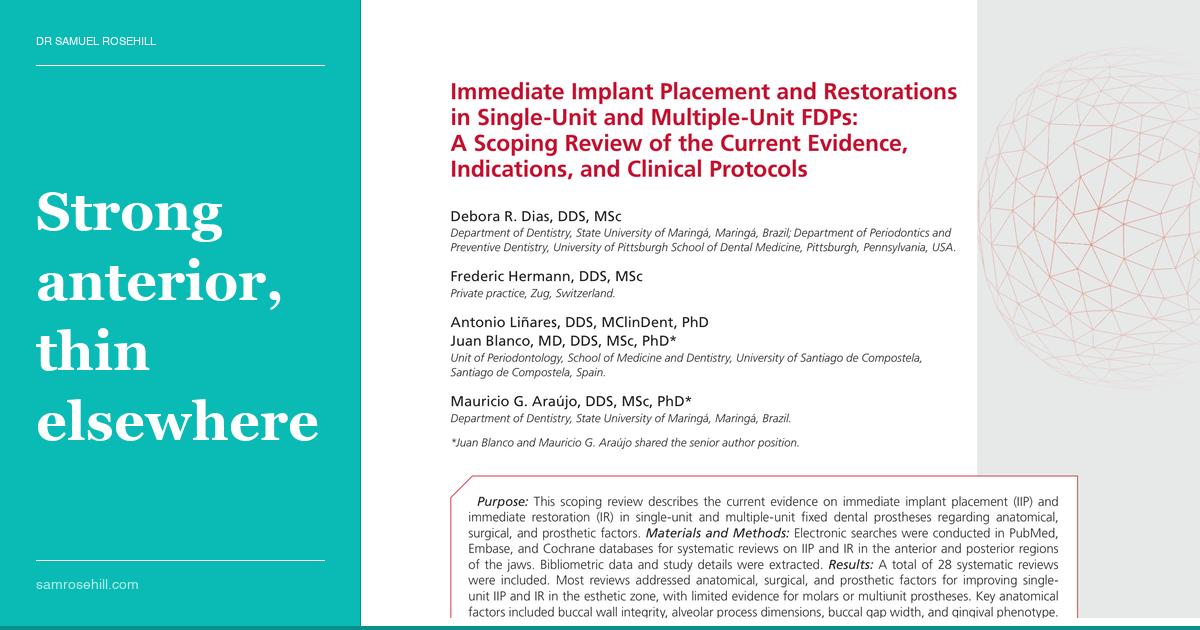
Source Paper
Immediate Implant Placement and Restorations in Single-Unit and Multiple-Unit FDPs: A Scoping Review of the Current Evidence, Indications, and Clinical Protocols
Immediate implants have acquired the confident manners of a settled protocol: extract, place, provisionalise, photograph. Dias and colleagues’ Immediate Implant Placement and Restorations in Single-Unit and Multiple-Unit FDPs: A Scoping Review of the Current Evidence, Indications, and Clinical Protocols checks the paperwork. Across 28 systematic reviews, the case was persuasive for carefully selected single anterior sites and strikingly sparse almost everywhere else. This is less a universal doctrine than a very successful specialist with a surprisingly specific postcode.
The Data Anchor
The authors searched PubMed, Embase and Cochrane for systematic reviews published from 2014 to 2024. From 414 screened records, 28 reviews met the criteria. Most examined single implants in the anterior maxilla, and 26 included studies with at least one year of follow-up. Only one review dealt exclusively with posterior sites. Only one addressed multiple-unit fixed dental prostheses (FDPs), and it yielded no restorative conclusion.
The recurring anterior protocol was familiar: intact or manageable socket walls, enough apical bone for primary stability, slightly palatal placement, grafting of the buccal gap, and a provisional restoration kept out of occlusion. Most reports used insertion torque above 30 Ncm or an implant stability quotient (ISQ) above 60. These are recurring traits in the evidence, rather than commandments handed down on a stone surgical guide.
The review did not run a fresh meta-analysis — a detail worth remembering when the numbers begin to sound pooled. It reported prosthetic success ranging from 87% to 100% in selected aesthetic-zone protocols, but eligibility, loading and tissue management varied across the source reviews. A map can show where the roads are; it cannot make every road equally sound.
The protocol looks mature because clinicians have refined it carefully. Its evidence map is still rather small.
Key Findings
-
The evidence has an anterior postcode. Immediate placement plus restoration had survival comparable with delayed protocols in selected single sites, chiefly in the maxillary aesthetic zone.
-
Selection mattered more than bravado. A buccal gap of at least 2 mm was the only site-specific factor associated with higher survival in one included meta-analysis, yet just four of the 28 reviews reported gap dimensions.
-
Tissue management carried much of the burden. Palatal positioning, gap grafting and selective connective tissue grafting helped compensate for thin or compromised anatomy; favourable outcomes did not make the original risk disappear.
-
Posterior and multi-unit confidence is mostly borrowed. Evidence for molars was limited and evidence for multiple-unit restorations was nearly absent. The scoping review also inherited the variable methods and overlapping primary studies of its source reviews.
💡 The Clinical Bottom Line
For a well-selected single anterior maxillary tooth, immediate placement and restoration remain defensible when implant position, primary stability and tissue support are controlled. For molars or multiple-unit spans, use the familiar protocol with the humility owed to borrowed evidence. It has a good passport; it has not travelled much.
Dr Samuel Rosehill is a general dentist with a prosthodontic focus, practising at Ethical Dental in Coffs Harbour, NSW. He holds a BDSc (Hons) from the University of Queensland, an MBA, an MMktg, and an MClinDent in Fixed & Removable Prosthodontics (Distinction) from King’s College London.
Clinical Relevance
Immediate placement and restoration are well supported for carefully selected single implants in the anterior aesthetic zone. Evidence is sparse for posterior sites and multiple-unit prostheses, so protocols derived from anterior single-tooth studies should be applied to those cases with explicit caution.
Disclosure: The author has no financial conflicts of interest related to the products or topics discussed in this review. This is an independent summary prepared for educational purposes.
Continue the conversation
This review is also published on Substack, where you can leave comments and join the discussion.
Read on Substack →