Does Implant Diameter Actually Predict Prosthesis Complications? A Meta-Analysis Says: Not Really
A systematic review and meta-analysis of 18 studies finds that implant diameter has surprisingly little influence on most prosthesis complications — but narrow-diameter implants do show significantly fewer abutment fractures than standard ones.
Size doesn't matter (much)
Source Paper
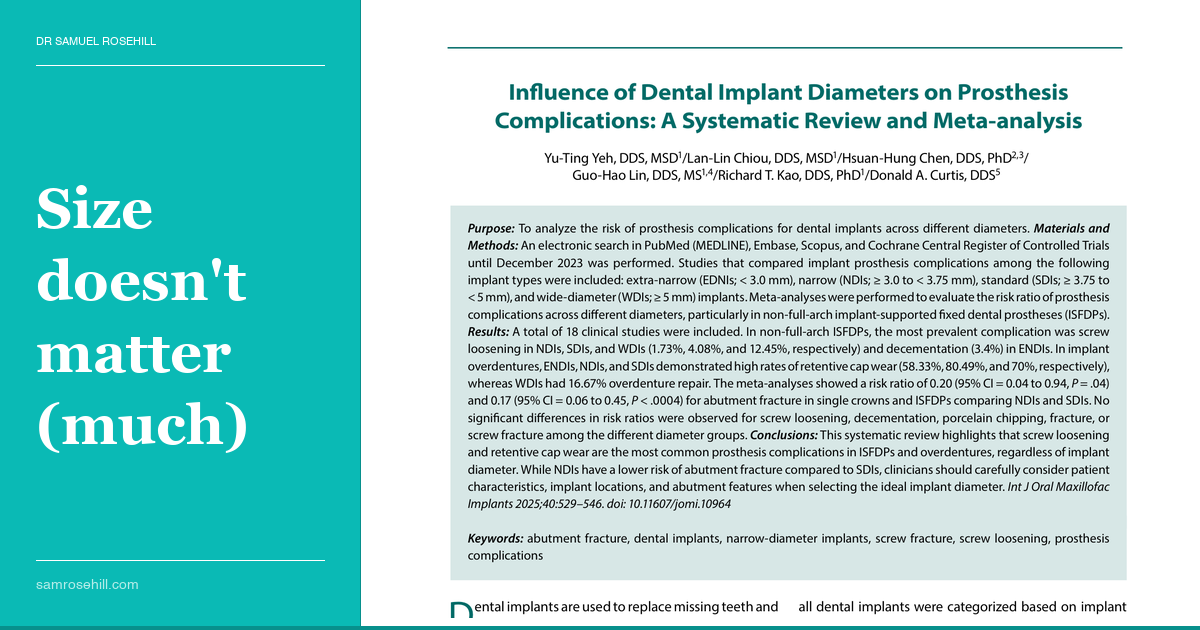
Influence of Dental Implant Diameters on Prosthesis Complications: A Systematic Review and Meta-analysis
Everything we think we know about implant diameter and mechanical failure may be slightly, quietly, reassuringly wrong. The received wisdom runs something like this: narrow implants are structurally weaker, therefore they must fail more often. Wider is sturdier, ergo safer. It is the kind of logic that feels irresistible in the treatment planning software and entirely untroubled by the published data. Yeh, Chiou, Chen, Lin, Kao, and Curtis have now assembled the data in “Influence of Dental Implant Diameters on Prosthesis Complications: A Systematic Review and Meta-analysis” (International Journal of Oral and Maxillofacial Implants, 2025), and the picture is considerably more interesting than the folklore suggests.
The Data Anchor
This PRISMA-compliant systematic review searched PubMed, Embase, Scopus, and the Cochrane Library through December 2023 (PROSPERO: CRD42024510977). From 4,788 initial records, 18 studies met inclusion criteria: four RCTs and 14 retrospective or prospective studies. Implant diameters were categorised as extra-narrow (ENDIs; less than 3.0 mm), narrow (NDIs; 3.0 to less than 3.75 mm), standard (SDIs; 3.75 to less than 5 mm), and wide (WDIs; 5 mm or greater). Meta-analyses used fixed or random effects depending on heterogeneity, with risk ratios as the primary measure. Risk of bias was assessed using RoB 2 for RCTs and ROBINS-I for non-RCTs. Three of four RCTs were judged low risk; among non-RCTs, nine were moderate risk and five were serious.
Key Findings
- Screw loosening was the most prevalent complication in non-full-arch fixed prostheses across all diameter groups (NDIs 1.73%, SDIs 4.08%, WDIs 12.45%), yet meta-analysis found no significant difference in screw loosening risk between any diameter comparison (all P values greater than .10).
- Narrow-diameter implants showed significantly lower abutment fracture risk than standard ones (RR 0.17, 95% CI 0.06 to 0.45, P = .0004), with zero heterogeneity (I² = 0%). This was the single statistically significant finding across all pooled comparisons.
- In overdentures, retentive cap wear dominated regardless of diameter: 58.33% in ENDIs, 80.49% in NDIs, and 70% in SDIs. Overdenture fracture was more prevalent with both 3.0 mm and 3.75 mm diameter implants.
- No significant differences were found for decementation, porcelain chipping or fracture, or screw fracture across any diameter comparison. Heterogeneity was low (I² = 0%) in almost all subgroup analyses.
- Limitations are considerable: most included studies were non-RCTs with moderate-to-serious risk of bias. Parafunctional habits and opposing dentition were rarely recorded. The overdenture and full-arch subgroups were too small for reliable meta-analysis.
The counterintuitive finding here is worth sitting with: narrower implants, which receive smaller abutments relative to the occlusal load, actually fractured those abutments less often. The authors attribute this partly to site selection bias (NDIs tend to be placed in lower-force anterior zones), but the signal is consistent and the heterogeneity is nil.
💡 The Clinical Bottom Line
The next time you find yourself reaching for a wider implant purely because it feels mechanically safer, this meta-analysis suggests you can relax. Complication patterns shift with diameter (ENDIs decementate; NDIs and SDIs loosen screws; overdentures chew through retentive caps regardless), but the overall complication burden does not meaningfully change. Select your implant diameter based on the anatomy, the ridge width, the prosthetic plan, and the abutment features available, not on an assumption that bigger means fewer problems. The screw will loosen or it won’t, and it appears not to care much about the diameter of its host.
Dr Samuel Rosehill is a general dentist with a prosthodontic focus, practising at Ethical Dental in Coffs Harbour, NSW. He holds a BDSc (Hons) from the University of Queensland, an MBA, an MMktg, and an MClinDent in Fixed & Removable Prosthodontics (Distinction) from King’s College London.
Reference: Yeh YT, Chiou LL, Chen HH, Lin GH, Kao RT, Curtis DA. Influence of dental implant diameters on prosthesis complications: A systematic review and meta-analysis. Int J Oral Maxillofac Implants. 2025;40:529-546. doi: 10.11607/jomi.10964
Clinical Relevance
Implant diameter selection should be driven by site anatomy and prosthesis design, not fear of mechanical complications — the complication profiles differ across diameters, but the overall risk does not.
Disclosure: The author has no financial conflicts of interest related to the products or topics discussed in this review. This is an independent summary prepared for educational purposes.
Continue the conversation
This review is also published on Substack, where you can leave comments and join the discussion.
Read on Substack →