A Decade of Gleaming Promises: What Ten Years Teaches Us About Chairside Lithium Disilicate
Fasbinder et al. track 100 IPS e.max CAD crowns over ten years and find 92% survival — with a twist: cement choice barely affects longevity overall, but determines whether your crown debonds or fractures.
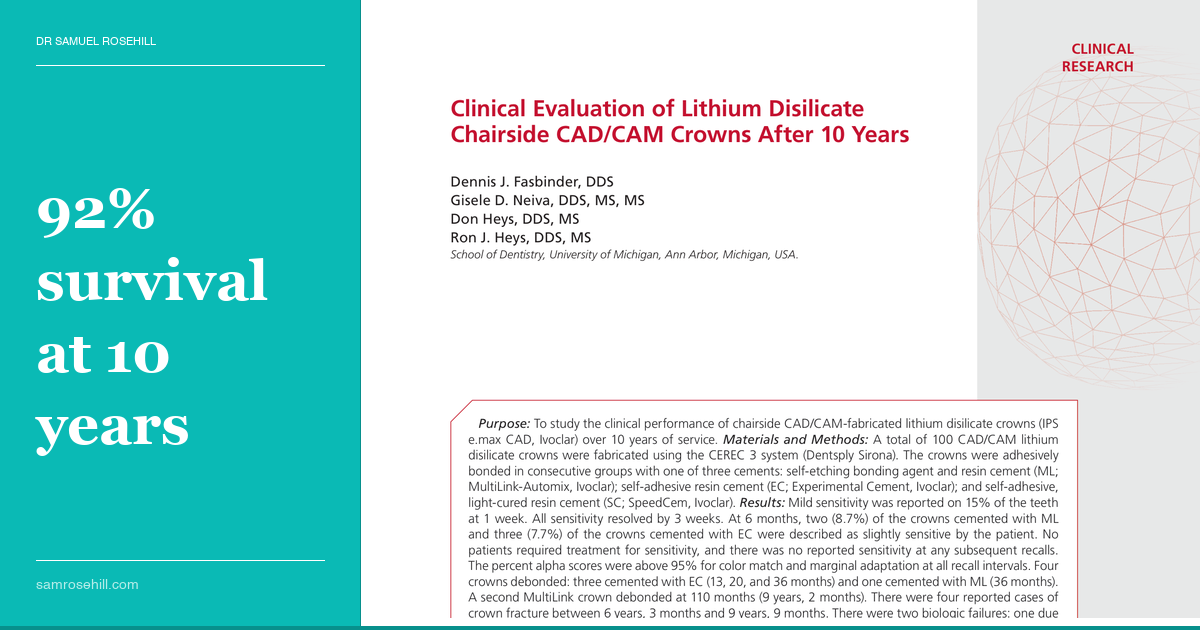
92% survival at 10 years
Source Paper
Clinical Evaluation of Lithium Disilicate Chairside CAD/CAM Crowns After 10 Years
It’s Tuesday morning and the phone rings. A patient who had a crown done with “that new milling machine” — you know, the one that buzzes and beeps and makes everyone in the surgery feel vaguely like they’ve entered a minimalist art installation — wants to know if it’s still going to work. It’s now been ten years. The technology that felt revolutionary when it was installed is now, somehow, a decade old. The question is deceptively simple: does chairside-milled lithium disilicate really go the distance? And perhaps more pragmatically, does it matter which cement you’ve glued it down with?
This is the clinical conflict at the heart of Dennis Fasbinder’s Clinical Evaluation of Lithium Disilicate Chairside CAD/CAM Crowns After 10 Years, published in the International Journal of Prosthodontics. What his team at the University of Michigan found was reassuring and, like most thorough answers to deceptively simple questions, charmingly complicated.
The Data Anchor
The University of Michigan trial tracked n = 100 IPS e.max CAD crowns milled via CEREC 3 across n = 55 patients (41 women, 14 men). The cohort included 30 premolars and 70 molars — a clinically representative distribution. Three cement systems were examined consecutively (not randomised): MultiLink Automix (n = 23), an Experimental Cement (n = 39), and SpeedCem (n = 38), all from Ivoclar. Follow-up rates were tenacious: 100% at one year, declining gradually to 87% at ten years. Modified USPHS criteria evaluated margins, colour match, structural integrity, and postoperative response throughout.
Key Findings
- 92% Kaplan-Meier survival at 10 years (CI = 86.8% to 97.5%), with no significant difference between cement groups (P > .5) — cement choice appears almost irrelevant to decade-long survival outcomes.
- Debonding patterns diverged by cement group. Experimental Cement: three debonds (13, 20, 36 months). MultiLink Automix: two debonds (36 months, 110 months). All recemented with MultiLink and remained functional. SpeedCem: zero debonds.
- Fracture behaviour told the opposite story. All four crown fractures occurred in the SpeedCem group (48, 75, 80, 93 months), with one additional failure at 117 months. SpeedCem is debond-resistant but fracture-prone — cement choice influences failure mode even when it doesn’t influence survival rate.
- Colour stability and surface integrity held up well: >95% alpha ratings throughout, though MultiLink marginal discolouration declined to 66.7% alpha by year 10. Marginal wear became detectable at six months and progressed gradually; no surface chipping in any monolithic crown. Postoperative sensitivity resolved fully within three weeks.
The quiet lesson: cement choice doesn’t determine whether your crown survives the decade. It determines how it eventually dies.
- Caveat: Non-randomised cement allocation limits direct comparison between groups; confounding by indication cannot be excluded.
💡 The Clinical Bottom Line
Chairside lithium disilicate crowns survive reliably over a decade. The cement you select matters far less to overall survival than one might intuitively fear — but it shapes how your crown eventually fails. This is not a set-and-forget technology, yet it is genuinely serviceable. A decade later, Fasbinder’s evidence affirms that chairside milling delivers what it promises: durable, predictable restorations — and a Tuesday morning phone call you can now answer with confidence.
Dr Samuel Rosehill is a general dentist with a prosthodontic focus, practising at Ethical Dental in Coffs Harbour, NSW. He holds a BDSc (Hons) from the University of Queensland, an MBA, an MMktg, and an MClinDent in Fixed & Removable Prosthodontics (Distinction) from King’s College London.
Reference: Fasbinder DJ, Neiva GD, Heys D, Heys RJ. Clinical Evaluation of Lithium Disilicate Chairside CAD/CAM Crowns After 10 Years. Int J Prosthodont. 2025;38:645–656. https://doi.org/10.11607/ijp.9257
Clinical Relevance
Chairside-milled lithium disilicate crowns deliver 92% survival at ten years — clinically reassuring and worth telling patients. Cement selection doesn't dramatically affect overall survival, but it does shape failure mode: SpeedCem showed zero debonds but all four fractures, whilst resin cements debonded occasionally but held structural integrity. Choose your cement with failure mode in mind, not just bond strength.
Disclosure: The author has no financial conflicts of interest related to the products or topics discussed in this review. This is an independent summary prepared for educational purposes.
Continue the conversation
This review is also published on Substack, where you can leave comments and join the discussion.
Read on Substack →