No Evidence, Strong Opinions: The Occlusion Debate for Fixed Partial Dentures
Goodacre and Goldstein's 2025 review finds zero clinical trials comparing occlusal schemes for tooth-supported FPDs, forcing the profession back to First Principles.
No evidence, strong opinions
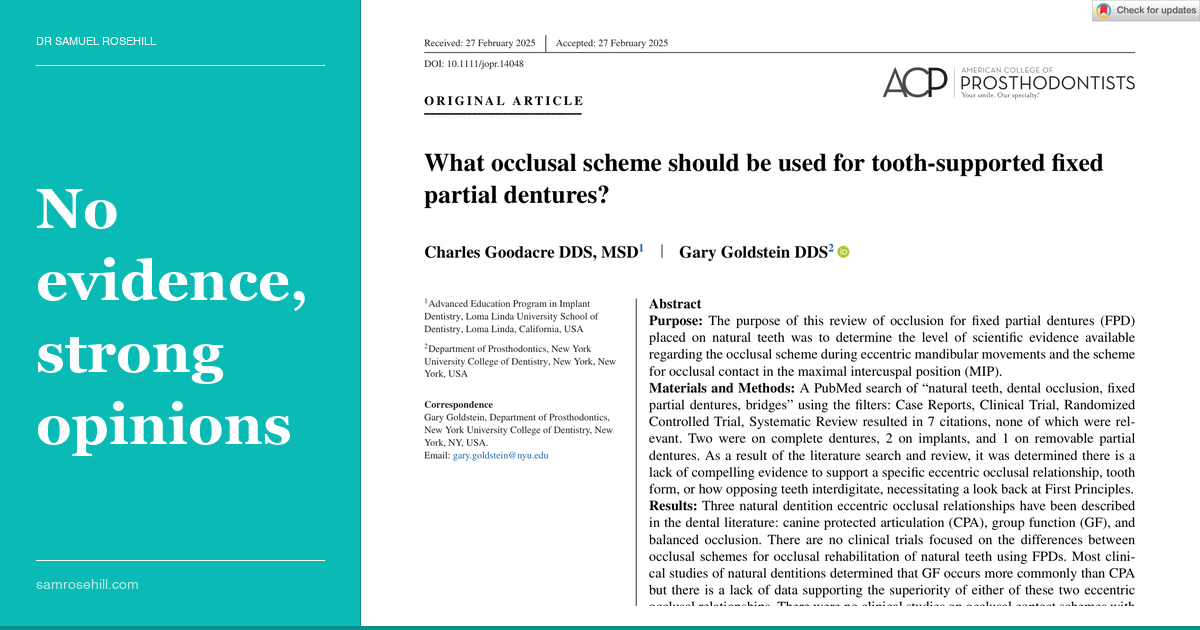
Source Paper
What occlusal scheme should be used for tooth-supported fixed partial dentures?
The word “occlusion” has launched more conference arguments, more laboratory remakes, and more quietly resentful emails between clinician and technician than perhaps any other term in prosthodontics. Canine guided or group function? Cusp-to-fossa or cusp-to-marginal ridge? Tripodised contacts or flat fossae? Ask five prosthodontists and you will receive six opinions, each delivered with the serene certainty of someone who learned it from a professor who learned it from Schuyler. So when Goodacre and Goldstein set out, in “What occlusal scheme should be used for tooth-supported fixed partial dentures?” (Journal of Prosthodontics, 2025), to find the actual clinical evidence behind these convictions, the result is both clarifying and faintly mortifying.
The Data Anchor
The authors conducted a PubMed search for clinical evidence on occlusion in tooth-supported FPDs using filters for case reports, clinical trials, RCTs, and systematic reviews. The search returned seven citations, none of which were relevant — two addressed complete dentures, two involved implants, and one covered removable partial dentures. Zero clinical trials have ever compared occlusal schemes for FPDs on natural teeth. Faced with this evidence vacuum, the authors turned to First Principles: examining what we know about eccentric occlusal relationships in natural dentitions and extrapolating from there. Their review of the natural dentition literature found that group function (GF) occurs more commonly than canine protected articulation (CPA) in most studies, with GF prevalences ranging from 6.6% to 88.5% and CPA from 1.3% to 57%. Critically, the type of occlusal relationship changes with the amount of lateral movement — GF predominates close to maximum intercuspation, with CPA becoming more prevalent as lateral excursion increases.
Key Findings
- Zero clinical trials exist comparing occlusal schemes for FPDs on natural teeth — the entire evidence base is observational data from natural dentitions and expert opinion
- Group function is more common than canine protected articulation in most natural dentition studies, but neither scheme has demonstrated clinical superiority
- Protrusive guidance by incisors alone (without posterior contact) is the most common pattern, present in 56–78% of subjects studied
- Nonworking-side contacts should not be present on posterior teeth during lateral movements — this is the one point of near-universal agreement
- No evidence supports tripodising over cuspal contact on flat fossae for positional stability or masticatory function
- When restoring one arch, the prosthesis should harmonise with the patient’s existing occlusal scheme if no other pathology exists
The profession has spent decades teaching occlusal schemes with the confidence of settled science while standing on an evidence base that is, by the authors’ own demonstration, essentially empty.
💡 The Clinical Bottom Line
The Monday morning takeaway is both liberating and unsettling: match the patient’s existing occlusion rather than imposing a textbook ideal, avoid nonworking-side contacts, and stop agonising over canine guidance versus group function as though the answer were hiding in a clinical trial somewhere. It isn’t. Goodacre and Goldstein’s review is a rare and valuable act of professional honesty — a reminder that the gap between what we teach with certainty and what we actually know can be rather wider than the occlusal table.
Dr Samuel Rosehill is a general dentist with a prosthodontic focus, practising at Ethical Dental in Coffs Harbour, NSW. He holds a BDSc (Hons) from the University of Queensland, an MBA, an MMktg, and an MClinDent in Fixed & Removable Prosthodontics (Distinction) from King’s College London.
Reference: Goodacre C, Goldstein G. What occlusal scheme should be used for tooth-supported fixed partial dentures? J Prosthodont. 2025;1–12. doi:10.1111/jopr.14048
Clinical Relevance
No clinical evidence supports one occlusal scheme over another for FPDs on natural teeth; harmonise with the patient's existing occlusion.
Disclosure: The author has no financial conflicts of interest related to the products or topics discussed in this review. This is an independent summary prepared for educational purposes.
Continue the conversation
This review is also published on Substack, where you can leave comments and join the discussion.
Read on Substack →